



Vest Markets has announced a major shake-up to its evaluation lineup, removing 1-Step and 2-Step hard breach Daily Loss Limit (DLL) accounts from its standard storefront and raising prices on all remaining No DLL evaluations by 15%. At the same time, the firm is officially allowing cross-account hedging as it prepares to launch $100K, $250K, and $500K accounts alongside built-in copy trading tools.
The overhaul arrives after an extraordinary surge in payouts. Vest Markets sat under $2 million in total payouts at the end of September, has now surpassed $60 million in total payouts, and paid out $14.8 million over the last 7 days alone.
Much of that rapid growth came down to one thing: trader freedom. Traders flocked to Vest for its stripped-back rules, multiple on-demand payouts, and deep account customisation. Only recently, Vest rolled out the Vest Customizer, opening up 777 product combinations across Instant, 1-Step, and 2-Step accounts and expanding 1-Step ranges to 5%–20% profit targets, 6%–8% max drawdown (up from a fixed 6%), None–5% DLL, and 70%–95% profit splits. Those trader-friendly features even inspired copycat plans across the industry.
Removing the hard DLL option walks back that exact selling point, restricting trader choice and making Vest significantly worse value for everyday traders.
Summary of Every Vest Markets Change
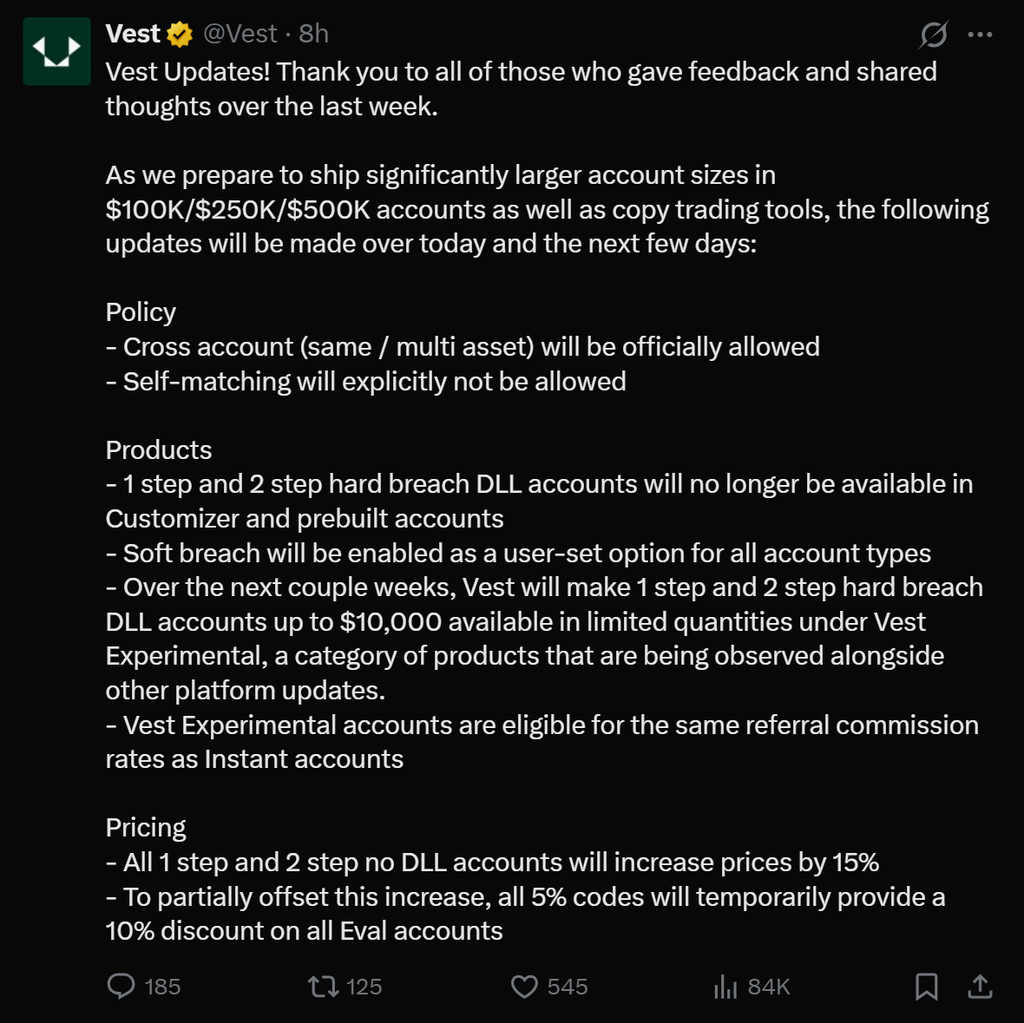
| Category | What Changed |
| Cross-Account Hedging | Officially allowed across same-asset and multi-asset accounts |
| Self-Matching | Explicitly prohibited |
| Hard Breach DLL Accounts | Removed from Vest Customizer and prebuilt 1-Step and 2-Step plans |
| Soft Breach DLL | Enabled as a user-set option across all account types |
| Vest Experimental | Hard breach DLL accounts returning in limited quantities under a new Experimental tier, paying Instant-tier referral commissions |
| No DLL Pricing | 15% price increase across all 1-Step and 2-Step No DLL evaluations |
| Affiliate Discount Boost | All 5% codes (including TPJ) temporarily increased to 10% off evaluations to partially offset the price hike |
| Upcoming Releases | $100K, $250K, and $500K account sizes plus copy trading tools |
What the Price Hike Looks Like in Practice
On paper, a 15% increase on No DLL accounts sounds manageable. In practice, removing the cheaper hard DLL tier completely changes what you pay for the same account parameters.
My favourite setup on Vest was a $10K account with 8% drawdown, a 5% profit target, a 3% hard DLL, and an 80% split. That account cost $180 ($171 with a 5% discount).
With hard DLL accounts gone, the No DLL version of that exact same $10K setup now costs $400 ($360 even with the temporary 10% discount). You are paying more than double ($360 vs. $171) for the exact same drawdown, profit target, and profit split.
Vest is also highlighting that you can now add a user-set soft DLL to any account at no extra cost. That sounds like a perk until you realise you now have to buy a far more expensive No DLL account just to use it. Turning a permanent flagship option into a limited-edition “Experimental” account is certainly a first for the industry, and overall, it is a clear downgrade for buyers.
CEO Justin’s Defence: “Vest Wins When Traders Win”
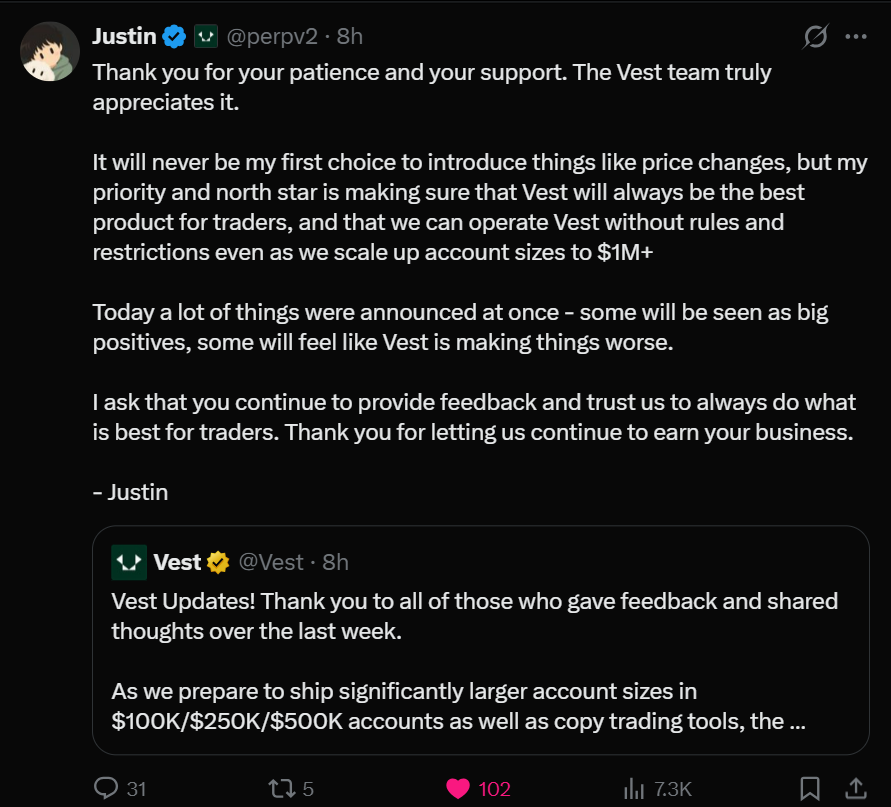
In a series of replies on X, Vest CEO Justin defended the changes as a necessary trade-off to keep Vest free of consistency rules, minimum trading days, and payout restrictions as account sizes scale toward $500K and eventually $1M+.
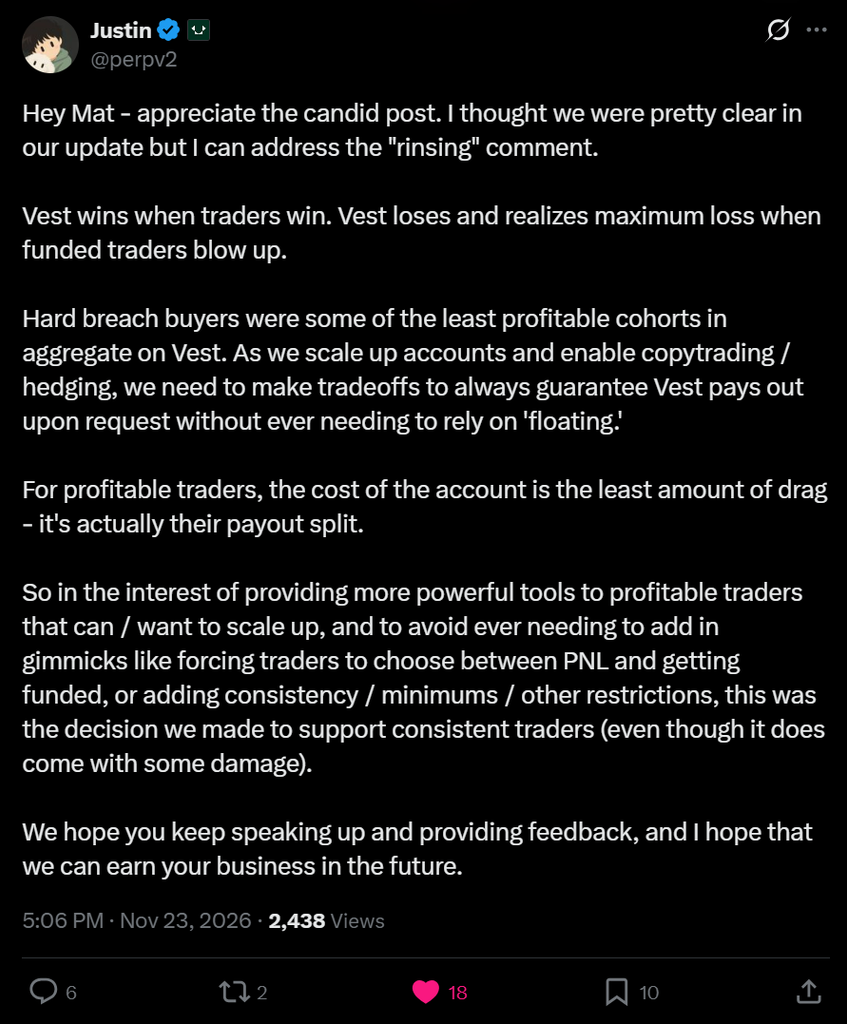
His argument rested on three main points:
- Hard DLL traders were unprofitable: Justin claimed that hard breach DLL buyers were among the least profitable cohorts on Vest in aggregate, and that letting those accounts scale alongside cross-account hedging, copy trading, and $100K–$500K sizes would create a risk problem.
- The “we win when traders win” model: Justin stated that Vest realises maximum loss when a funded trader blows up, pointing to Vest’s 30%+ evaluation pass rate. Addressing Matt and My Funded Futures continuing to offer hard breach DLL plans, Justin argued that “some models require losers to subsidise winners” and said Vest wants to optimise exclusively for consistent, profitable traders instead.
- Account cost vs. profit split: Responding separately to criticism from another trader on X, Justin argued that for profitable traders, the upfront evaluation fee is the smallest drag compared to their profit split, and that raising prices is better than adding gimmicks or consistency rules.
Why Vest’s Reasoning Deserves Scepticism
While Justin was candid in engaging with critics, two parts of Vest’s explanation do not hold up cleanly under scrutiny.
1. No Evidence for “We Win When Traders Win”
Vest has repeatedly leaned on the line that it wins when traders win, yet it still has not provided concrete evidence to back that claim up. Many competitors and prominent figures across the prop industry remain openly sceptical that the maths is even possible.
Justin has previously shared details about A-booking funded traders, but that explanation only covered how funded trades interact with the perps order book. It did not explain how Vest actually generates a net profit from funded traders. Executing every funded trade in live markets is generally a losing proposition: first, most traders lose money over time, and second, even when a trader wins, Vest only keeps a small portion of the profits while absorbing 100% of the losses.
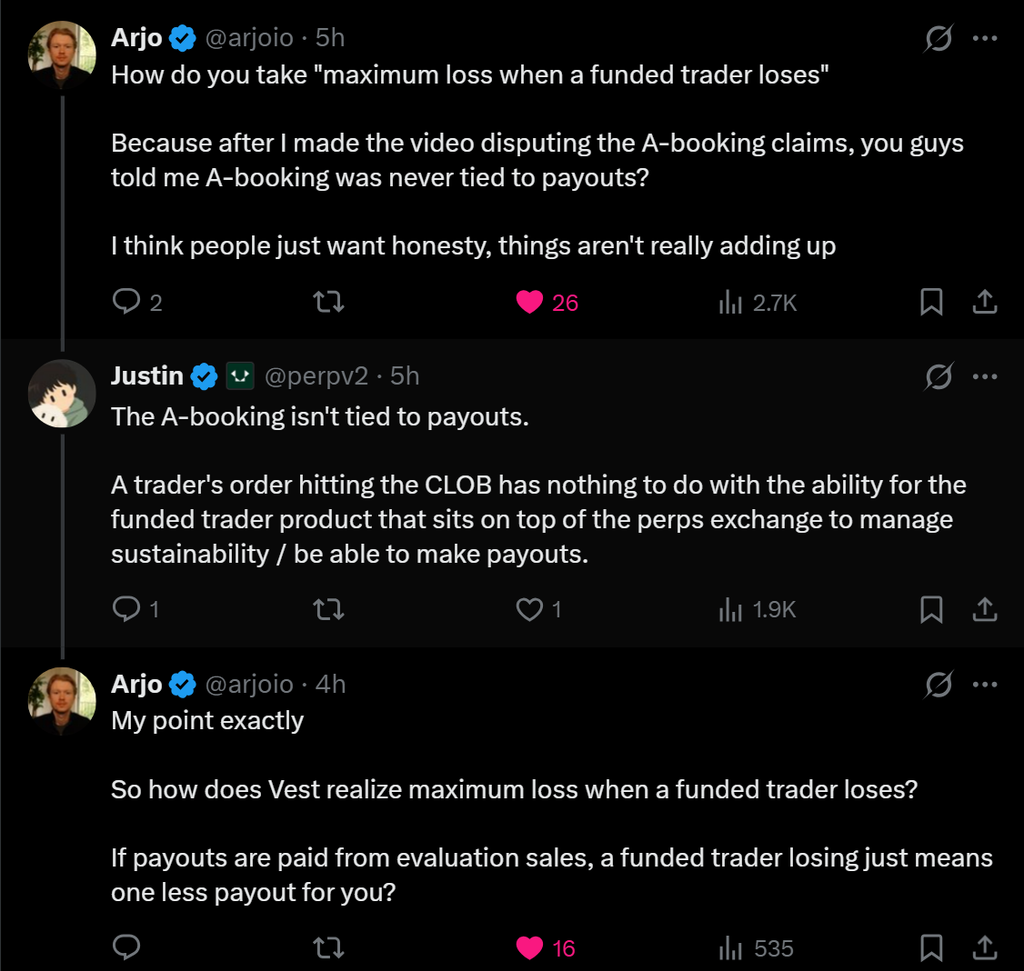
Vest has said it does not want to share too much detail on how it makes money from winning traders because competitors are looking to copy it. That is a reasonable stance for a fast-growing firm to take, but it does not change the fact that these are big claims that remain unproven. Paying out over $60 million shows that something at Vest is clearly working, yet removing its best-value plans and raising prices by 15% suggests that the model may now be coming under pressure.
2. Blaming DLL Traders vs. Unsustainable Pricing
Pinning the removal of hard DLL accounts on those traders being unprofitable also feels convenient. Hard DLL plans were by far the best-value accounts on Vest. The fact that Vest is removing its best-value product at the exact same moment it hikes prices by 15% on its more expensive No DLL plans suggests the old pricing structure may simply have been unsustainable, rather than it being the traders’ fault for not being good enough.
The Retail Reality: Lower Value for Most Traders
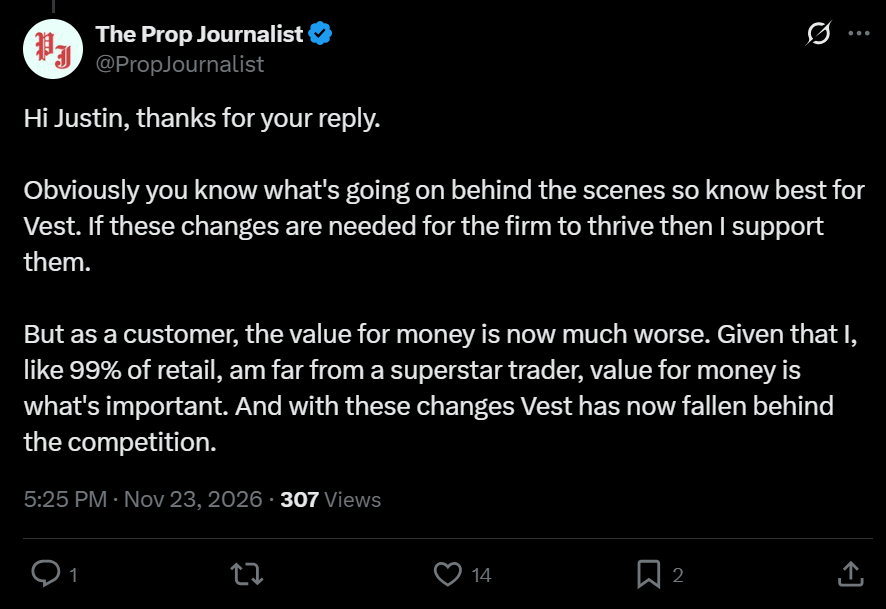
When Justin replied to my feedback on X, my view was straightforward: he knows what is going on behind the scenes, and if these changes are genuinely needed for Vest to thrive and keep paying out $60 million+, then I support the firm doing what it has to do to stay solvent.
As a customer, though, the value for money is now much worse. Justin’s argument that evaluation cost barely matters only applies to elite traders who rarely blow accounts. Like 99% of retail traders, I am not a superstar trader, which means cost per attempt and drawdown per dollar are what decide whether a firm is worth using. By stripping away hard DLL customisation and pushing prices up, Vest has fallen behind the competition on value.
Who Vest Still Works For (And Where to Look Instead)
- Vest Markets still makes sense for: Proven, consistent traders who want zero consistency rules, official cross-account hedging, upcoming copy trading, and access to $100K–$500K sizes without worrying about upfront fees. If you are buying a Vest evaluation while the offset promo is live, code
TPJtemporarily gives 10% off instead of the usual 5%. - Better value for budget-conscious traders: If you want static drawdown and cheaper hard DLL options rather than paying $360+ for a $10K account, competitors still fill that gap. You can compare current pricing and rules in our My Funded Perps Elite guide (which still offers a 3% hard DLL option at roughly half the cost of No DLL), our Tradeify Miami Plan review, or browse live codes on our prop firm discounts page.