



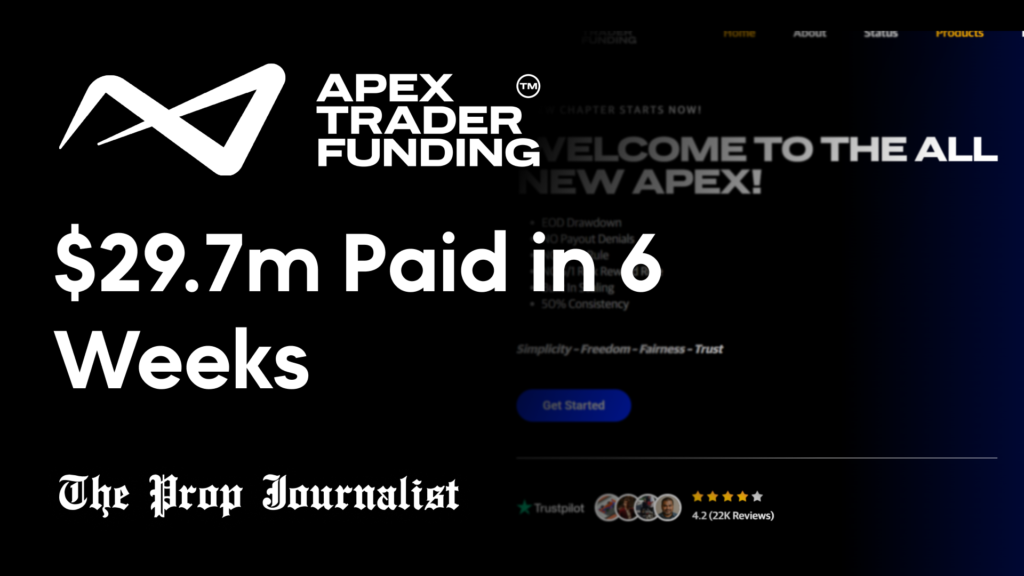
Apex Trader Funding paid approximately $29.7 million to traders between October 1 and November 10, across nearly 22,000 separate payouts, according to figures the firm shared with affiliates this week. The same announcement exposed the account churning carried by some traders, including one case involving more than 15,000 evaluations and up to 2,400 funded accounts cycled through.
In this article I’ll cover the payout milestone, what Apex says it found, and what the enforcement push means for traders running multiple discounted accounts.
The payout milestone
| Total paid out | ~$29.7 million |
| Separate payouts | ~22,000 |
| Users paid $30,000+ | 88 |
| Users paid $50,000+ | 23 |
| Users paid $60,000+ | 17 |
| Largest individual total | ~$110,000 |
Eighty-eight traders took home $30,000 or more in roughly 30 trading days, and one reached $110,000. At the top end, the cheap-evaluation, multiple-account model does exactly what it advertises.
But nearly 22,000 payouts against $29.7 million puts the average payout at about $1,350. The distribution is steep: a small group of very successful traders at the top, a long tail of ordinary payouts below. That is normal for the industry.
The churning exposed
The firm’s second message to affiliates was unusually blunt. Payouts by themselves do not mean profitable trading, it wrote, and sometimes represent “enormous spend, enormous churn, and behaviour that looks much more like payout extraction than an actual sustainable trading strategy.”
The cases it confirmed:
- Extreme account cycling: multiple users identified, including more than 15,000 evaluations purchased and anywhere from 700 to 2,400 funded accounts (PAs) cycled through in an effort to abuse the simulated environment.
- Legacy account violations: traders repeating the same violations on new trading days despite warning letters, and accounts with dozens of trading days removed over their lifetime for hedging or other rule breaks.
This is the behaviour that has circulated on social media for months: claims of huge payout totals that turn out to rest on buying evaluations in bulk, passing a fraction of them, and extracting one payout from each before blowing the account.
The move to Live
When behaviour warrants action, Apex says the response can include probation, evaluation purchase restrictions, account restrictions, shutdowns, or a move to Live. Detection is speeding up: the firm says AI and predictive models, built on billions of trade executions and tens of millions of historical accounts, now identify these patterns faster.
Apex frames a Live move as a graduation: real capital, real results, continued payouts. Traders who intended to stay in simulation will read it less positively, since this can reset their sim funded progress. The firm’s defence is that the trigger is behaviour, not payout size, and the numbers back it up. A firm that pays one trader $110,000 in a month is not banning people for being profitable.
The caveat: this is discretionary enforcement. No published rule defines exactly where the line sits, and a model deciding whether you are “running a strategy” or “extracting payouts” is not something a trader can check against. The only practical guidance is the obvious one. If your approach would survive in a real market, you are probably fine.
What this means for you
- If you run a real strategy across multiple accounts: nothing changes, and the milestone payouts prove the model still rewards exactly that.
- If your plan is buy cheap, account churn, repeat: the easy era is over, and the detection is getting faster.
- If you buy during the anniversary sales: the discounts stay, but assume behavioural vetting now runs alongside them.
The milestone and the churn are the same story. Cheap, plentiful evaluations produced both a $29.7 million payout run and the 15,000-evaluation churn cases, and Apex has chosen to keep the first while hunting the second. The $30K to $110K earners show the door is still open to disciplined traders at scale. But the people being removed were not banned for winning. They were removed for trying to abuse the low cost of entry.
Thanks for reading, for more prop firm content check out The Prop Journalist on YouTube, read the full Apex Trader Funding review here, and find the current Apex codes on the prop firm discounts page.