





Blue Guardian has launched two new CFD evaluation models, the 1-Step Nano and 2-Step Nano. The new challenges are designed as lower-cost alternatives to Blue Guardian’s existing Standard accounts, with different rules around drawdown, consistency and payouts.
Blue Guardian now advertises CFD accounts starting from just $20, making the Nano models particularly interesting for traders looking for a cheaper route to funding.
In this article, I’ll explain how the new Blue Guardian Nano challenges work, how they compare with the Standard accounts and whether they’re worth considering.
 Buy Blue Guardian Challenges

Blue Guardian Nano Challenge Rules
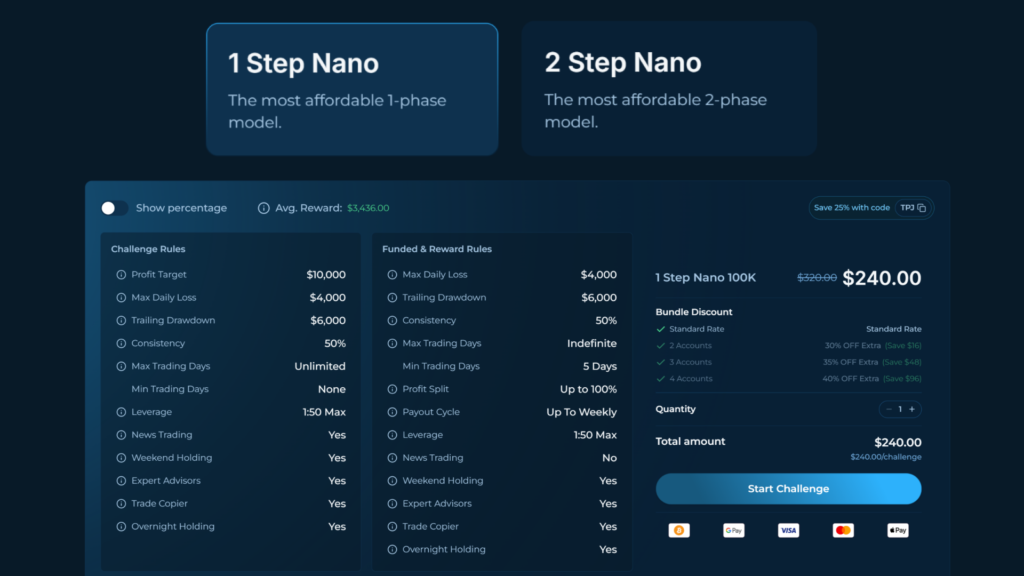
The 1-Step and 2-Step Nano accounts have quite different rules:
| 1-Step Nano | 2-Step Nano | |
| Profit Target | 10% | 8% / 5% |
| Daily Drawdown | 4% | 3% |
| Maximum Drawdown | 6% Trailing | 10% Static |
| Evaluation Minimum Days | None | None |
| Profit Split | 85% | 80% |
| Consistency Rule | 50% | 50% Funded Only |
| Payout Frequency | 7 Days | 14 Days |
| Payout Cap | None Stated | 2% Per Cycle |
Both accounts allow overnight and weekend holding, EAs and copy trading between accounts legally owned by the same trader. There is also a minimum trade duration of two minutes, while high-impact news trading is restricted within five minutes either side of the event once funded.
Blue Guardian Nano Pricing
The biggest selling point of the new Nano accounts is the price. Use discount code TPJ for the highest discount available.
The 1-Step Nano starts at an original price of $26.66 for a $5K account, which is currently discounted to just $20. Account sizes are available all the way up to $200K.
| Account Size | Original Price | Discounted Price |
| $5K | $26.66 | $20 |
| $10K | $38.66 | $29 |
| $25K | $78.66 | $59 |
| $50K | $160 | $120 |
| $100K | $320 | $240 |
| $200K | $585 | $438 |
The 2-Step Nano is even cheaper at the larger account sizes, with a $25K challenge currently costing just $50.
| Account Size | Original Price | Discounted Price |
| $25K | $66.66 | $50 |
| $50K | $127 | $95 |
| $100K | $239 | $179 |
| $200K | $460 | $345 |
These are the prices displayed by Blue Guardian at the time of writing and may change with promotions.
The low fees are important when considering the Nano accounts. Some of the trading rules are more restrictive than the Standard models, but you’re risking considerably less money each time you purchase an evaluation.
How The 1-Step Nano Works

The 1-Step Nano has a 10% profit target, 4% maximum daily drawdown and 6% balance based trailing drawdown.
However, there is a 50% consistency rule during both the Challenge and Funded Account. This means your largest profitable day must account for less than 50% of your total profits. If you exceed this, the account isn’t failed, but you’ll need to continue trading until your profits meet the consistency requirement.
Once funded, you also need five profitable trading days before requesting a payout, with each qualifying day requiring at least 0.5% profit. The starting profit split is 85%, although Blue Guardian offers an optional 100% profit split add-on, and payouts can then be requested every seven days.
How The 2-Step Nano Works

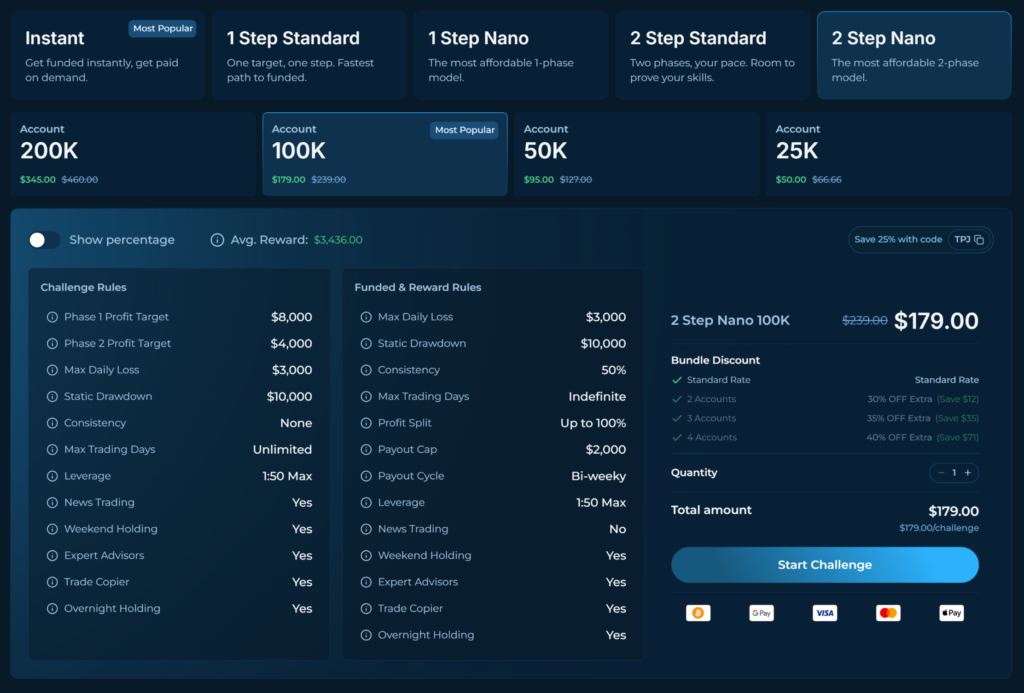
The 2-Step Nano is very different. You need to make 8% in Phase 1 and another 5% in Phase 2, with a 3% maximum daily drawdown and a much larger 10% static maximum drawdown.
There are no minimum trading days during either evaluation phase. Unlike the 1-Step Nano, the 50% consistency rule only applies once funded, so it doesn’t affect how quickly you can pass the evaluation.
However, there are two major compromises. Firstly, the profit split is only 80%. Secondly, funded payouts are capped at 2% of the initial account balance per payout cycle.
For example, a $100K Nano account would have a maximum payout of $2,000 every 14 days. Any additional profit stays in the account for a future payout cycle.
Nano vs Standard Accounts
The biggest question is whether the cheaper Nano accounts are actually better value than Blue Guardian’s Standard challenges.
For the 1-Step accounts, the Nano model is arguably more restrictive. Blue Guardian recently reduced the Standard 1-Step profit target to 9% for accounts purchased from August 20 onwards. It also has the same 4% daily and 6% trailing drawdown as Nano, but doesn’t list the 50% consistency rule that applies to the Nano account.
The Standard account does require three profitable trading days during the evaluation, though, so Nano still has an advantage for traders who want to pass quickly.
The 2-Step Nano is more interesting. Blue Guardian’s Standard 2-Step currently has an 8% Phase 1 target, 4% Phase 2 target, 4% daily drawdown and 8% static maximum drawdown.
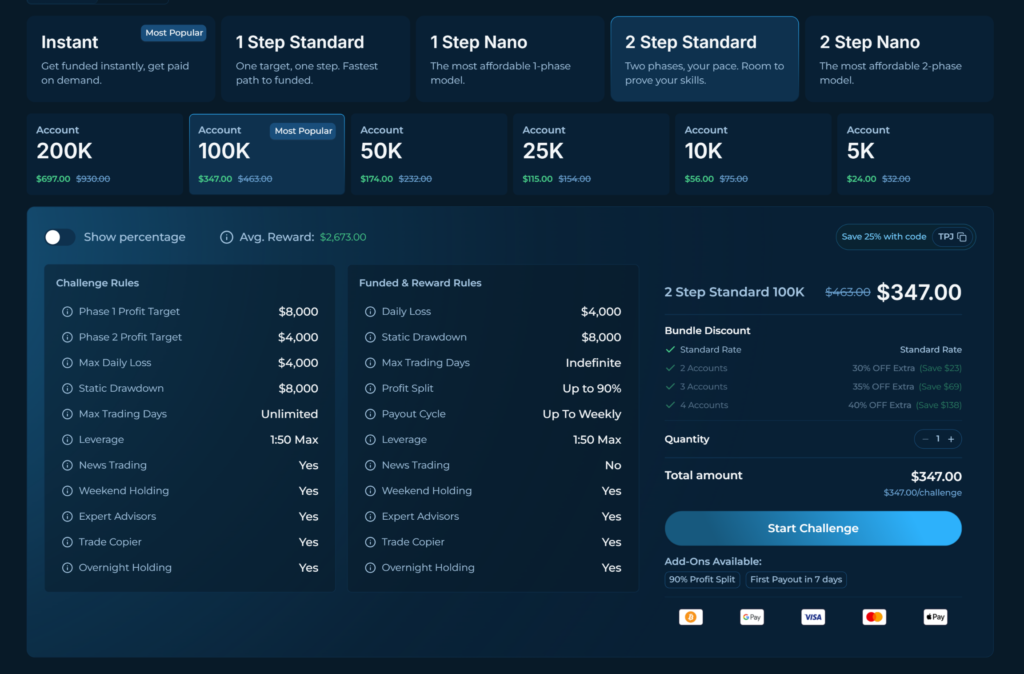
Nano increases the Phase 2 target to 5% and reduces the daily drawdown to 3%, but increases the overall static drawdown from 8% to 10% and removes the minimum trading day requirement. So traders get more overall drawdown room at a significantly lower price, but less room to lose in a single day.
Are The Blue Guardian Nano Accounts Worth It?
I think the 2-Step Nano is the more interesting of the two. A 10% static drawdown is generous for an 8% Phase 1 profit target, especially with no minimum trading days, although the 3% daily loss limit, 80% profit split and 2% payout cap are important compromises. The price is significantly cheaper than the competiton, at $179 for a $100k.
The 1-Step Nano is harder to get excited about from a rules perspective. It has the same 4% daily and 6% trailing drawdown as the Standard model, while the Nano target is currently higher at 10% versus 9% on newly purchased Standard accounts. You also have the additional 50% consistency rule.
So the main reason to choose Nano will likely come down to price. As the evaluation fee is significantly cheaper than the equivalent Standard account and other CFD firms, accepting slightly worse rules could make sense, particularly for traders who regularly buy new challenges.
Conclusion
Overall, Blue Guardian’s new Nano accounts are an interesting addition to its CFD lineup. Rather than simply offering smaller versions of the existing challenges, Blue Guardian has adjusted the rules to make the accounts cheaper while introducing some additional restrictions.
The 2-Step Nano stands out with its extremely low price, 10% static drawdown, and no minimum trading days, although the 2% payout cap and 80% profit split reduce its funded potential. It’s still a very attractive offering, potentially unsustainably, so I wouldn’t be surprised if this plan is changed in the future.
Meanwhile, the 1-Step Nano offers seven-day payouts and an optional 100% profit split, but the 10% target, 5 trading profitable days for payout, and 50% consistency rule make it more restrictive than the Standard account in some areas.
For traders mainly concerned with keeping evaluation costs low, the Nano accounts could offer good value, especially when using discount code TPJ. But if you’re more focused on large payout potential and flexible trading rules, regular CFD models may still be the better option.