





FTMO has officially entered the futures prop trading market with FTMO Futures, launching two evaluation models called Growth and Pro.
The new futures offering is currently in beta and gives traders access to $50K, $100K and $150K simulated accounts, with up to three Sim-Funded Accounts held at once. FTMO says that means traders can access up to $450,000 in simulated capital.
The launch is a significant expansion for FTMO, which has built its reputation around CFD prop trading since 2015. FTMO says it has served more than 4.5 million customers and paid over $650 million in rewards across its wider business.
In this article, I’ll explain how FTMO Futures works, the difference between Growth and Pro, and how competitive the new offering looks.
FTMO Futures Pricing
Both Growth and Pro are monthly subscription evaluations, with Pro costing slightly more in exchange for larger drawdowns and better payout terms.
| Account Size | Growth | Pro |
|---|---|---|
| $50K | $119/month | $139/month |
| $100K | $169/month | $199/month |
| $150K | $229/month | $269/month |
Reset fees range from $109 to $219 on Growth and $129 to $259 on Pro.
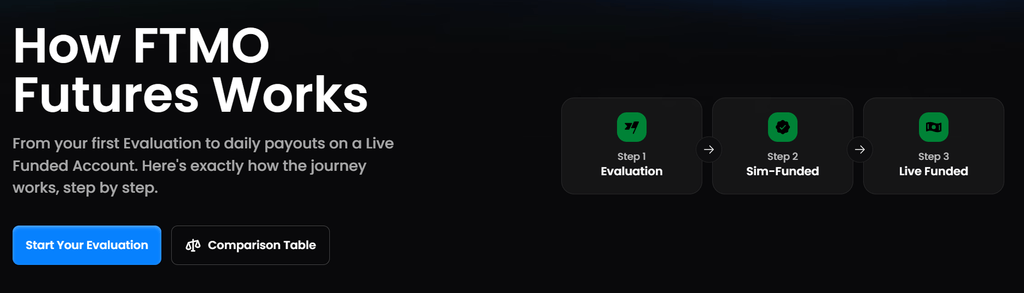
Importantly, there is no activation fee after passing. Once you complete the Evaluation, you move onto an FTMO Sim-Funded Account without paying another setup fee.
The pricing isn’t especially cheap compared with some futures prop firms, so FTMO appears to be competing more on account rules and payout structure than on headline evaluation cost.
Growth vs Pro Rules
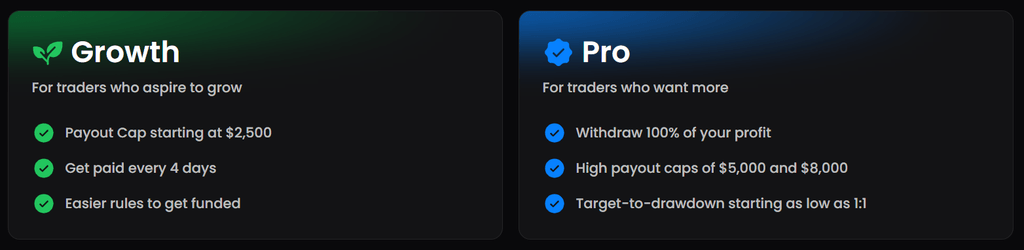
The biggest difference between the two models is that Growth is cheaper and has better daily loss rules, while Pro gives you more drawdown, an easier evaluation and stronger payout terms once funded.
| Growth | Pro | |
|---|---|---|
| Profit Target | $3K / $6K / $9K | $3K / $6K / $9K |
| Max Drawdown | $2K / $3.5K / $5K | $3K / $4.5K / $6K |
| Daily Loss | $1K / $1.5K / $2K Soft (Sim Funded Only) | $1K / $1.5K / $2K Hard |
| Consistency | 40% | 50% |
| Drawdown Type | EOD Trailing | EOD Trailing |
| Max Contracts | 5 / 10 / 15 | 5 / 10 / 15 |
Both models use an end-of-day trailing drawdown, so unrealised intraday profits don’t immediately move the loss threshold higher.
Growth has no daily loss limit during the Evaluation, which want to trade more aggressively during the evaluation. Pro introduces a hard daily loss limit, but compensates with a significantly larger maximum drawdown.
The standout is the $50K Pro account, which gives you a $3,000 maximum drawdown against a $3,000 profit target.
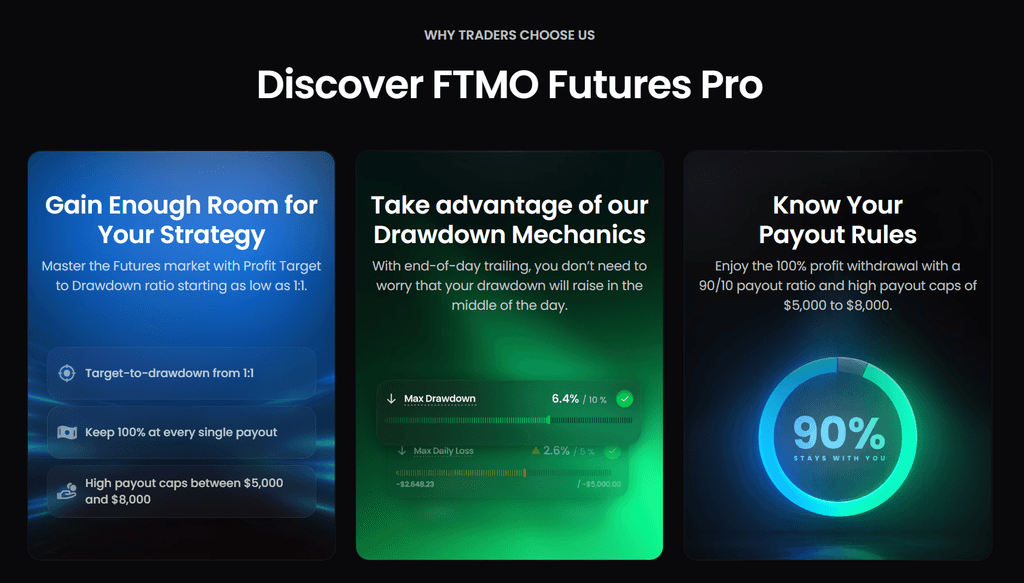
That creates a 1:1 drawdown-to-profit-target ratio, which is very generous for a futures evaluation. FTMO itself highlights the Pro plan as offering target-to-drawdown ratios starting as low as 1:1.
What Happens After Passing?
Successful traders move onto an FTMO Sim-Funded Account, where there is no profit target and, importantly, no consistency rule.
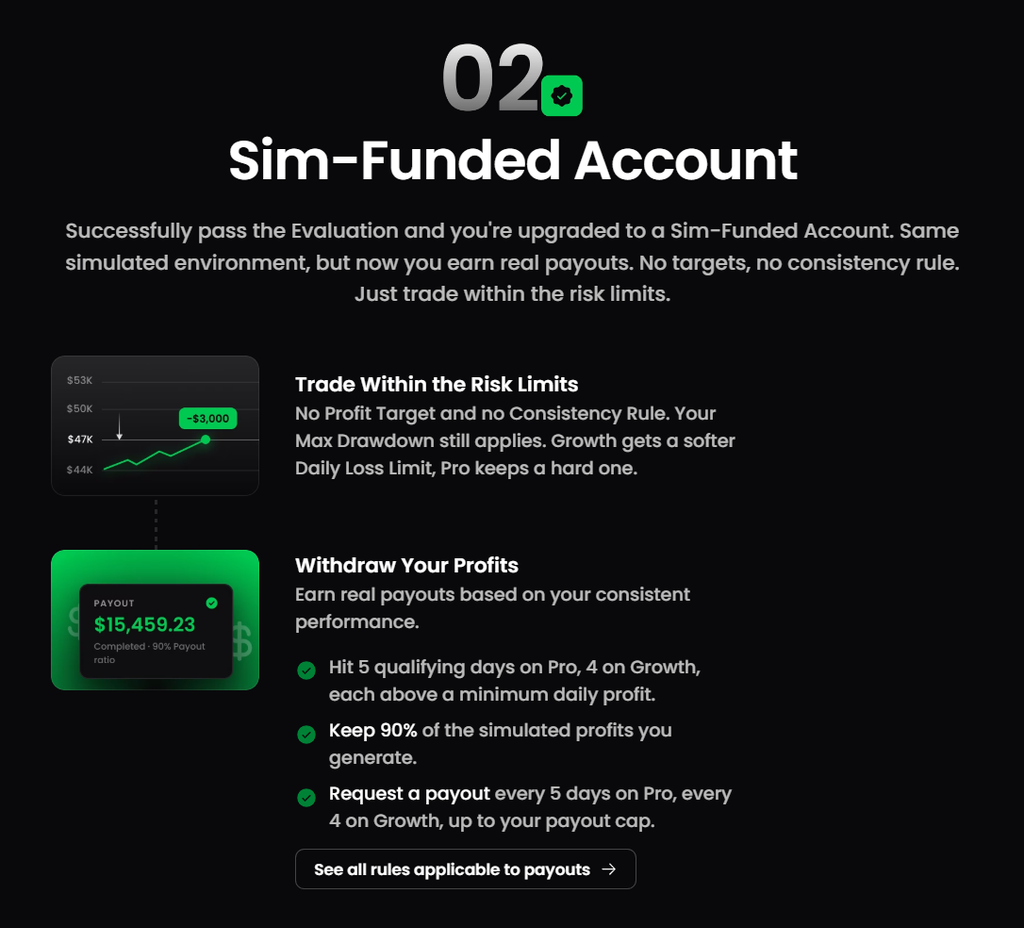
The payout ratio is 90% across both models, but the withdrawal rules differ. Growth traders can withdraw up to 50% of their profits at each payout, while Pro traders can withdraw 100%.
Growth payouts are available every four qualifying days, with payout caps of $2,500, $3,000 and $4,000 depending on account size.
Pro payouts are available every five qualifying days, with much higher caps of $5,000, $6,000 and $8,000.
This is where Pro becomes much more attractive despite the higher monthly fee. For example, the $50K Pro costs only $20 more per month than Growth, but increases the maximum drawdown from $2,000 to $3,000 and doubles the payout cap from $2,500 to $5,000.
Sim-Funded Risk Rules
The risk rules also change slightly after passing.
Growth switches from having no Evaluation daily loss limit to a soft daily loss limit of $1,000, $2,000 or $3,000 depending on account size.
Pro keeps its existing hard daily loss limits of $1,000, $1,500 and $2,000. Both plans retain the same end-of-day trailing maximum drawdown used during the Evaluation.
How Many FTMO Futures Accounts Can You Have?
There is no limit on the number of Evaluations you can run simultaneously, although each one has its own monthly subscription.
Once funded, you can hold a maximum of three Sim-Funded Accounts across Growth and Pro combined. FTMO says there is no separate maximum capital allocation beyond this three-account limit.
That means three $150K accounts would give you access to $450,000 in simulated capital.
FTMO also says top-performing traders may be considered for an FTMO Live Account, although the initial Sim-Funded stage remains simulated trading.
Conclusion – Is FTMO Futures Competitive?
I think the Pro plan is the more interesting of the two.
The monthly fee is only moderately higher, but you get substantially more drawdown room and much better payout conditions. The $50K account in particular stands out with its 1:1 drawdown-to-profit-target ratio and $5,000 payout cap.
Growth is relatively uncompetitive, with a price higher than the competition, a 40% consistency rule, and daily loss limits on the funded account.

The broader appeal is also FTMO itself. Many futures prop firms compete aggressively on discounts and cheap evaluations, but FTMO enters the market with a well-established brand, a decade of operating history and a large existing trader base. That won’t automatically make its futures product better, but it should immediately make it one of the more closely watched launches in the sector.