




Prop firms make money in very different ways depending on whether they are traditional institutional trading firms or modern retail-funded trading firms.
A traditional proprietary trading firm uses its own capital to trade financial markets and keeps the profits it generates.
Retail prop firms, such as FTMO and Topstep, work differently. Most sell trading evaluations, commonly known as challenges, where traders pay a fee to prove they can meet a profit target without breaking predefined risk rules. Successful traders can then qualify for payouts, usually while continuing to trade in a simulated environment.

For most retail prop firms, evaluation fees are the core source of revenue. Firms can also make money from subscriptions, resets and activation fees, profit splits from live traders, hedging or copying successful traders, and using aggregated trading data to improve their own risk management or trading.
This article explains where the money actually comes from and why prop firms can afford to offer traders accounts advertised as $50k, $100k or more.
Key Takeaways
- Retail prop firms primarily make money by charging traders to take evaluations.
- The advertised account balance usually doesn’t mean the firm is giving the trader that amount of cash.
- Many funded accounts remain simulated, with the firm paying real rewards based on simulated profits.
- Some successful traders are moved to live capital or have their trades copied or hedged in the real market.
- Firms can also earn from subscriptions, resets, activation fees, commissions and other account charges.
- Traditional institutional prop firms are different: they primarily make money by trading the firm’s own capital.
Evaluation Fees
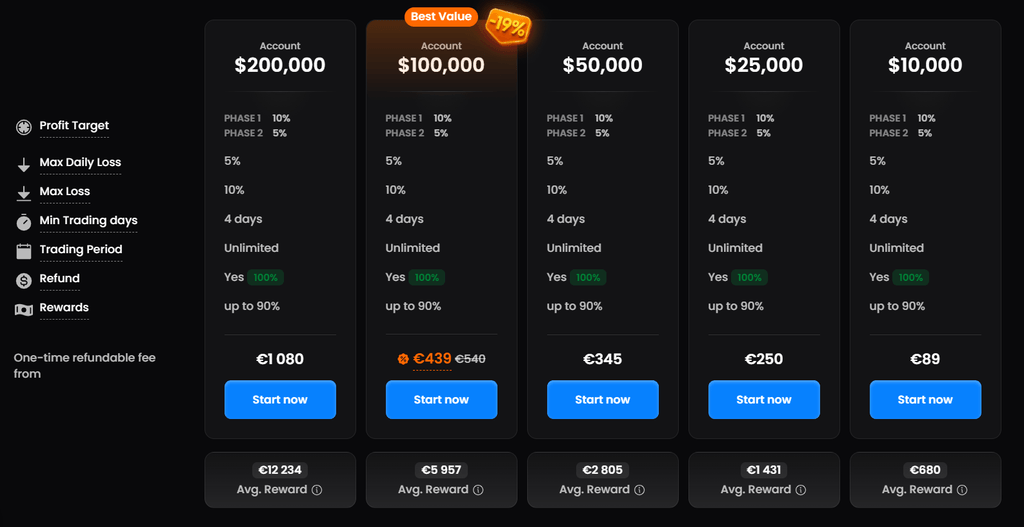
Evaluation fees are the most important revenue source for most retail prop firms.
This model is used by many of the biggest retail prop firms. FTMO charges traders to complete its evaluation process, while Topstep uses a subscription-based Trading Combine before traders can progress to funded stages.
A trader might pay $50, $100, $500 or more to attempt a challenge. They then have to reach a profit target while staying inside rules such as maximum drawdown, daily loss limits and consistency requirements.
If the trader fails, the fee normally isn’t refunded.
This creates a simple business model.
For example, imagine a prop firm sells 10,000 evaluations at an average price of $100. That generates $1 million in gross evaluation revenue.
The firm does not need to provide $100,000 of real trading capital for every trader who buys a $100K challenge. The evaluation usually takes place on a simulated account, meaning the main direct costs are things such as trading platforms, market data, payment processing, customer support, affiliate commissions and marketing.
Most traders also don’t reach a payout.
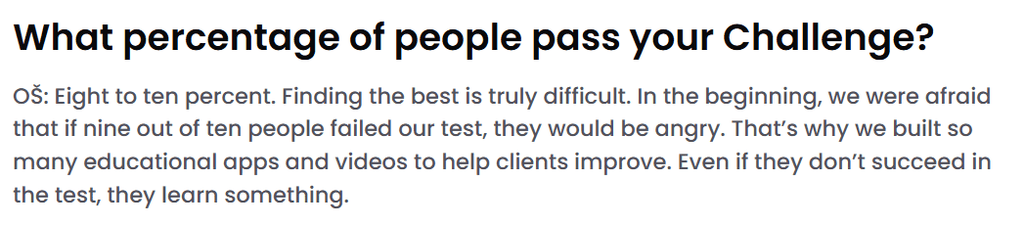
This means evaluation revenue from unsuccessful traders can help fund payouts to the smaller percentage of traders who successfully progress through the program.
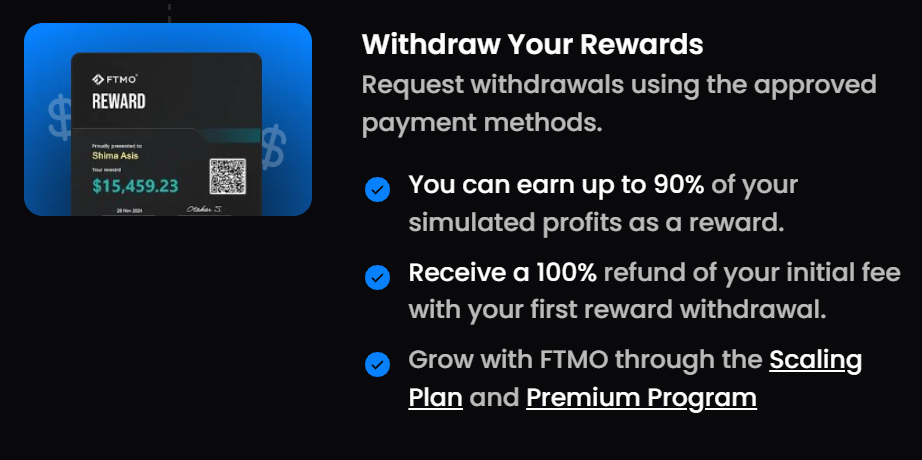
FTMO, for example, states that its Challenges and funded-stage accounts use simulated capital. Its co-founder has also said that the vast majority of the company’s income comes from fees charged for its evaluation and educational services.
This is why challenge pricing, pass rates and customer acquisition are so important to the retail prop firm business model.
Resets, Subscriptions and Activation Fees

The evaluation price isn’t always the only fee a prop firm charges.
Depending on the firm, additional revenue can come from:
- Monthly subscriptions
- Evaluation resets
- Funded account activation fees
- Data fees
- Platform fees
- Account upgrades and add-ons
This is especially common among futures prop firms.
Some futures evaluations run as monthly subscriptions rather than one-time purchases. A trader who takes several months to pass can therefore pay the evaluation fee multiple times.
Others offer cheap evaluations but charge an activation fee once the trader passes.
Resets are another revenue source. Instead of purchasing a completely new challenge after failing, traders may be offered a discounted reset that returns the account to its starting balance.
These charges can substantially increase the firm’s average revenue per customer beyond the headline challenge price.
For example, FTMO Futures currently uses monthly subscriptions during its Evaluation stage, although the subscription stops after passing and there is no separate funded activation fee.
Profit Splits From Live Traders
The original concept behind proprietary trading is straightforward: the firm provides capital, the trader generates profits, and they split the money.
If a trader makes $10,000 on a live account with a 90/10 profit split, the trader receives $9,000 and the firm keeps $1,000.
This is still a revenue source for retail prop firms that place successful traders onto real capital.
However, it is important to understand that not every “funded” trader is actually trading a live brokerage account.
Many modern retail prop firms initially keep funded traders in a simulated environment and pay them real rewards based on their simulated performance.
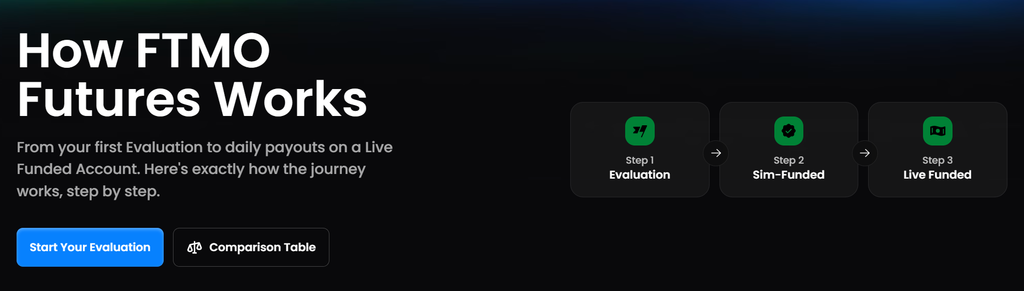
For example, FTMO states that its regular FTMO Accounts use fictitious capital, while FTMO Futures traders first progress to a Sim-Funded Account. Only selected traders may later be moved onto live capital.
Therefore, the traditional profit-split model is only part of the economics of modern retail prop trading.
Hedging and Copying Successful Traders
A prop firm doesn’t necessarily have to move a trader onto a live account to profit from their trading ability.
Instead, it can analyse successful traders and copy, hedge or replicate selected trades using its own capital.
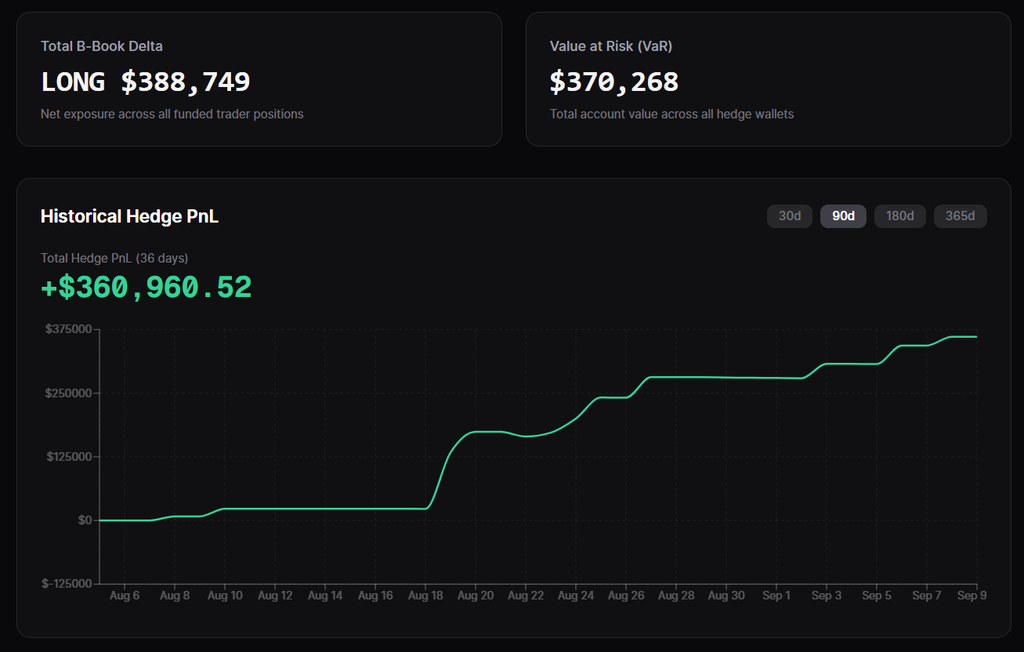
Imagine a trader has consistently profitable results on a simulated $100K account.
The trader continues seeing a simulated account on their side, but the prop firm may decide that some or all of their trades are worth reproducing in a separate live brokerage account.
If the live trades make money, the firm keeps the resulting trading profit while still paying the trader according to their agreed reward structure.
The firm can also choose how much exposure to copy.
It could replicate a trader at:
- 100% of their simulated position size
- A smaller percentage of their exposure
- A larger position size
- Only on selected instruments or strategies
- Not at all
This gives the firm much more control over risk than simply handing every successful applicant a large live brokerage account.
FTMO publicly explains that it monitors trading performed by its simulated traders and may use selected trading data when executing trades with its own capital. Whether FTMO copies a trade has no effect on the trader’s contractual payout.
This is sometimes described as A-booking profitable traders, although the exact risk-management model varies significantly between firms.
Trading Data Monetisation
One of the least discussed assets a large prop firm has is trading data.
A firm with tens or hundreds of thousands of traders can collect a huge amount of information about how people behave in financial markets.
This can include:
- Entry and exit prices
- Position sizing
- Instruments traded
- Stop-loss placement
- Holding periods
- Performance around economic news
- Behaviour after winning or losing trades
- Which strategies remain profitable over time
Individually, one trader’s data may not be especially valuable. Across a very large trader base, however, patterns can become useful.
A prop firm can analyse this data to identify profitable traders, improve its risk models, determine which positions it may want to hedge, or develop trading strategies for its own capital.
This doesn’t necessarily mean the firm is “selling traders’ data” to third parties. In many cases, the more valuable form of monetisation is simply using aggregated trading information internally to make better trading and risk-management decisions.
Again, FTMO provides a useful public example. The company states that it may analyse simulated trades and use trading data from selected traders when trading its own capital. For a large prop firm, the trader network can therefore function as both a customer base and a source of trading signals.
Trading Commissions and Spread Markups
Some prop firms can also generate revenue from the trading activity itself.
Depending on how the firm and its brokerage or platform relationships are structured, revenue may come from:
- Per-lot commissions
- Futures contract commissions
- Spread markups
- Platform charges
- Market-data fees
This revenue becomes more meaningful when a firm has a large number of active traders placing thousands or millions of trades.
A small commission on each trade may look insignificant at the individual-account level, but it can become substantial at scale.
However, this varies considerably between prop firms. Traders shouldn’t automatically assume that every commission or spread charged represents pure profit for the firm, because exchanges, brokers, liquidity providers and technology companies may also receive part of it. On purely simulated accounts, displayed commissions are not necessarily direct trading revenue for the firm, although firms may still charge separate platform or data fees.
Why Don’t Prop Firms Lose Money When Traders Get Funded?
This is one of the biggest misconceptions about retail prop trading.
A “$100K funded account” usually doesn’t mean the prop firm has deposited $100,000 into a brokerage account and handed it to the trader.
What matters economically is the maximum drawdown amount the trader is allowed to lose.
Suppose a $100K account has a 5% maximum drawdown.
Although the headline account size is $100,000, the trader can only lose $5,000 before the account is closed.
The firm’s actual risk is therefore much closer to the drawdown than the advertised account balance.
And if the account is simulated, the firm isn’t directly losing even that amount when the trader loses. The balance is simply reset or the account is terminated.
Real financial exposure primarily comes from paying profitable traders their rewards and from any positions the firm chooses to replicate on live markets.
This distinction is fundamental to understanding the economics of retail prop firms.
Why Can Prop Firms Offer 80%, 90% or Even 100% Profit Splits?

At first glance, giving a trader 90% or 100% of their profits sounds like a terrible business model.
It makes much more sense once you understand that many funded accounts are simulated.
If a trader makes $5,000 in simulated profit and receives a $4,500 reward, the prop firm’s cost is the $4,500 payout, not $5,000 of lost brokerage profit.
That payout can be financed by the wider business, particularly evaluation revenue.
If the firm also copies profitable traders into the live market, it may generate additional trading profits that offset or exceed the rewards it pays.
This is why the advertised profit split alone tells you very little about a prop firm’s profitability.
Do Prop Firms Want Traders to Fail?
Retail prop firms financially benefit from evaluation fees, so failed challenges can clearly be profitable for the business.
But saying that every prop firm simply wants every trader to fail is too simplistic. A sustainable firm also benefits from successful traders.
Profitable traders provide:
- Marketing and payout proof
- Repeat customers and referrals
- Potential live trading profits
- Valuable trading data
- Strategies the firm can potentially replicate
- Credibility for the funded-trader model
A firm where virtually nobody receives payouts would eventually struggle to attract customers.
The economic incentive is therefore more nuanced: the evaluation side of the business benefits from large numbers of paying applicants, while the trading side benefits from identifying a small number of genuinely profitable traders.
The strongest business models can therefore earn from both sides: evaluation revenue from unsuccessful traders and trading value from successful ones.
Institutional Prop Firms vs Retail Prop Firms
Traditional proprietary trading firms operate very differently from the online challenge model.
Firms such as quantitative trading companies, market makers and proprietary trading desks hire professional traders, researchers and developers to trade the firm’s own money.

Their revenue can come from:
- Directional trading profits
- Quantitative strategies
- Arbitrage
- Options trading
- Market making
- Liquidity provision
There is normally no evaluation fee paid by the trader. The trader is an employee, partner or contractor who receives salary, bonuses or a share of the trading profits.
Retail prop firms such as FTMO and Topstep operate differently. Instead of hiring most traders as employees and allocating live capital immediately, they use paid evaluations and simulated accounts to identify traders they may later fund, copy or hedge.
Instead of paying salaries to thousands of applicants, they charge traders to complete an evaluation and use the results to identify potentially profitable traders.
How Does a Retail Prop Firm Make Money Overall?
A simplified example shows how the model fits together.
Imagine a prop firm receives $2 million in evaluation and account fees during a month.
It then has to pay:
- $600,000 in trader payouts
- $500,000 in marketing and affiliate costs
- $200,000 in platforms, staff, payment processing and infrastructure
That leaves $700,000 before taxes and other business expenses.
If the firm’s live trading or hedging operation also generates $200,000, its economics improve further.
The exact numbers vary enormously between firms, but the important point is that retail prop firms don’t need every trader to become profitable in the live market for the business model to work.
Evaluation revenue creates the base economics, while successful traders can provide additional value through live profits, hedging and trading data.
Are Prop Firms Profitable Businesses?
FTMO is a good example of how profitable the retail prop model can become at scale. The company reported roughly $330 million in revenue and $117 million in EBITDA for 2024.
They can be extremely profitable, but the model isn’t as easy as it appears.
Prop firms also face significant costs from:
- Trader payouts
- Advertising
- Affiliate commissions
- Payment processing
- Chargebacks and fraud
- Trading technology
- Market data
- Customer support
- Staff
- Legal and compliance costs
The industry has seen numerous firms close despite generating large amounts of challenge revenue.
A firm therefore needs to balance evaluation revenue against customer acquisition costs and, most importantly, its payout liabilities.
Selling lots of challenges doesn’t automatically make a prop firm financially healthy. In some cases, firms can make challenges so generous that they lose money on each evaluation sold. This can work as a short-term customer acquisition strategy, but it is unsustainable if maintained for too long, as losses can quickly outweigh the value of the new customers being acquired.
Early retail prop firms could operate with very high margins, but increased competition has steadily improved trader conditions and compressed profitability across the industry.
Conclusion
Most retail prop firms primarily make money from evaluation fees, rather than simply giving traders real capital and taking a percentage of their profits.
Additional revenue can come from subscriptions, resets, activation fees and trading-related charges. Successful traders can also create value when firms place them onto live capital, copy their trades or use their trading data when managing the firm’s own money.
This explains why a prop firm can advertise a $100,000 funded account for a relatively small evaluation fee. The $100,000 is usually simulated buying power, while the firm’s real financial exposure is primarily the payouts owed to successful traders and any live positions it chooses to take.
Understanding that difference between simulated buying power and real financial exposure is the key to understanding the modern retail prop firm model.