




Some prop firms let you pay extra to keep a larger share of your profits. But a higher profit split doesn’t automatically mean better value.
Use the calculator below to compare how much the price increases with how much your profit share increases. Then read on for examples showing the difference between higher ROI and more cash profit.
Profit Split Upgrade Calculator
Which offers better value for the price?
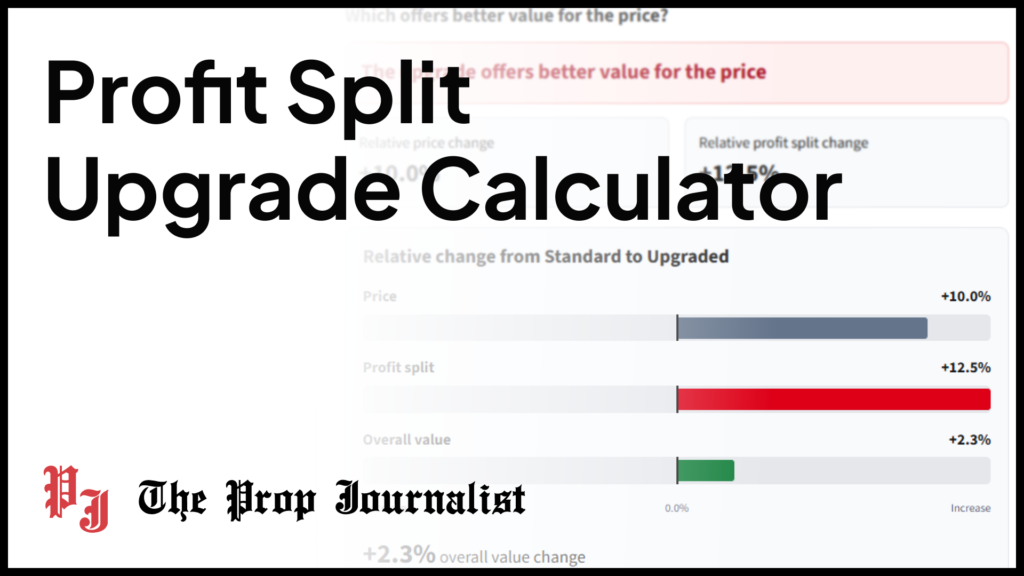
Relative change from Standard to Upgraded
overall value change
Overall value change = (Upgraded split ÷ Standard split) ÷ (Upgraded price ÷ Standard price) − 1, expressed as a percentage.
How to Use the Calculator
Enter the total price and trader’s profit split for both options:
- Standard: the price without the upgrade and the percentage you keep.
- Upgraded: the total price including the upgrade and the higher percentage you keep.
Use the prices you would actually pay after discounts. Compare the same account size and evaluation terms, with both prices in the same currency.
The calculator shows the relative price change, relative profit split change and overall value change.
How to Tell Which Option Offers Better Value
Assuming the same eligible profits and otherwise identical terms:
If your profit share increases more than the price, the upgrade offers better value and higher ROI.
If the price increases more than your profit share, the standard option offers better value and higher ROI. If both increase by the same percentage, they offer equal value relative to cost.
The key is to compare relative percentage increases, rather than percentage-point differences.
For example, moving from an 80% split to 90% adds 10 percentage points. Relative to the original 80%, however, your profit share increases by 12.5%:
(90 ÷ 80 − 1) × 100 = 12.5%
If the price increases from $100 to $110, that’s a 10% increase:
($110 ÷ $100 − 1) × 100 = 10%
Your profit share increases faster than your cost, so the upgrade offers better value.
What “Overall Value Change” Means
The calculator’s overall value result shows how much more or less profit share you receive per dollar spent.
In the $100 versus $110 example, overall value improves by approximately 2.3%:
[(90 ÷ 80) ÷ (110 ÷ 100) − 1] × 100 = 2.3%
You receive 2.3% more profit share per unit of cost. This doesn’t mean your net profit or ROI increases by 2.3 percentage points.
It also doesn’t tell you whether you will earn enough to recover the extra upgrade fee. That depends on your eligible profits.
E8 Pro Example: Higher Profit Split, Higher ROI
Using an E8 Pro $50K evaluation priced at $164 for an 80% split, compared with $197 for a 100% split:
| Comparison | Increase |
|---|---|
| Evaluation price | 20.1% |
| Trader’s profit share | 25.0% |
The profit share increases more than the price, so the 100% option offers better value under these assumptions.
Suppose you purchase four evaluations in total and eventually have $2,000 eligible for withdrawal before the split.
| Result | 80% split | 100% split |
|---|---|---|
| Four evaluation fees | $656 | $788 |
| Payout received | $1,600 | $2,000 |
| Net profit after evaluation fees | $944 | $1,212 |
| ROI | 143.9% | 153.8% |
The upgrade produces $268 more net cash profit and a higher ROI.
Here, ROI means:
(Payout received − evaluation fees) ÷ evaluation fees × 100
These figures use the eligible withdrawal before the split, rather than total account profit. Any payout buffer or withdrawal restriction must be accounted for separately.
Breakout Example: The Standard Split Offers Higher ROI
Now consider a Breakout 1 Step Pro $50K evaluation priced at $280 for an 80% split, compared with $336 for a 90% split.
The price increases by 20%, while your profit share increases by only 12.5%.
The standard 80% option offers better value because you receive more profit share per dollar spent.
With four evaluation purchases and a total eligible withdrawal of $2,000:
| Result | 80% split | 90% split |
|---|---|---|
| Four evaluation fees | $1,120 | $1,344 |
| Payout received | $1,600 | $1,800 |
| Net profit after evaluation fees | $480 | $456 |
| ROI | 42.9% | 33.9% |
The standard option leaves you with $24 more after fees and a higher ROI.
More Cash Profit Doesn’t Always Mean Higher ROI
Increase the eligible withdrawal in the Breakout example to $4,000, keeping the same four evaluation purchases.
| Result | 80% split | 90% split |
|---|---|---|
| Four evaluation fees | $1,120 | $1,344 |
| Payout received | $3,200 | $3,600 |
| Net profit after evaluation fees | $2,080 | $2,256 |
| ROI | 185.7% | 167.9% |
The upgrade now earns you $176 more cash profit, but its ROI remains lower.
Both measures matter:
- Net cash profit tells you how much money remains after the costs included in the comparison.
- ROI tells you how much net profit you earn relative to those costs.
Higher ROI helps you compare how efficiently you use your evaluation budget. Higher cash profit may also matter if you expect substantial payouts.
When Does the Upgrade Pay for Itself?
To find the point where the upgrade produces more net cash profit, divide the extra cost by the extra profit share expressed as a decimal:
Break-even eligible profit = extra cost ÷ extra profit share
In the Breakout example, four upgraded evaluations cost $224 extra. The upgrade adds 0.10 to your profit share:
$224 ÷ 0.10 = $2,240
At $2,240 in eligible withdrawals before the split, both options leave the same amount after evaluation fees. Above that, the upgraded option earns more net cash profit.
The standard option still offers higher ROI at the same eligible profit.
Getting the Best Value From Your Evaluation
Before buying, check our prop firm discounts page and enter the discounted prices into the calculator.
Also check whether the options have the same payout rules, drawdown limits and other terms. Fee refunds, recurring charges, payout caps and tiered profit splits can change the comparison.
The calculator gives you a clear comparison of profit share relative to price. Use that result alongside your likely eligible payouts and account rules to decide whether the upgrade makes sense for you.