






Lucid Trading has brought back its Live Cash Out option, giving traders the choice to take a guaranteed payment instead of moving onto a live trading account.
The change follows Lucid publishing unusually detailed data on what happens after traders move from simulated funding to real capital.
According to Lucid, 50% of live accounts are blown in a single trading day, while 48% fail on their very first day. Only 18% of live accounts ultimately receive a payout, and the average account survives for around three days.
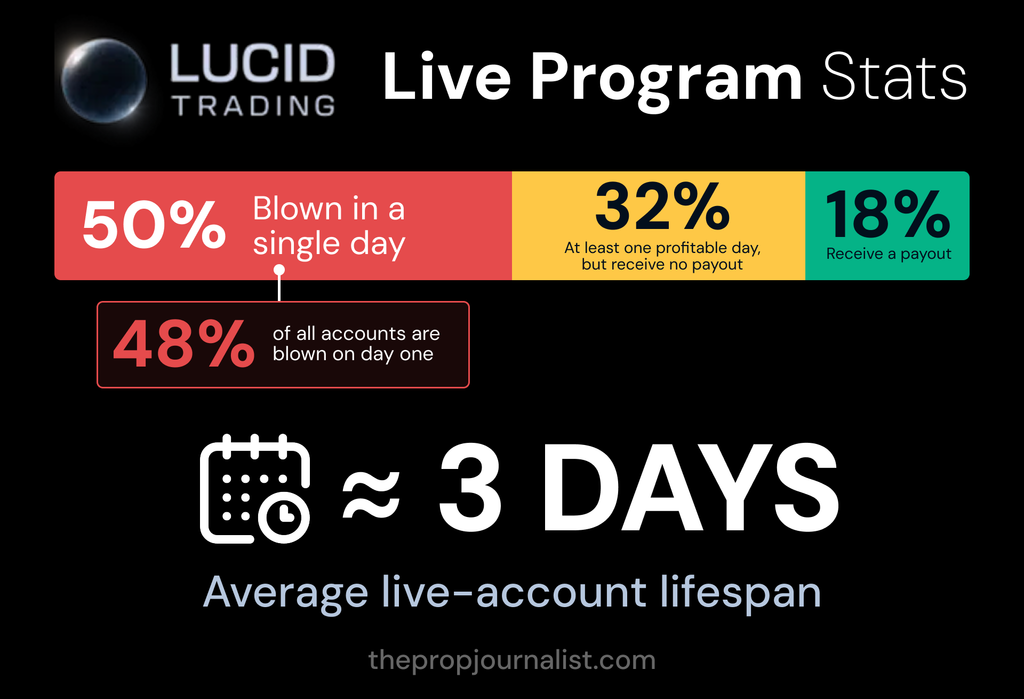
Those numbers help explain why Lucid has decided to bring the cash-out option back.
How Lucid Live Cash Out Works
When Lucid selects a trader to move from simulated funding to a live account, the trader can now choose between:
- Moving onto the live account as normal
- Taking a Live Cash Out instead
If you choose the cash-out, Lucid pays 50% of the live drawdown you would otherwise have received, subject to the applicable profit split.
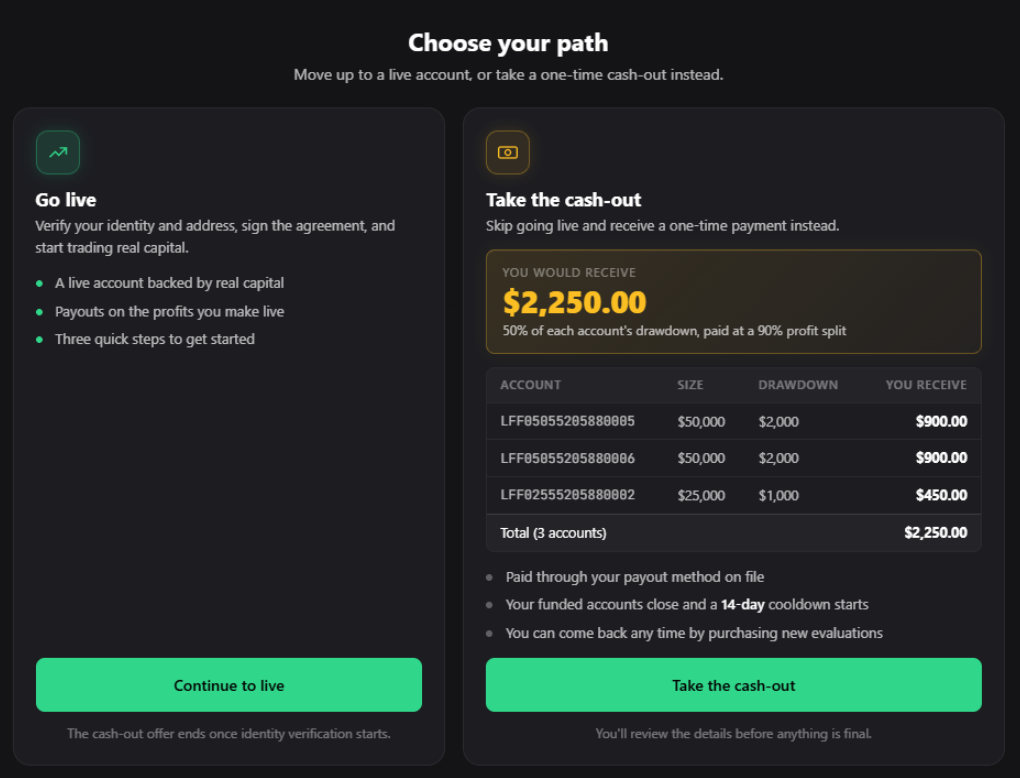
You then give up the live account rather than risking that capital in the market.
The decision is optional. Traders who still want to trade real capital can continue with the normal live transition.
Lucid also says choosing the cash-out rather than going live will not negatively affect whether a trader can later return to simulated funding or become eligible for LucidMaxx.
Why Has Lucid Brought It Back?
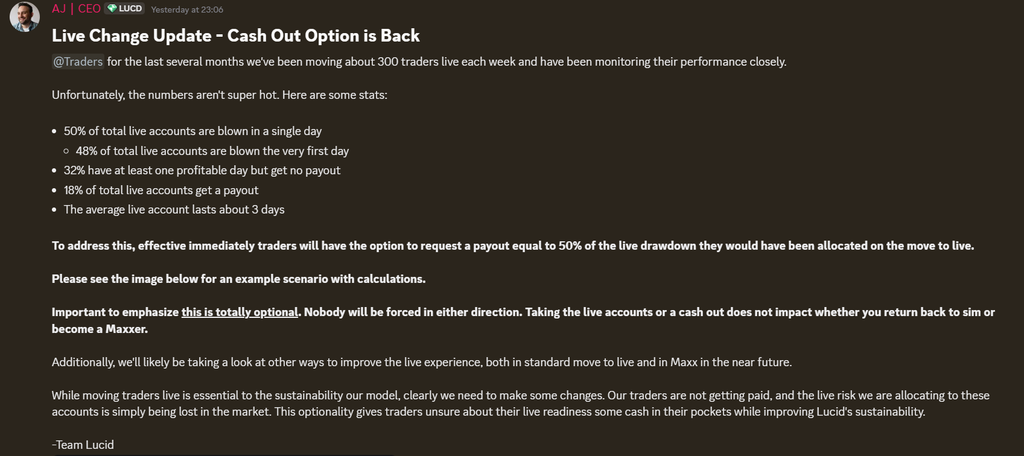
The live-account data makes the reasoning fairly obvious.
Lucid revealed the following statistics:
| Live Account Outcome | Percentage |
|---|---|
| Blown within a single trading day | 50% |
| Blown on the very first day | 48% |
| At least one profitable day, but no payout | 32% |
| Receive at least one payout | 18% |
| Average account lifespan | Around 3 days |
The most striking number is that almost half of all live accounts are lost on day one.
Lucid says around 300 traders are currently being moved live each week, so this is based on a considerable sample size.
For traders, the Live Cash Out creates an alternative to taking real capital when the historical odds of surviving long enough to receive another payout are relatively low.
Only 18% Of Live Accounts Get A Payout
The statistics also show a major difference between making money and actually withdrawing it.
Around 32% of live accounts have at least one profitable trading day but still never receive a payout.
Combined with the 18% that do reach a payout, that suggests half of live traders are capable of producing at least some profitable trading before the account closes.
But only around one in five actually turns that into a withdrawal.
This is an important distinction because moving live is often advertised as the ultimate goal of prop trading. In reality, the transition can make trading considerably harder psychologically.
The account is now using real capital, losses have a genuine financial impact on the firm, and traders may change their behaviour as a result.
Almost Half Blow The Account On Day One
The 48% first-day failure rate is probably the most surprising statistic.
Lucid’s standard live accounts start with a relatively small drawdown rather than the full headline balance of the simulated account.
For example, current LucidDaily live accounts start with:
| Funded Account | Starting Live Drawdown |
|---|---|
| $25K | $1,000 |
| $50K | $2,000 |
| $100K | $3,000 |
| $150K | $4,500 |
They also use end-of-day drawdown and have no daily loss limit.
That gives traders flexibility, but it also means aggressive position sizing can destroy a live account very quickly.
Lucid has previously said traders who repeatedly blow live accounts through reckless or “yolo” trading may face longer cooldown periods before purchasing another evaluation.
Is Taking The Cash Better Than Going Live?
For some traders, I think it clearly will be.
Moving live gives you the opportunity to continue generating payouts from real trading capital, so a consistently profitable trader could ultimately make much more than the Live Cash Out. But that comes with risk.
If your live drawdown were $3,000, for example, the Live Cash Out would be based on 50% of that amount, or $1,500 before applying the relevant profit split.
The alternative is taking the $3,000 of live risk capital and attempting to grow the account. Given Lucid’s own statistics, a large percentage of traders will end up with nothing from that choice.
So the decision effectively becomes:
Take a smaller guaranteed payment now, or risk it for potentially much larger future payouts.
For traders who know they tend to become more aggressive after moving live, the guaranteed cash could be the better option.
The Live Data Is More Interesting Than The Cash Out
The return of Live Cash Out is useful, but I think the statistics Lucid released are the bigger story.
Prop firms rarely publish detailed information about what happens after traders move onto real capital. Pass rates and simulated payout statistics are becoming more common, but data on actual live-account survival is still difficult to find.
Lucid’s figures show just how large the gap can be between succeeding in a simulated prop environment and successfully trading real capital. An average lifespan of only three days is particularly notable.
It suggests that simply identifying profitable simulated traders isn’t enough. Position sizing, psychology and adapting to a live environment appear to become just as important once real money is involved.
Conclusion
Overall, bringing back Live Cash Out looks like a sensible change from Lucid Trading.
The option allows traders selected for live funding to take 50% of their allocated live drawdown as a cash-out, subject to the applicable profit split, rather than moving onto the live account.
And based on Lucid’s own statistics, there is a strong argument for considering it.
48% of live accounts fail on the first day, 50% are lost within a single trading day, only 18% reach a payout, and the average account lasts around three days.
Going live still offers much greater upside for traders who can survive and remain profitable.
But for traders less confident about sustaining a live account, taking guaranteed money instead could be the better risk-adjusted choice.
More importantly, Lucid publishing these numbers gives traders a rare look at what actually happens after simulated funding, and shows just how difficult the transition to live trading can be.