



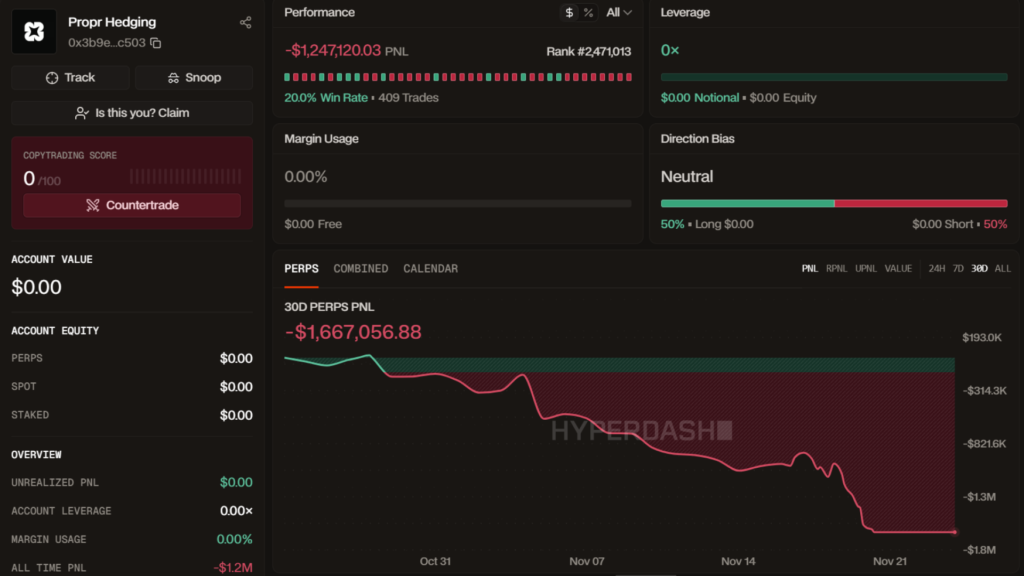
Perps prop firm Propr has suspended its public hedging programme and reverted to a completely internalised model until early 2027, following a steep drawdown on its public hedging wallet.
According to on-chain data from Hyperdash, Propr’s hedging wallet is down -$1,667,056.88 over the last 30 days, wiping out earlier gains and pushing all-time performance to -$1,247,120.03. Alongside the pause, Propr has removed hedging wallet performance from its public transparency dashboard.
Founder Louis published a detailed announcement explaining how the firm’s risk engine worked, why the wallet took a heavy hit, and what mistakes the team made. While the explanation is unusually candid for the prop trading industry, putting the wallet’s losses next to Propr’s own dashboard figures shows just how much pressure the drawdown put on the business.
Propr’s Transparency Numbers Put the Loss in Context
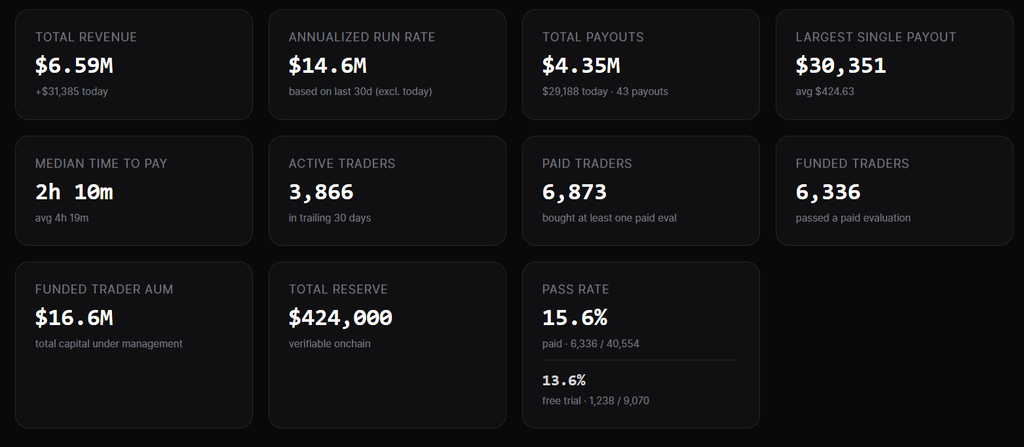
Propr’s public transparency dashboard still tracks revenue, payouts, reserves, and pass rates in real time:
| Metric | Reported Figure |
| Total Revenue | $6.59M (+$31,385 today) |
| Annualised Run Rate | $14.6M (based on trailing 30 days) |
| Total Payouts | $4.35M ($29,188 today across 43 payouts) |
| Largest / Average Payout | $30,351 largest / $424.63 average |
| Median Time to Pay | 2h 10m (4h 19m average) |
| Funded Trader AUM | $16.6M |
| Total Reserve (On-Chain) | $424,000 |
| Paid Evaluation Pass Rate | 15.6% (6,336 passed / 40,554 paid evals) |
| Active / Paid Traders | 3,866 active (30d) / 6,873 paid traders |
Those figures make the scale of the hedging drawdown immediately clear:
- The 30-day hedge loss exceeded a full month of revenue: At an annualised run rate of $14.6M, Propr is bringing in roughly $1.22M per month in revenue. Losing $1.67M in 30 days on the hedging wallet is larger than an entire month’s top-line income.
- Over half of lifetime gross margin erased: Across its history, Propr has generated $6.59M in revenue against $4.35M in payouts—a gross spread of $2.24M before operating costs, staff, tech, and affiliate commissions. An all-time hedging loss of $1.25M eats up more than 55% of that entire spread, leaving under $1M across the firm’s lifetime to cover all other expenses.
- Thin on-chain reserves: Propr currently reports $424,000 in verifiable on-chain reserves against $16.6M in funded trader AUM and $4.35M in cumulative payouts. After a $1.67M monthly hit, pausing live hedging to protect capital looks less like a choice and more like a necessity.
How Propr’s Hedging Model Worked
In his announcement, Louis laid out the risk framework behind Propr’s public hedging wallet in technical detail. It came down to three core mechanics:
1. Why Prop Firms Are Short Volatility
A trader’s downside is capped at the evaluation fee, while their upside is a share of funded profits. Louis compared every funded account to a short call option (or barrier option, given the profit target and max drawdown limits): when volatility doubles, accounts resolve roughly four times faster and expected payouts rise sharply even if traders have no statistical edge.
2. Why Upside Moves Hurt Crypto Prop Firms Most
Around 70% of Propr’s evaluation and funded book was skewed long during the recent drawdown. Because crypto traders overwhelmingly bet on prices going up, sharp upside moves (such as late August 2026) produce the firm’s biggest payout spikes. By contrast, Propr’s payout liabilities during sharp sell-offs were only about a third of what it owed during equivalent upside moves.
3. The $300K VaR Trigger and Two-Part Hedge
Rather than hedging trade by trade, Propr hedged at the firm level. Below $300,000 of Value at Risk (VaR), the firm kept exposure on its own book. Above $300,000, its system opened positions to bring VaR back under the threshold using two methods:
- Replicating top traders: Propr ranked its best traders by Sharpe ratio over time, converted their directional exposure into a beta-adjusted large-cap equivalent, and held linear exposure rather than chasing every entry and exit.
- Long-skewed delta hedging: Alongside top-trader replication, the wallet held a directional long bias on liquid large caps to offset the surging payout liabilities that occur during strong crypto rallies.
What Went Wrong (and Four Mistakes Propr Admitted)
Louis attributed the $1.67M 30-day drawdown to two overlapping problems:
- Top traders hit a losing streak together: Because the hedging wallet replicated the directional exposure of Propr’s highest-Sharpe traders, when that cohort lost money over the same window, the hedge lost alongside them.
- The long-tail altcoin trap: Propr previously allowed large notional positions on volatile, long-tail altcoins such as XPL and WLD. Those tokens move independently and do not track large-cap beta, meaning a large-cap hedge cannot actually protect against them. Large notionals on those alts pushed firm VaR above $300,000, and traders martingaling losing positions forced the system to keep holding mismatched hedges.
Looking back, Louis admitted four specific setup errors:
- Slow trader reassessment: Trader skill was evaluated over a 6-week window and reassessed only every 2 weeks, which was too slow when top performers went cold.
- Oversized altcoin notionals: Allowing heavy sizing on long-tail alts created unhedgeable basis risk.
- Loose VaR threshold: The firm’s Value at Risk limit was set too high and needed to be stricter.
- Excessive daily loss budget: The hedging engine was allowed to absorb too much daily loss before cutting risk.
“What the PnL Doesn’t Show” vs. The Reality Check
Louis’s main defence of the red numbers is that hedge PnL cannot be viewed in isolation. A prop firm’s net position is hedge PnL minus the change in payout liabilities, and only the hedge sits on-chain. When top traders lose, Propr owes them less in payouts—so in theory, a hedge losing money while liabilities shrink is doing what it is supposed to do.
That logic is sound on paper, and Louis deserves credit for explaining the mechanics openly rather than pretending nothing happened. Still, two things stand out:
- This wasn’t just “a hedge doing its job”: While losing on a top-trader hedge during a bad month is expected, Louis’s own admission about XPL and WLD martingaling confirms that a significant share of the damage came from broken basis hedging—taking real market losses on large caps to “cover” unrelated altcoins.
- Pulling the wallet weakens the transparency pitch: Louis opened his post by saying “transparency wins, and that has to be true when things don’t go our way too.” Removing the hedging wallet’s performance from the transparency dashboard right after a -$1.67M month undercuts that message, even with a detailed announcement post alongside it.
There is also a wider lesson here for the prop trading industry. Firms such as Vest Markets have recently leaned heavily on claims that they A-book funded traders and “win when traders win” without showing verifiable proof. Propr actually put its hedging wallet on-chain—and the result is a reminder of just how difficult, messy, and expensive live prop firm hedging is in practice.
What Happens Next for Propr Traders
In the short term, Propr has paused the hedging system entirely and is running a 100% internalised book while it rebuilds its risk parameters. The firm has already reduced maximum notionals on long-tail altcoins and says it plans to relaunch public hedging in early 2027.
For traders currently on the platform, payout speeds remain fast according to the dashboard, with a 2-hour 10-minute median payout time and 43 payouts processed on the day of writing. Even so, with on-chain reserves sitting at $424,000 against $16.6M in funded AUM after a seven-figure monthly loss, Propr’s handling of the transition back to an internalised book—and whether those reserves rebuild—will be worth watching closely over the coming months.