




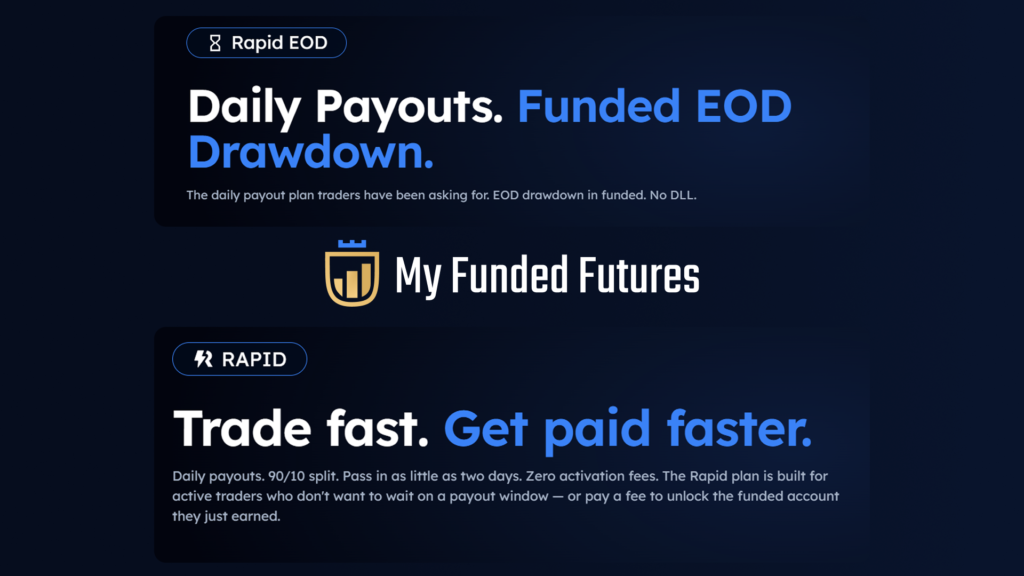
The My Funded Futures Rapid and Rapid EOD plans look very similar at first. Both $50K accounts currently cost $209, have a $3,000 profit target, $2,000 maximum drawdown, no daily loss limit and offer a 90% profit split.
However, there is one major difference.
Rapid is easier to pass. Rapid EOD is easier once funded.
Rapid has a more forgiving 50% consistency rule and can be passed in two trading days, but switches to restrictive intraday trailing drawdown after funding.
Rapid EOD requires four trading days and has a much stricter 30% consistency rule during the evaluation. In return, you keep the much more forgiving end-of-day trailing drawdown once funded.
In this article, I’ll compare My Funded Futures Rapid vs Rapid EOD, explain how the drawdown rules work and look at which plan is better for different traders.
 Buy My Funded Futures Challenges

Rapid vs Rapid EOD At A Glance
Using the $50K accounts for comparison:
| Rapid | Rapid EOD | |
|---|---|---|
| Standard Price | $209 | $209 |
| Profit Target | $3,000 | $3,000 |
| Evaluation Drawdown | $2,000 EOD | $2,000 EOD |
| Daily Loss Limit | None | None |
| Evaluation Consistency | 50% | 30% |
| Minimum Trading Days | 2 | 4 |
| Evaluation Contracts | 5 Minis / 50 Micros | 3 Minis / 30 Micros |
| Funded Drawdown | Intraday Trailing | EOD Trailing |
| Funded Contracts | 5 Minis / 50 Micros | 3 Minis / 30 Micros |
| Funded Consistency | None | None |
| Required Buffer | $2,100 | $2,100 |
| Minimum Payout | $500 | $500 |
| Payout Frequency | Daily | Daily |
| Profit Split | 90% | 90% |
| Activation Fee | $0 | $0 |
The evaluation target and maximum drawdown are the same, while the payout structures are also very similar.
The main trade-off is Rapid’s easier evaluation versus Rapid EOD’s better funded drawdown.
Evaluation Rules Compared
Rapid Evaluation
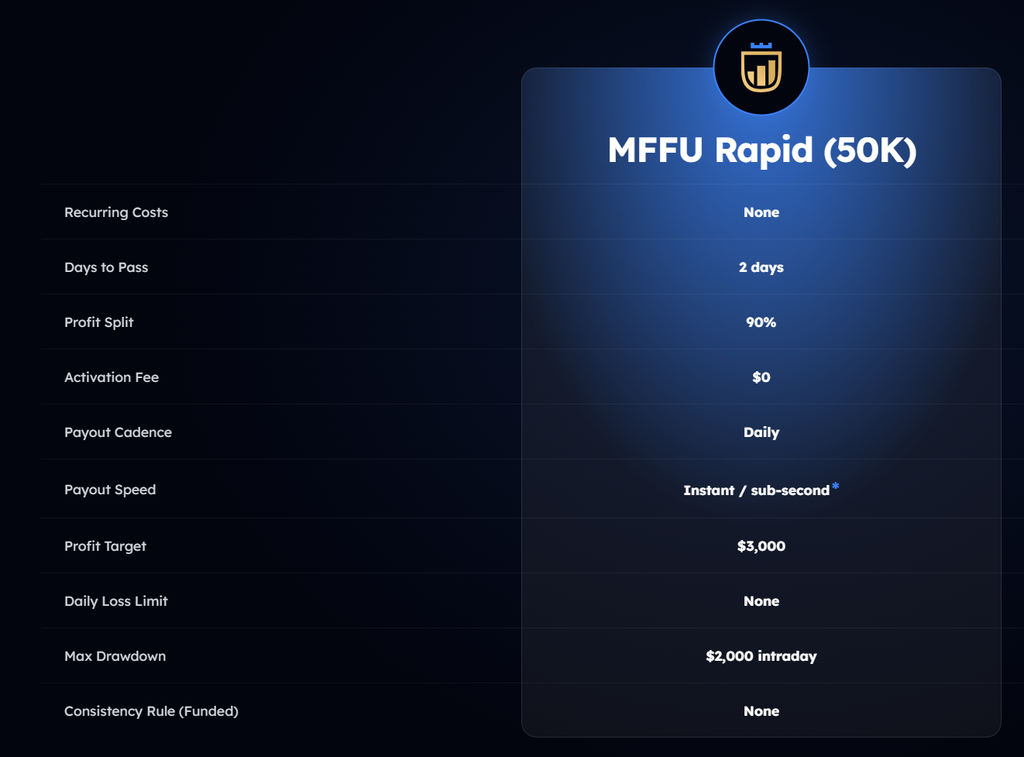
The $50K Rapid evaluation has a $3,000 profit target and $2,000 end-of-day trailing drawdown. There is no daily loss limit, and you can trade up to five minis or 50 micros.
Rapid uses a 50% consistency rule, meaning your largest profitable day cannot account for more than 50% of your total profit when you pass.
For a $3,000 target, you could theoretically make $1,500 on each of two days and complete the evaluation in the minimum two trading days.
If you make more than $1,500 on your best day, you do not fail. You simply need to keep trading until that day represents 50% or less of your total profit.
This makes Rapid relatively quick and simple to pass.
Rapid EOD Evaluation
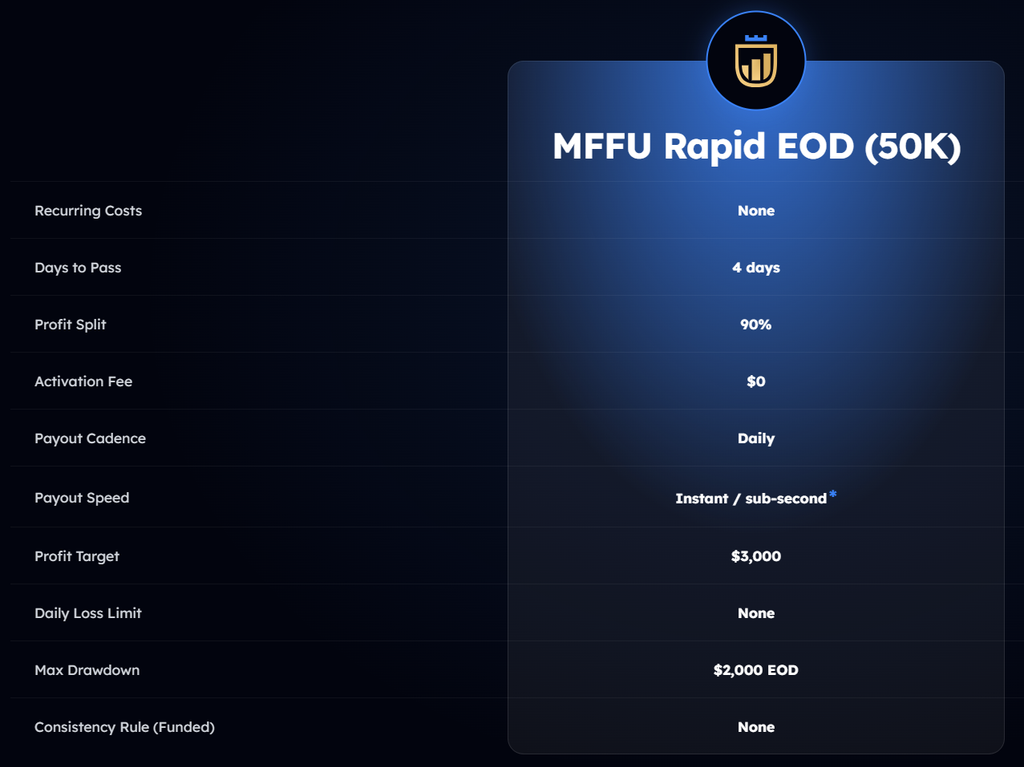
Rapid EOD has the same $3,000 target and $2,000 EOD trailing drawdown on the $50K account.
However, the consistency rule falls to 30%, while the minimum trading requirement increases to four days.
That makes a significant difference.
To pass at exactly $3,000 profit, your largest winning day could only be $900.
If you instead make $1,500 on your best day, you would need to reach $5,000 in total profit before that day represents 30%.
A large winning session can therefore effectively increase the amount you need to make before passing.
Rapid EOD rewards a much steadier trading style and makes rushing through the evaluation considerably harder.
Both Use EOD Drawdown During The Evaluation
One important point is that Rapid does not use intraday trailing drawdown during the evaluation.
Both plans use end-of-day trailing drawdown at this stage.
On a $50K account, you start with $2,000 of drawdown. The loss threshold only moves higher after the account finishes a trading day at a new high.
Temporary unrealised profits during the session therefore do not immediately move your maximum loss level.
The major drawdown difference only appears after you pass.
Funded Drawdown: The Biggest Difference
Rapid Uses Intraday Trailing Drawdown
Once funded, standard Rapid switches to intraday trailing drawdown.
Rather than waiting until the end of the session, your maximum loss threshold follows your highest account equity in real time.
Crucially, this includes unrealised profits.
Imagine a trade reaches $1,500 in unrealised profit before pulling back and eventually closing for $400.
With EOD drawdown, that temporary $1,500 gain would not matter. With Rapid’s intraday trail, the maximum loss threshold can move higher based on the equity peak.
You can therefore make money on a trade while still significantly reducing your remaining drawdown room.
This particularly affects traders who let winners run, use runners, scale out gradually or trade volatile markets such as NQ.
Intraday trailing drawdown effectively rewards locking in profits quickly rather than allowing positions more room to develop.
The good news is that the drawdown does not trail forever. On the $50K Rapid account, once the maximum loss floor reaches +$100, it locks permanently.
The challenge is surviving long enough to get there.
Rapid EOD Keeps EOD Trailing Drawdown
Rapid EOD keeps end-of-day trailing drawdown after funding.
The maximum loss threshold only moves after the trading session closes at a new high, so temporary intraday equity swings do not affect it.
If a position reaches $1,500 in unrealised profit and then returns to breakeven, your drawdown remains where it was.
That gives traders considerably more freedom to manage positions naturally.
The drawdown also eventually locks at +$100, after which it becomes effectively static.
For me, this is the biggest advantage of Rapid EOD.
Why The Drawdown Difference Matters
Prop traders often focus heavily on how easy an evaluation is to pass.
But passing the challenge itself does not produce a payout.
The real objective is reaching the funded stage, building the required buffer and withdrawing profits. That is why I think the funded drawdown structure deserves more weight than the evaluation rules when comparing these plans.
Rapid gets you funded faster. Rapid EOD gives you a better environment once you get there.
Other Rapid vs Rapid EOD Differences
Payout Rules
Both plans have very similar payout structures.
On the $50K account, you first need to build $2,100 in realised profit before requesting your first payout.
After that, payouts are available daily with a $500 minimum request and 90% profit split. There is no funded consistency rule on either plan.
Rapid EOD also requires $500 in net new profit after a payout before the next withdrawal unlocks.
Overall, the payout structure is not the main reason to choose between the plans.
The more important question is how easily you can build and protect the required buffer, which is where Rapid EOD has the advantage.
Contract Limits
Rapid offers higher contract limits.
The $50K Rapid account allows up to five minis or 50 micros, compared with three minis or 30 micros on Rapid EOD.
That gives aggressive traders more flexibility during both the evaluation and funded stage.
For traders who normally use smaller position sizes, the difference may not matter much. But if you regularly trade more than three contracts, Rapid EOD could feel restrictive.
Account Sizes
Rapid also offers a wider range of account sizes.
Standard Rapid is currently available as:
- $25K
- $50K
- $100K
- $150K
Rapid EOD is currently limited to:
- $25K
- $50K
Traders wanting a $100K or $150K account will therefore need to choose standard Rapid or another My Funded Futures plan.
For a direct comparison, I think the $50K account is the most useful because both models use the same $3,000 target and $2,000 drawdown.
Pricing
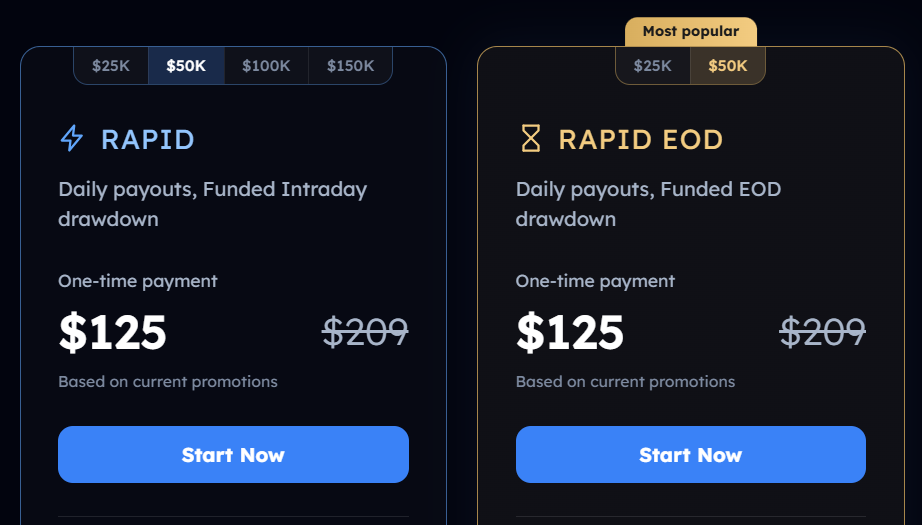
The $50K Rapid and Rapid EOD both have the same $209 standard price.
Neither has a monthly subscription or activation fee.
My Funded Futures frequently runs promotions, so the checkout price can temporarily differ. However, I would not choose between the plans based on a short-term discount.
At the same standard price, the decision comes down almost entirely to which stage you want to be easier.
Which Plan Is Easier?
Rapid Is Easier To Pass
If your priority is reaching the funded stage as quickly as possible, Rapid is clearly easier.
The 50% consistency rule allows you to complete the $3,000 target across two equal $1,500 winning days.
Rapid EOD’s 30% rule forces profits to be distributed much more evenly, while its four-day minimum prevents an especially quick pass.
Rapid also offers higher contract limits, giving more flexibility to aggressive traders.
From an evaluation perspective, Rapid wins comfortably.
Rapid EOD Is Easier Once Funded
Once funded, my preference reverses.
Intraday trailing drawdown is one of the more restrictive rules a futures prop trader can deal with because unrealised profits can reduce your usable risk allowance.
EOD trailing is much more forgiving because only end-of-day performance moves the loss threshold.
That allows you to manage positions more naturally without constantly worrying about temporary equity highs moving your drawdown.
For traders focused on actually reaching payouts, I think this advantage matters more than passing the evaluation a couple of days faster.
Which Should You Choose?
Choose Rapid If…
Rapid makes the most sense if you want to get funded quickly and your trading style is less affected by intraday trailing drawdown.
It particularly suits short-term scalpers who take profits quickly and rarely allow large unrealised gains to retrace.
The higher contract limits are also useful for more aggressive traders.
If you are confident you can quickly build the $2,100 buffer and lock the drawdown at +$100, Rapid gives you the easier route through the evaluation.
Choose Rapid EOD If…
Rapid EOD makes more sense if you value flexibility after passing.
If you let winners run, scale out of positions or regularly experience large intraday swings, EOD drawdown can make a major difference.
You have to accept the much harder 30% consistency rule during the evaluation, but that restriction disappears once funded.
The difficult part of Rapid EOD is temporary.
Once you pass, you get the more forgiving drawdown structure on the account where you can actually request payouts.
Rapid vs Rapid EOD Verdict
At the same $209 standard price, I prefer Rapid EOD for most traders.
Rapid definitely has the better evaluation. It can be passed in two days, has a much easier 50% consistency rule and offers higher contract limits.
But Rapid EOD has the rule I care about more: EOD drawdown after funding.
The whole point of buying an evaluation is to eventually receive payouts. A slightly harder challenge can therefore be worth accepting if the funded account gives you a better environment for surviving and building profits.
Rapid is still the better choice for traders whose priority is speed or who are comfortable managing intraday trailing drawdown.
Conclusion
The difference between My Funded Futures Rapid vs Rapid EOD comes down to where you want the easier rules.
Rapid uses a 50% consistency rule, can be passed in two days and gives you higher contract limits. If your priority is getting funded as quickly as possible, it is the better evaluation.
Rapid EOD requires four days and has a much more restrictive 30% consistency rule, so passing takes more patience. But once funded, it keeps the end-of-day trailing drawdown, giving you substantially more room to manage trades naturally and build towards payouts.
With both $50K plans costing the same $209 at standard pricing, I think Rapid EOD offers the stronger overall package for most traders.
Rapid wins on speed. Rapid EOD wins where it matters more: after you pass.