




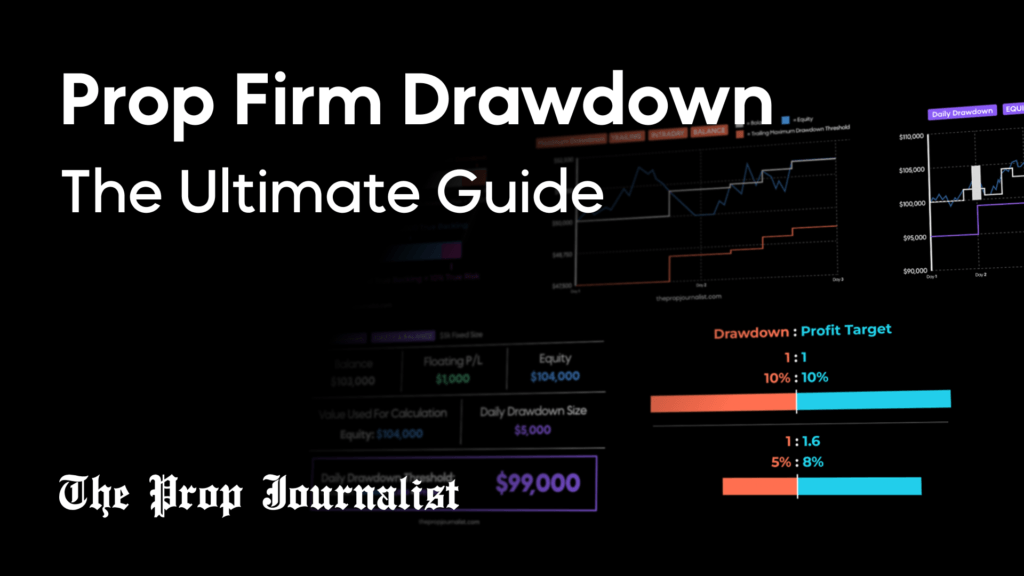
Drawdown rules are the number one reason prop firm traders fail challenges and lose funded accounts.
And yet most traders don’t fully know how their drawdown works until after they’ve breached it.
If you don’t understand drawdown you’re not only risking your prop firm accounts, you might also be buying the wrong challenges in the first place.
So in this prop firm drawdown guide I’ll explain every type you need to know, with interactive diagrams and examples to help you choose the best prop firm drawdown rules for your trading.
Types of Prop Firm Drawdown
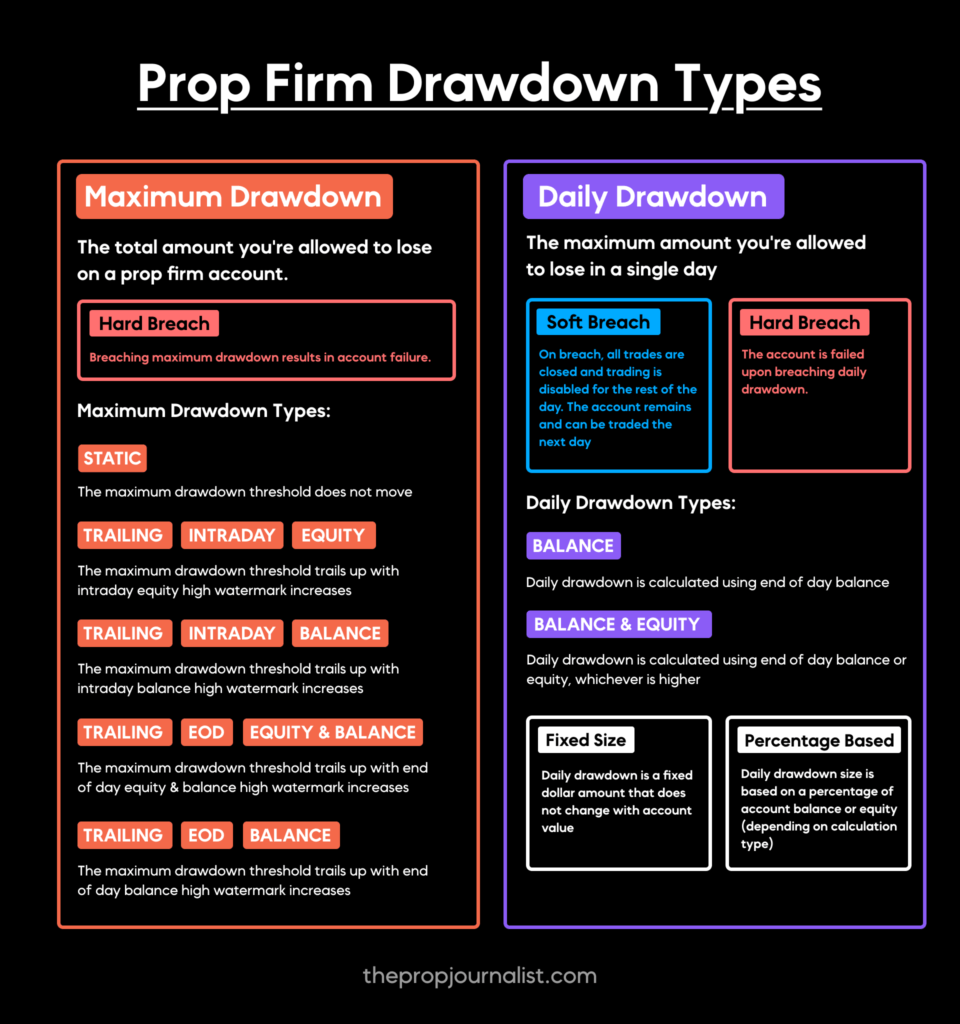
Prop firms use two types of drawdown to limit losses: maximum drawdown and daily drawdown.
Maximum drawdown is the lowest value your account can reach. If your equity hits the maximum drawdown threshold at any point, the account is failed.
Daily drawdown is the largest loss your trading account can sustain within a single trading day. It resets at a specific time each day, meaning you have a new limit every 24 hours. Exceeding this limit is known as a daily drawdown breach, which depending on the account rules, may either prevent trading for the remainder of the day or result in full account failure.
Both of these have different calculation methods and types, which we’ll cover in detail. But first, you need to understand how balance and equity work, because drawdown rules depend on them.
Balance, Equity and Floating P/L
Your account balance is the money in your account that isn’t tied up in open trades. It only changes when you close a position, deposit funds, or withdraw.
Equity is the real-time value of your account. It’s your balance plus or minus any unrealised (floating) profits or losses from open positions. When you have no trades open, equity and balance are the same. When you do have trades open, they’ll differ depending on whether those trades are in profit or loss.
Balance vs equity with open trades
Drag the slider to simulate floating profit or loss on an open trade.
If your open trades have a combined floating profit, equity will be higher than balance. If they have a combined floating loss, equity will be lower.
This matters because drawdown is measured against equity. Your balance might look fine, but if your open trades are in loss, your equity could be below the drawdown threshold and you'd be breached.
Maximum Drawdown
Maximum drawdown is the total amount of money you can lose on your account before it's breached. If account equity reaches the maximum drawdown threshold, the account is failed.
How It's Calculated
Maximum drawdown size is taken away from the initial account balance to find the starting maximum drawdown threshold. For example, $100k account with 10% maximum drawdown means you can lose $10k. So the drawdown threshold starts at $90k ($100k - $10k = $90k).
Whether the maximum drawdown threshold moves depends on the drawdown type.
Static Maximum Drawdown
If maximum drawdown is static, the threshold doesn't move. In the $100k example, the threshold stays at $90k no matter how much profit you make. You can grow the account to as much as you want and the drawdown threshold will still stay at $90k.
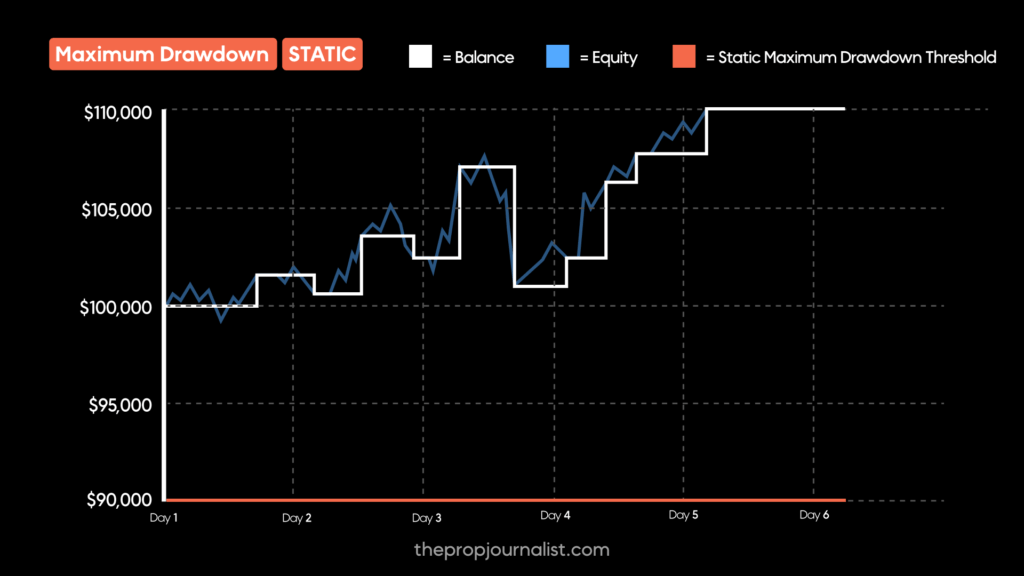
This is the most trader-friendly option. You're not penalised for making money, and your effective room to trade grows as your account balance increases. A $100k account with 10% static maximum drawdown that's grown to $120k now has $30k of room before the $90k breach level, instead of the original $10k.
Trailing Maximum Drawdown
If maximum drawdown is trailing, the threshold moves up as your account grows. How it moves depends on the trailing type. There are four main types, ranked from worst to best:
- Trailing Intraday (Equity Based)
- Trailing Intraday (Balance Based)
- Trailing End Of Day (Equity & Balance Based)
- Trailing End Of Day (Balance Based)
While balance-based EOD trailing is the best type of trailing drawdown, it's still significantly worse than static. Let's look at how high watermarks and each trailing drawdown type works.
How High Watermarks Work
Every trailing drawdown is built on a high watermark. This is the highest value used for the trailing calculation, and the threshold sits a fixed distance below it.
What counts as the watermark depends on the type of trailing drawdown. Some types only update the watermark on closed balance, others use floating equity, others only check at the end of each day. We'll cover the differences in the four sections below. The mechanic is the same in all cases: the highest value the firm has used so far for the calculation gets locked in, and the threshold trails behind it.
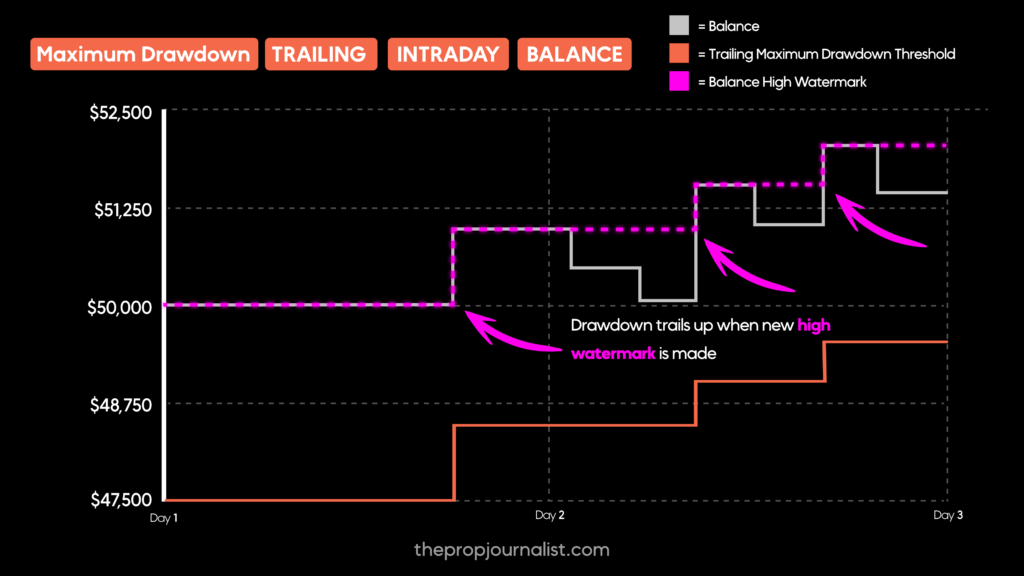
Take a $50k account with $2,500 balance-based trailing drawdown. The starting watermark is $50k, so the threshold is at $47,500. You close a trade for +$1,000, balance goes to $51k. The watermark moves to $51k and the threshold moves to $48,500. You then lose $500 on the next trade and balance drops to $50,500. The watermark stays at $51k and the threshold stays at $48,500. You now have $2,000 of room instead of the original $2,500. Once balance goes above the $51k watermark, this will bring the watermark up, so drawdown will trail up again.
This is the punishing part. Every qualifying high raises the threshold permanently. Every loss after that eats into your remaining room.
As a result, trailing drawdown only trails up, it does not move back down (except for some cases with reset upon withdrawal). It usually trails until it reaches the original account balance (sometimes +$100), where it locks in place.
Trailing Intraday (Equity Based)
This is the worst type of trailing drawdown by far, and it's common on instant funding and futures accounts.
The drawdown threshold trails up in real time whenever your equity makes a new high. The moment equity ticks higher, even for a second, the threshold moves up permanently. This means unrealised profits that you haven't locked in will still push your drawdown limit up.
Say you have a $50k account with $2,500 trailing drawdown. The initial threshold is at $47,500. You open a trade that reached $2k floating profit, meaning equity hits $52,000 during the day. The threshold has now moved to $49,500 ($52,000 - $2,500 = $49,500). If the trade reverses and you close it at breakeven, your balance is still $50,000 but your drawdown threshold is now only $500 below your balance instead of $2,500.
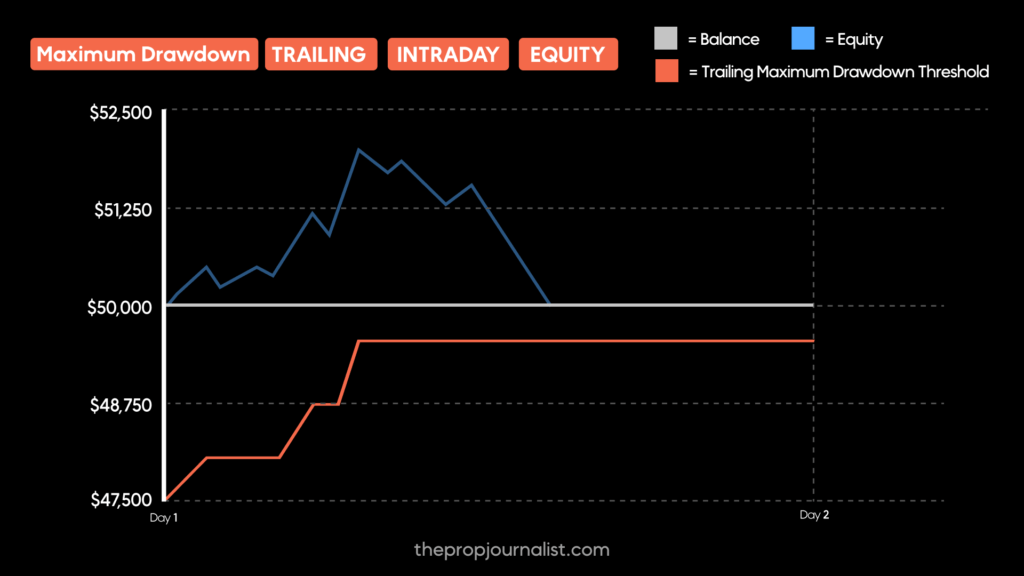
You gave up $2,000 of drawdown room from a trade that made you nothing. This is why equity-based intraday trailing is so punishing. Every unrealised high watermark permanently reduces your safety net.
This also makes it difficult to let winning trades run. The longer you hold a winning position, the more likely equity is to spike higher and pull back before you close it. Traders on equity-based intraday accounts often feel pressured to take profits quickly, which can hurt their overall strategy.
Fortunately, most equity-based intraday trailing accounts will lock the threshold once it reaches the initial account balance. On the $50k example, once the threshold trails up to $50,000, it stops moving. At that point it behaves like static maximum drawdown. But getting to that lock in point without blowing the account is the challenge, because every unrealised spike along the way restricts your room.
Trailing Intraday (Balance Based)
This drawdown trails up in real time, but only when your balance high watermark increases. So it only moves when you close a trade in profit, not while the trade is open. That difference makes it significantly better than equity-based intraday trailing.
Using the same $50k account with $2,500 trailing drawdown: if equity hits $52,000 during the day but you close the trade at $51,000 balance, the threshold moves to $48,500. The floating P/L didn't affect it, only the closed balance. If you'd been on equity-based intraday, the threshold would have jumped to $49,500 from that $52,000 equity spike, costing you an extra $1,000 of room.
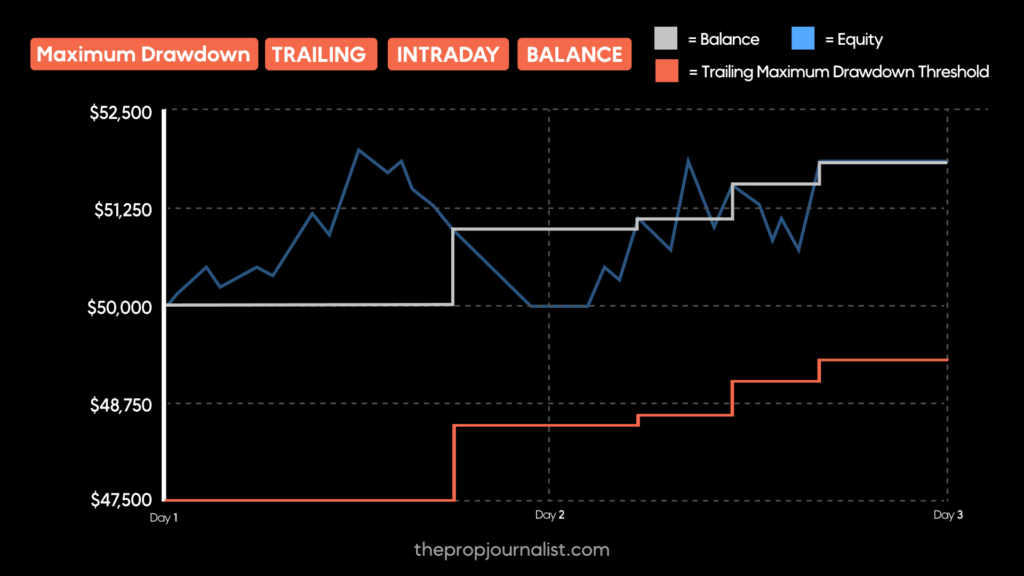
The key advantage is that you can let trades run without the threshold chasing every tick of unrealised profit.
That said, it still trails up with every profitable close that creates a new balance high, and it does so immediately. If you close three winning trades throughout the day, the threshold moves up three times. In comparison, with End Of Day trailing (which we will discuss next), closing profitable trades will increase drawdown room during the day.
Like equity-based intraday, most firms will lock the balance-based intraday threshold once it reaches the initial account balance. The difference is that getting to the lock point is much more manageable because you control when balance changes by choosing when to close trades.
Trailing End Of Day (Equity & Balance Based)
End of day (EOD) trailing works differently to intraday. Instead of recalculating in real time, the drawdown threshold only updates once a day at a fixed time, usually the end of the trading day (often midnight server time). Everything that happens intraday is ignored for the purpose of moving the threshold. You could have equity or balance spike to $52,500 and crash back down to $50,000 during the day and none of that would matter. The threshold is only updated using the account value at the end of the trading day.
With equity and balance EOD trailing, at the day rollover the firm looks at your equity and balance and uses whichever is higher to trail drawdown. If your balance is $50,000 but you're holding a trade with $1,250 in floating profit, equity is $51,250, so the firm uses $51,250 for the calculation. The new threshold would be $51,250 - $2,500 = $48,750.
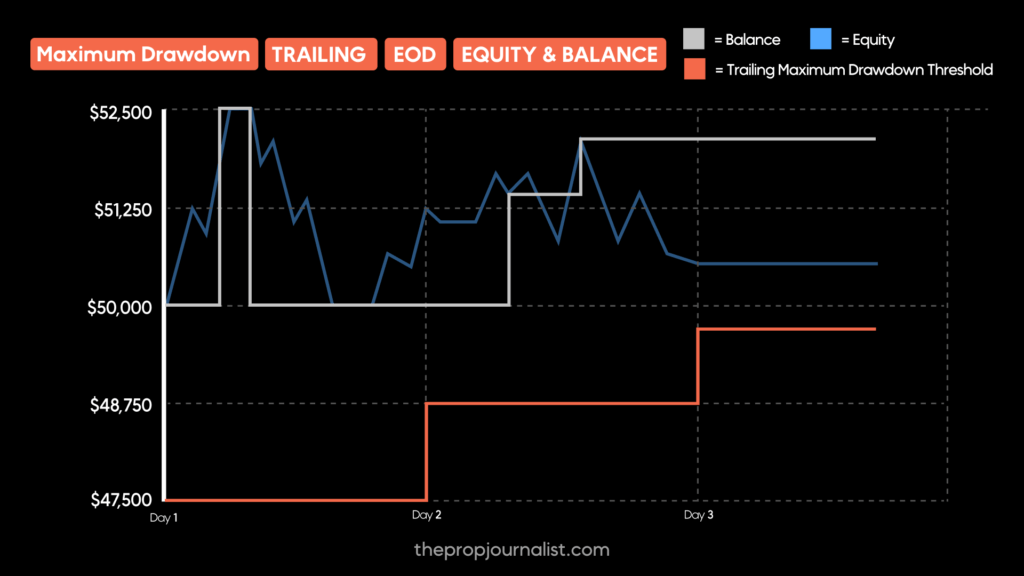
This creates a specific problem with holding winning trades over the daily reset. Like in the example, the firm uses the inflated equity figure to raise your threshold. If the trade then reverses the next day, your threshold has already moved up. You lost drawdown room from a trade that ended up being a loser.
The key takeaway is that if you're on an equity and balance EOD trailing account, holding open trades rather than closing them before the end of day won’t prevent the drawdown limit from moving up.
Despite this, EOD equity and balance trailing is still significantly better than either intraday type. The fact that intraday fluctuations don't count gives you much more breathing room during the trading session itself.
If there are no open trades, or they are in a net floating loss at the day rollover, equity is equal to or lower than balance, therefore balance is used for the trailing calculation. This means in this scenario EOD Equity and Balance trailing works the same as EOD Balance based.
Trailing End Of Day (Balance Based)
This is the best type of trailing drawdown. At the end of each trading day, the threshold recalculates based on balance only. Floating profits and losses from open trades are completely ignored.
Using the same scenario: your balance is $50,000 and you're holding a trade with $1,250 in floating profit at the daily reset. Equity is $51,250, but this will not impact the calculation. It uses the $50,000 balance. The therefore the threshold remains at $47,500.
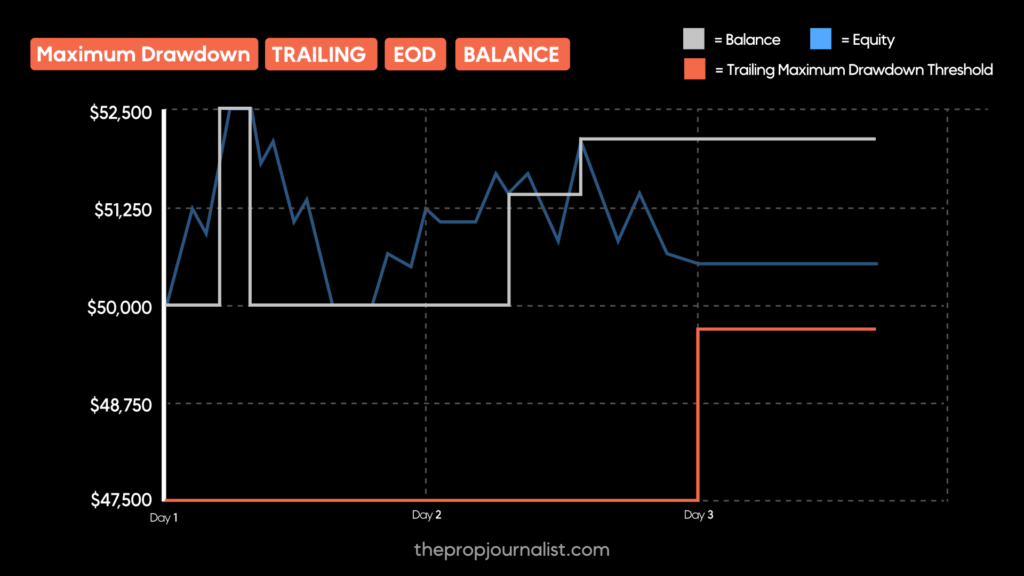
Compare this to equity and balance EOD, which would have used the $51,250 equity and set the threshold at $48,750. That's $1,250 less room.
The big advantage here is that you have full control over when the threshold moves. It only moves when you close profitable trades before the daily reset. If you're holding a winning trade overnight, your drawdown threshold stays the same as if the trade wasn't open. You could be sitting on $5,000 in unrealised profit at the reset and the threshold won’t move.
This also means you can be strategic about it. If you have a profitable trade and the daily reset is approaching, you can choose to hold through the reset and the threshold won't move. On an equity and balance EOD account, this option is not available. On a balance-only EOD account, the only thing that matters is whether you've hit the close button before the reset time.
That said, balance EOD trailing is still trailing. Every time your balance reaches a new high at the end of the day, the threshold moves up. Static maximum drawdown is still preferable, but balance based EOD trailing gives you the most control of any trailing type
Trailing Drawdown Lock
Most trailing drawdown types will eventually lock, meaning they stop trailing once the threshold reaches a certain level. Usually this is the original account balance, sometimes original balance + $100 (common with futures firms).
Take a $50k account with $2,500 trailing drawdown. The initial threshold is $47,500. As you make profit and the threshold trails up. Once it reaches $50,000 (or $50,100), it locks in place and stops moving. At that point it behaves like static drawdown.
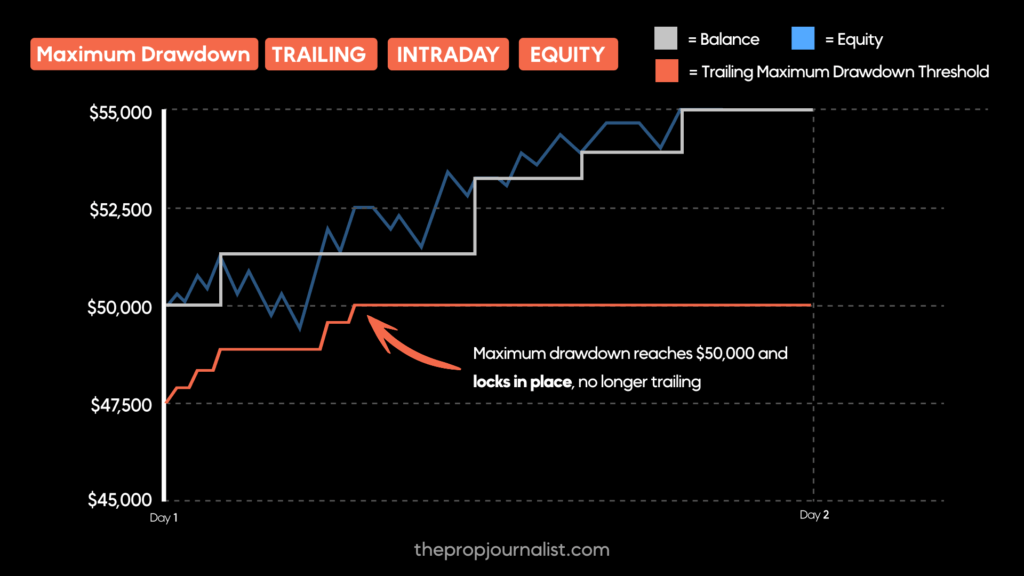
Once the drawdown locks at the original account balance, there's an important question: what happens when you withdraw profits?
If you've made $5,000 in profit on that $50k account, your balance is $55,000 and the drawdown threshold has locked at $50,000. You have $5,000 of room. But if you withdraw the entire $5,000, your balance drops back to $50,000, breaching the maximum drawdown.
Different firms handle this in three ways:
Forced buffer: The firm doesn't let you withdraw all your profits. They force you to keep a buffer between your balance and the locked threshold. So in the example above, you might only be able to withdraw $4,000, keeping $1,000 in the account as protection.
Optional buffer: The firm lets you withdraw everything, but it's on you to leave enough in the account. If you choose to withdraw all $5,000 you will breach the drawdown. If you want to keep your account after withdrawing, you’ll have to leave a buffer voluntarily.
Drawdown reset: Some firms reset the drawdown threshold when you withdraw. So withdrawing $5,000 would bring both your balance and drawdown threshold down, giving you room to keep trading. This is the best option for traders, as it lets you withdraw all profits without the risk of self-breaching.
Why Maximum Drawdown Matters
A lot of traders focus on profit targets and prices when choosing a challenge. But maximum drawdown is just as important, if not more so, because it determines how much money you actually have to work with.
Drawdown to Profit Target Ratio
Let's say you're comparing two challenges. One has a 10% profit target and the other has 8%. Which is easier?
It depends on the drawdown. If the 10% profit target comes with 10% maximum drawdown, the drawdown to profit target ratio is 1:1. For every dollar of drawdown you're allowed, you need to make one dollar in profit.
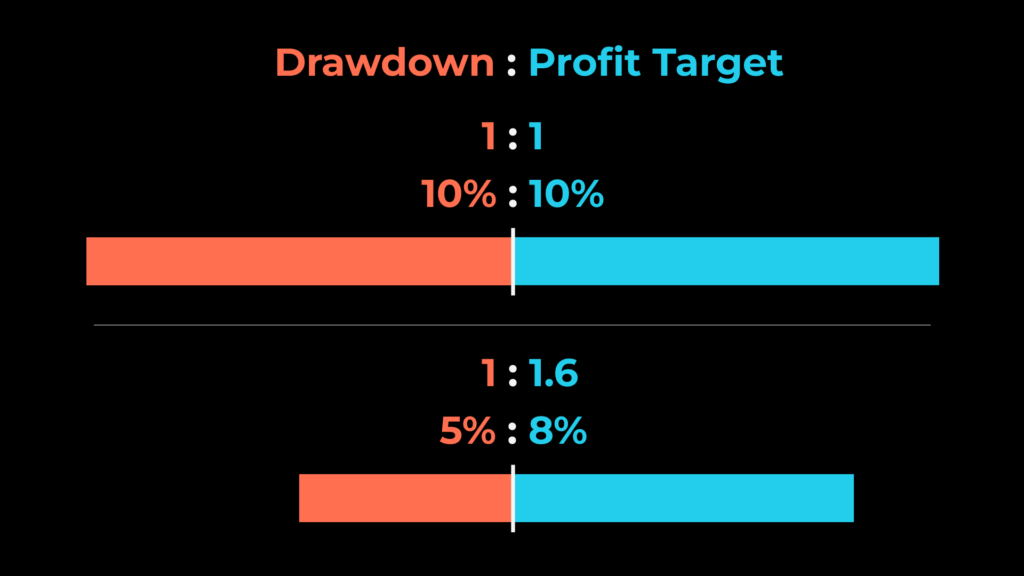
But if the 8% profit target comes with only 5% maximum drawdown, the ratio is 1:1.6. You need to make $1.60 in profit for every dollar of drawdown. Despite the lower target, it's actually harder to pass.
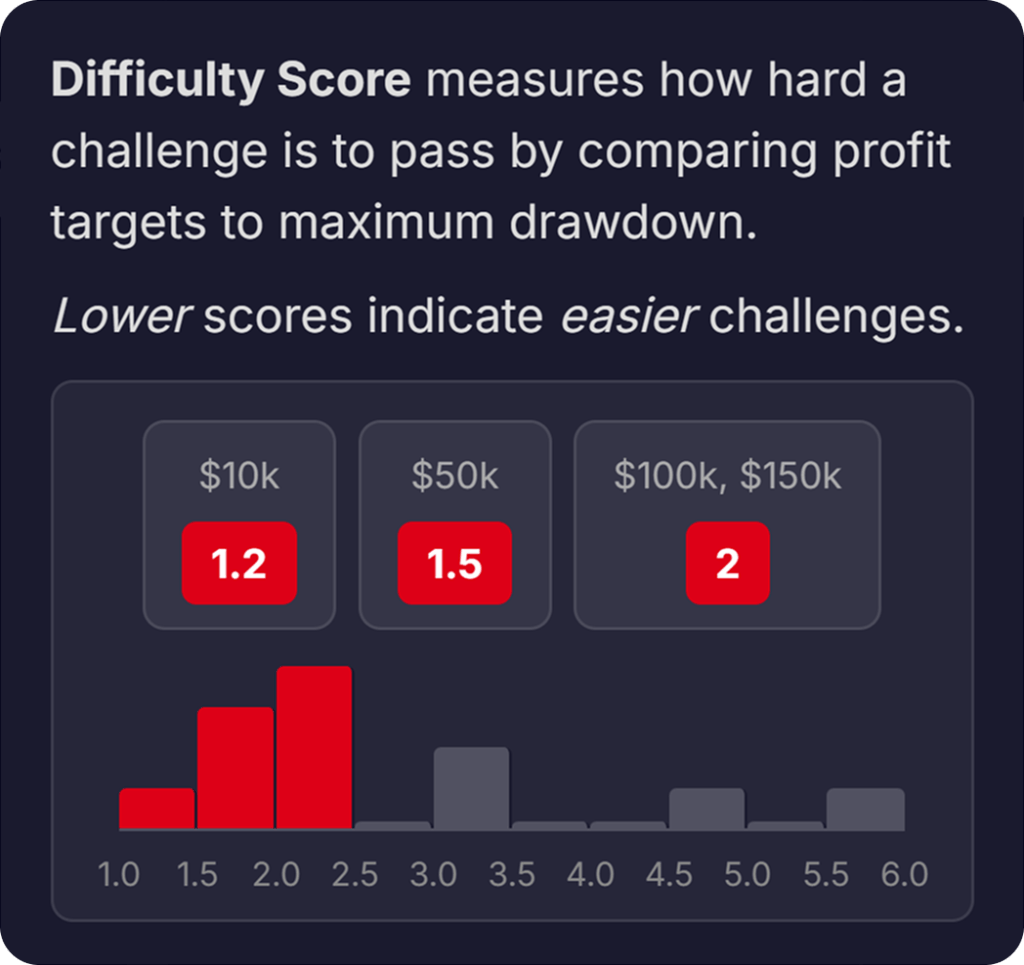
This ratio, combined with drawdown type is the real measure of challenge difficulty, not the profit target alone. That’s why I combine these factors in the difficulty score calculation I use in my reviews, so you can compare challenge difficulty at a glance.
True Backing
Maximum drawdown also determines the true size of your funded account. A $100k funded account with 10% maximum drawdown sounds impressive, but you only have $10k to work with before the account is breached. That $10k is what I call the True Backing.
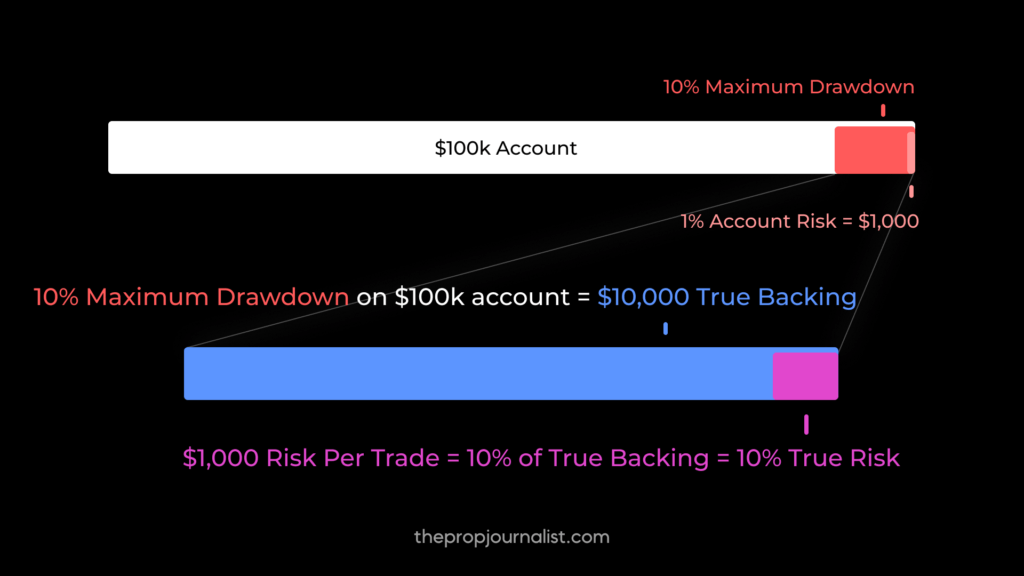
If you were to risk ‘1%’ of your $100k account per trade, you're actually risking 10% of your True Backing. That's aggressive, and it's why so many funded traders blow accounts quickly.
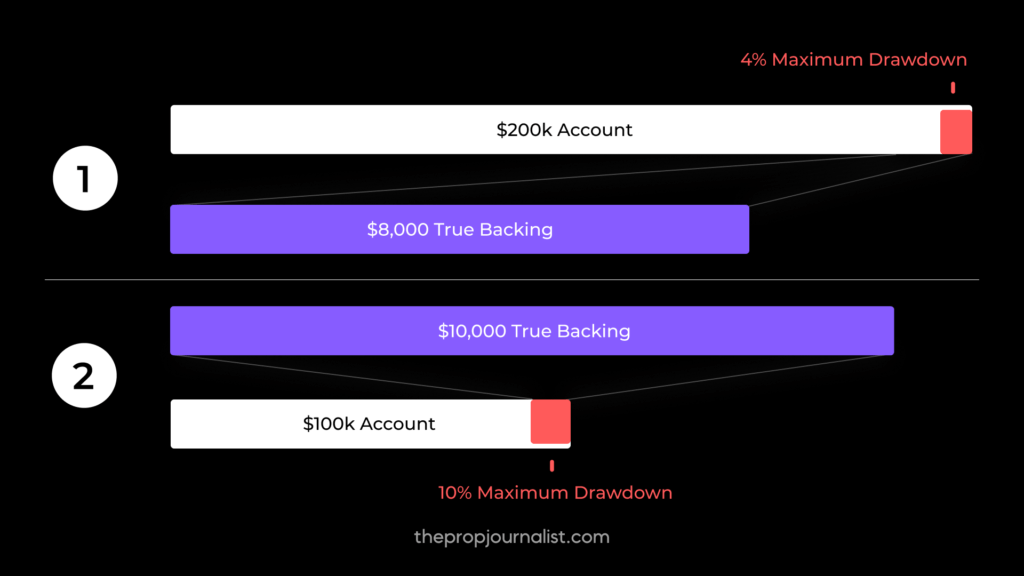
This is also why maximum drawdown matters so much when comparing prop firms. A $100k account with 10% maximum drawdown has $10k True Backing. A $200k account with 4% maximum drawdown has only $8k. The smaller account is actually better funded.
Understanding this changes how you approach risk management on a funded account. You should be sizing your trades relative to your True Backing, not the account balance.
Scaling Plans for Maximum Drawdown
Some prop firms offer scaling plans that increase your maximum drawdown limits over time as you prove consistency.
This is worth factoring into your decision when choosing a firm, as this, paired with account size increases, result in a significant increase in true backing.
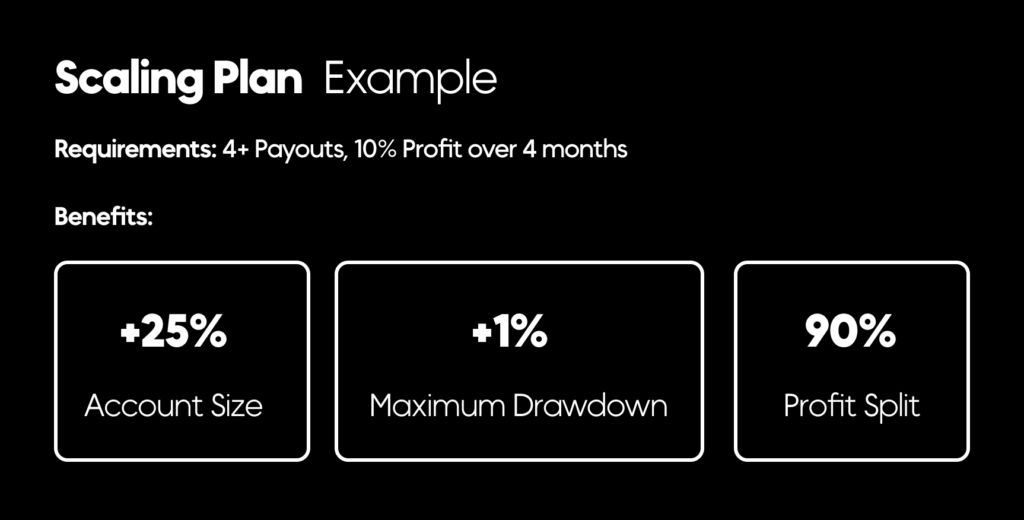
These scaling plans usually operate on a long term basis, requiring on average 3-4 months of consistent returns to be eligible.
Scaling plans are a nice bonus, but don't rely on them. You still need to survive long enough to reach them, which means managing your drawdown carefully from day one.
Daily Drawdown
Daily drawdown is the largest loss your trading account can sustain within a single trading day.
The consequence of breaching daily drawdown depends on the firm rules. It can be either a hard breach or a soft breach.
If daily drawdown is a hard breach, the account is failed.
If it's a soft breach, your trades are closed automatically and you can't trade for the rest of the day. The account stays active and you can trade the next day. Soft breaches are obviously more forgiving, but not all firms offer them.
Daily drawdown has two main types:
- Balance based
- Equity and balance based
Also, daily drawdown size is calculated in two different ways:
- Fixed dollar amount
- Percentage based
Daily drawdown: balance vs equity & balance
See how holding floating profit at the daily reset changes your daily drawdown limit.
Now we'll discuss when daily drawdown is calculated, and how these different types work.
Calculation Time
Daily drawdown resets at a specific time each day. This is usually midnight server time, though the exact timezone varies by firm. Common reset times are midnight UTC, or midnight GMT+2 for firms using MetaTrader server time.
At the reset point, the daily drawdown is recalculated. The new threshold stays in place for the next 24 hours, then at the next reset it's recalculated again.
It's important to know when your firm's daily reset happens, because it affects whether you're in "today's" or "tomorrow's" drawdown window. If you're trading close to the reset time, it’s best to double-check your dashboard.
Note that because daily drawdown is only based on account value at calculation time (regardless of any high watermarks), the daily drawdown threshold can move down, as well as up.
Does Daily Drawdown Size Scale?
Whether daily drawdown is a fixed size or increases with your account depends on the firm and the calculation method.
If daily drawdown is a fixed dollar amount, it stays the same regardless of your balance. A $5k daily drawdown limit is always $5k, whether your account is at $100k or $120k.
If daily drawdown is percentage-based, it scales with the value used in the calculation. With 5% daily drawdown calculated on a $103k balance, the daily drawdown is $5,150. If balance grows to $110k, the next day's daily drawdown becomes $5,500. But this also works in reverse. If balance drops to $95k, daily drawdown shrinks to $4,750, giving you less room.
Note that while some firms may describe daily drawdown as a percentage (like 5%), this doesn’t necessarily mean daily drawdown is percentage based. Often they are referring to a percentage of the original account balance, meaning daily drawdown is a fixed dollar value. It’s worth reading through a firm’s FAQ to understand how daily drawdown is actually calculated.
Some firms also increase daily drawdown through scaling plans.
For example, many futures funded accounts start with a lower daily loss limit, which can be increased once profit target ‘tiers’ are achieved.
Some firms also offer increased daily drawdown through long-term scaling plans too. This is more common with CFD firms, increasing daily drawdown by 1% at certain scaling stages when you hit specific profit and payout milestones.
Balance Based Daily Drawdown
Balance-based daily drawdown is the better type.
At the reset time, the firm uses your account balance to calculate the daily drawdown threshold. Floating profit or loss from open trades doesn't affect the calculation.
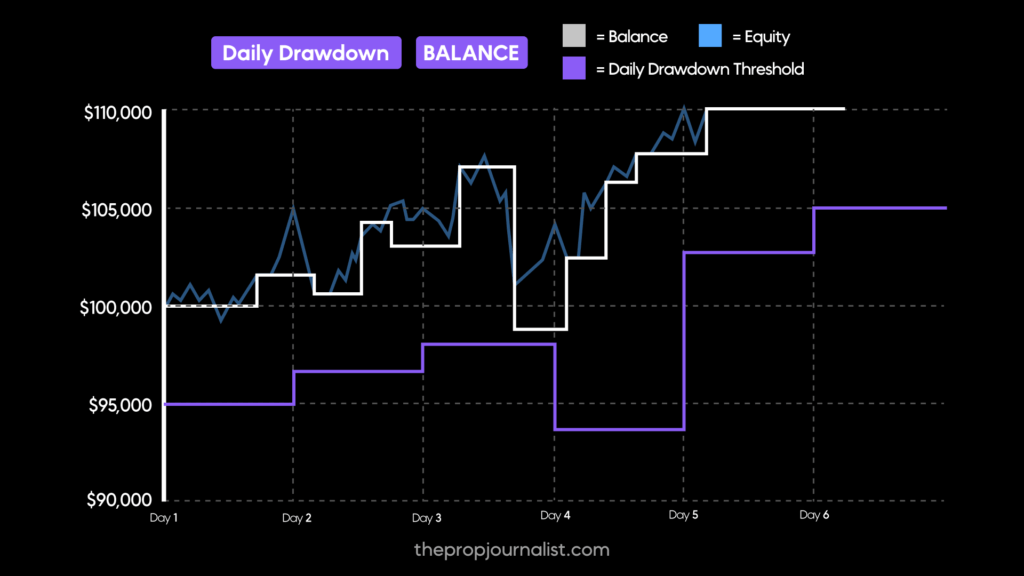
If daily drawdown is a fixed dollar value, it's subtracted from balance. For example, $5k fixed daily drawdown on $103k balance gives a $98k daily drawdown threshold for the next 24 hours, regardless of equity value (As seen on Day 3 in diagram).
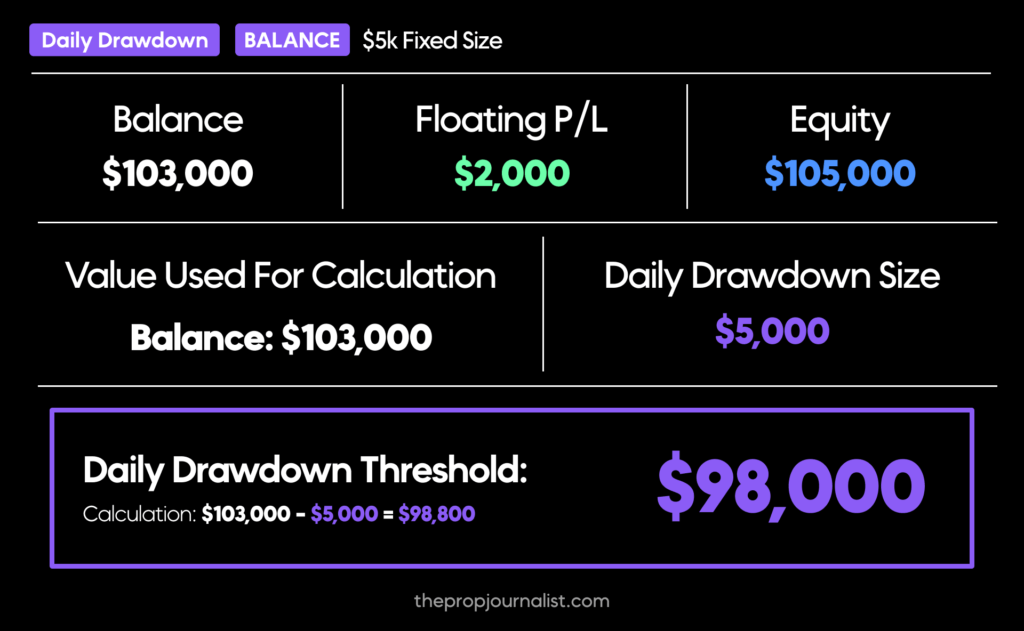
If it's percentage-based, the drawdown size is calculated from balance first, then subtracted. With 5% daily drawdown and $103k balance: 5% of $103k = $5,150. So the daily limit is $103k - $5,150 = $97,850.
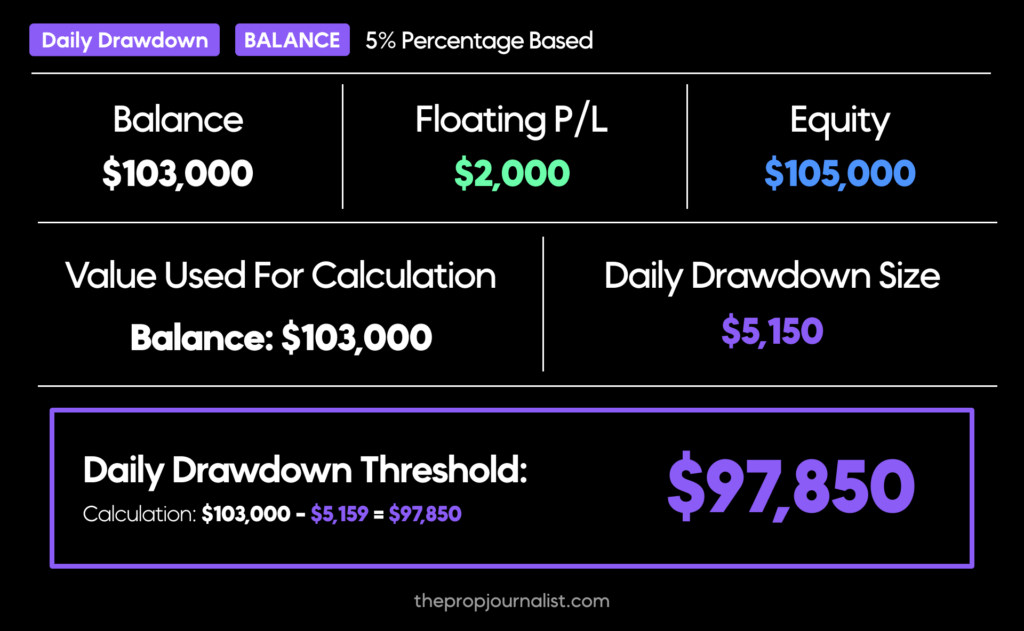
Equity and Balance Based Daily Drawdown
Equity and balance-based daily drawdown is more restrictive if you're holding trades with floating profit at the time of the daily reset.
At the reset time, the firm looks at both equity and balance, and uses whichever is higher to calculate the threshold.
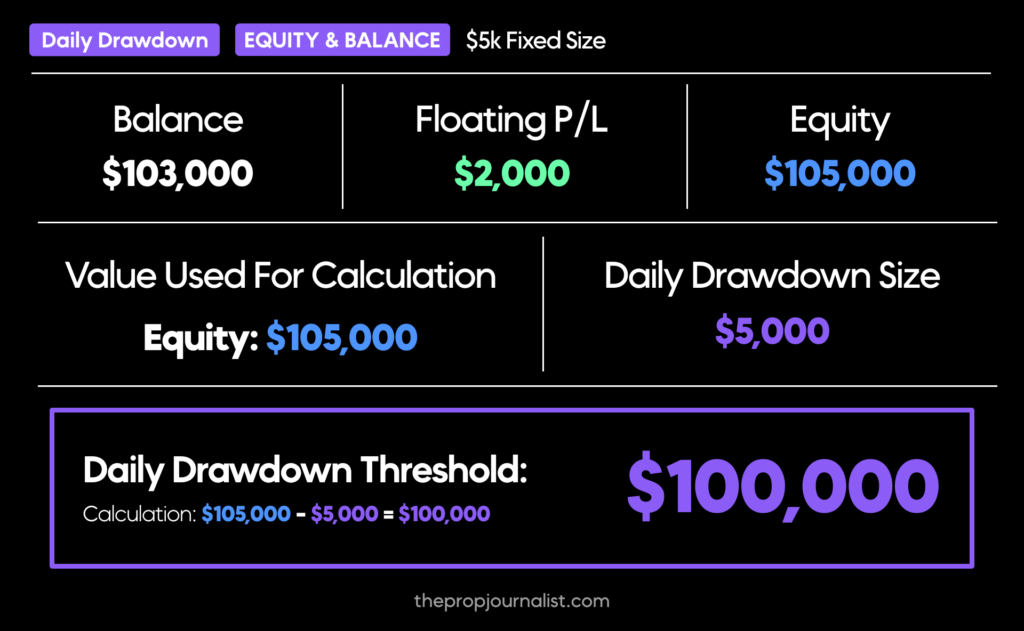
So if your balance is $103k but you're holding open trades with $2k in floating profit, your equity is $105k. The firm uses $105k for the calculation. With $5,000 daily drawdown, that gives a daily drawdown threshold of $105k - $5k = $100k.
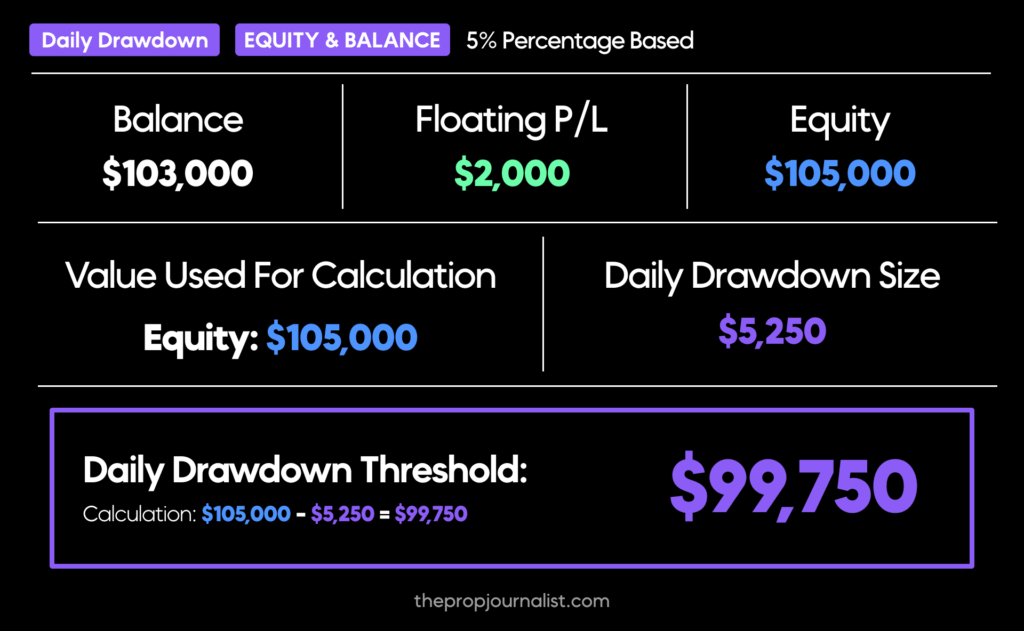
If daily drawdown is 5% percentage based, daily drawdown size is 5% of $105k = $5,250. So the daily drawdown threshold is $105k - $5,250 - $99,750.
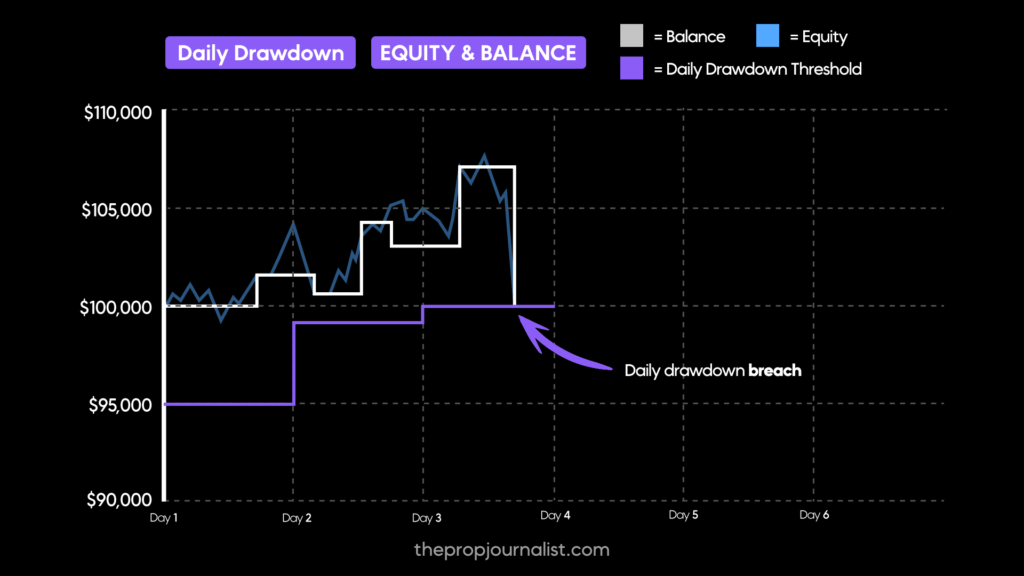
If you're holding winning trades over the daily reset with equity and balance-based daily drawdown, your floating profits are effectively raising the bar for the next day. If those trades then reverse, you're losing from a higher starting point with less room to fall.
This happens in the following example. Equity and balance based daily drawdown would have resulted in an account breach.
If trades are in floating loss, balance will be used for the daily drawdown calculation.
For example, if your balance is $102.5k but you're holding open trades with $1.5k in floating loss, your equity is $101k. So the firm uses the $102.5k balance for the calculation, because this is higher. With 5% daily drawdown, that's $5,150 subtracted from $102.5k, giving a daily threshold of $97,350.
Also, if no trades are open at the time of daily drawdown calculation, balance and equity will be equal. So both daily drawdown types will result in the same threshold. Therefore for traders who close all trades before the day rollover, both daily drawdown types are effectively the same.
Tips For Avoiding Drawdown Breaches
Understanding how drawdown works is one thing. Staying on the right side of it while you trade is another. Here are some practical tips.
Keep Track of Your Limits
This sounds obvious but it's where a lot of traders slip up. Know your current maximum drawdown threshold, your daily drawdown threshold, and when the daily reset happens. Most firm dashboards show these, but if yours doesn't, calculate them yourself and write them down before you start trading each day.
In the heat of a volatile session, it’s easy to start chasing losses and lose sight of your risk limits. Having the numbers in front of you stops you from accidentally crossing a line you didn't realise was so close.
Avoid Slippage
Slippage is when your order fills at a different price than expected. It can turn a trade that should have been within your limits into a drawdown breach. Here’s a few ways to reduce the risk of slippage:
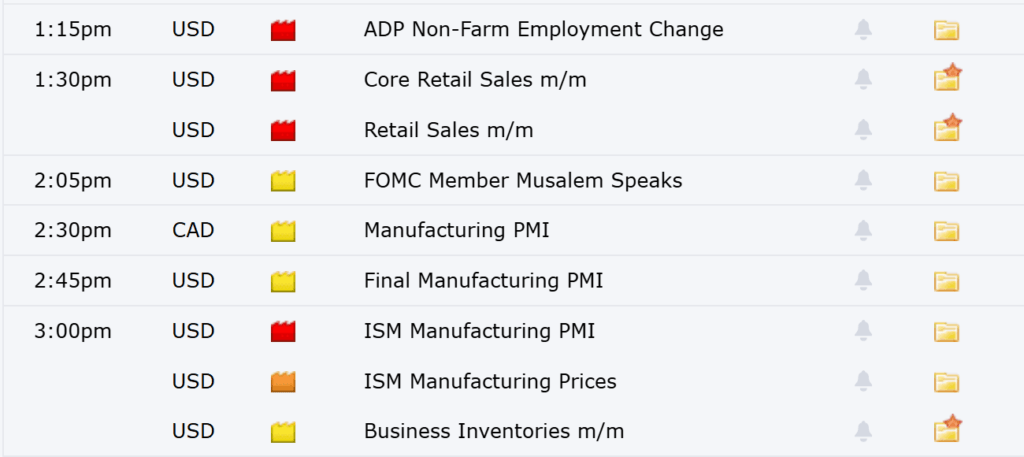
Keep track of high impact news events. Major economic releases like NFP, CPI, and interest rate decisions cause massive spikes in volatility and spreads. If you have a position open during one of these events, the slippage on your stop loss could be significant. Check an economic calendar like ForexFactory daily and know when the big events are. Either close positions before them or don't open new ones around them.
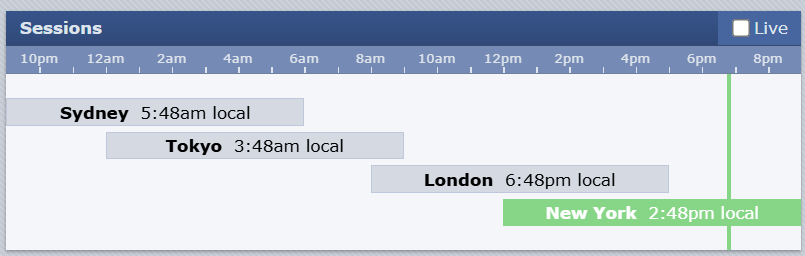
Understand spread hours. Spreads widen at certain times of day, particularly around the daily rollover (usually around 5pm EST / 10pm GMT). They also widen around market open and close times. If your stop loss is tight and spreads blow out, you could get stopped out at a much worse price than planned. Be aware of when your broker's spreads are widest and avoid having tight stops during those windows.
Don't hold trades over the weekend. Markets close on Friday and reopen on Sunday/Monday. If something happens over the weekend, prices can gap significantly at the open. A gap through your stop loss means you get filled at the gap price, not your stop level. On a funded account with tight drawdown limits, a weekend gap can easily breach your account. Most of the time it's not worth the risk, and some firms don't allow it anyway.
Conclusion
Drawdown rules are the foundation of prop firm risk management, and the single biggest factor in whether you keep or lose your account. Understanding the difference between static and trailing, knowing whether your daily drawdown is balance-based or equity-based, and tracking your limits daily are all non-negotiable if you want to stay funded.
Overall, the most trader friendly types are static maximum drawdown, and balance-based soft-breach daily drawdown.
But when comparing firms, drawdown is just one factor that you need to consider. Keeping track of targets, buffers, leverage, prices, trading restrictions and more can be overwhelming, especially when so many key details are hidden away in firm FAQs.
So when choosing your next challenge, check out my prop firm reviews, where I explain every detail with unique analysis and helpful score metrics.
And when you’re ready to buy an account, make sure to check my prop firm discount code page to get the best deal and help support me creating quality prop firm content.
Thanks for reading, I hope this helped improve your understanding of prop firm drawdown, making you more confident in your prop firm analysis skills. If you’d like to suggest content and discuss prop firms with other traders, make sure to join The Prop Journalist’s Discord Server.