




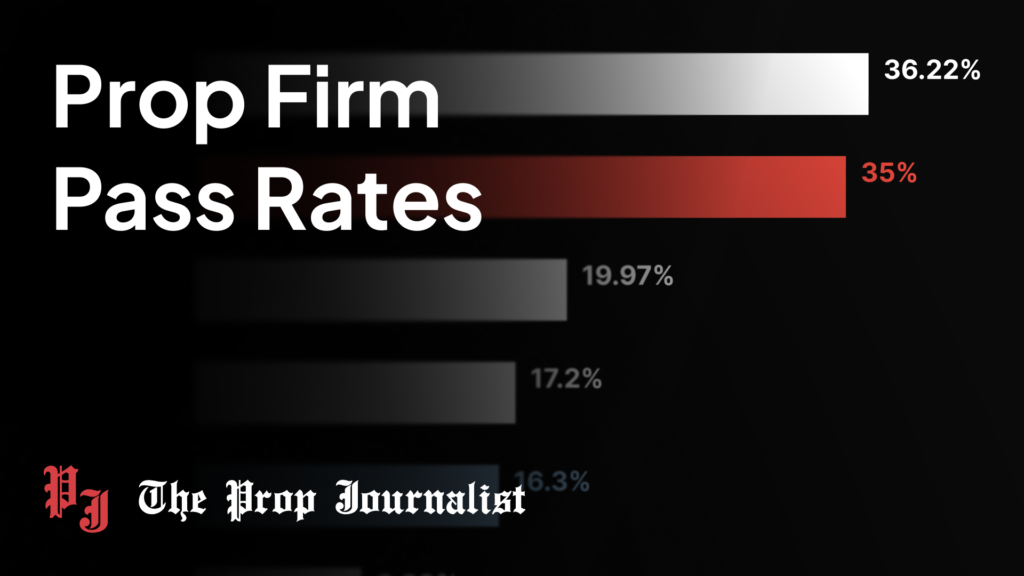
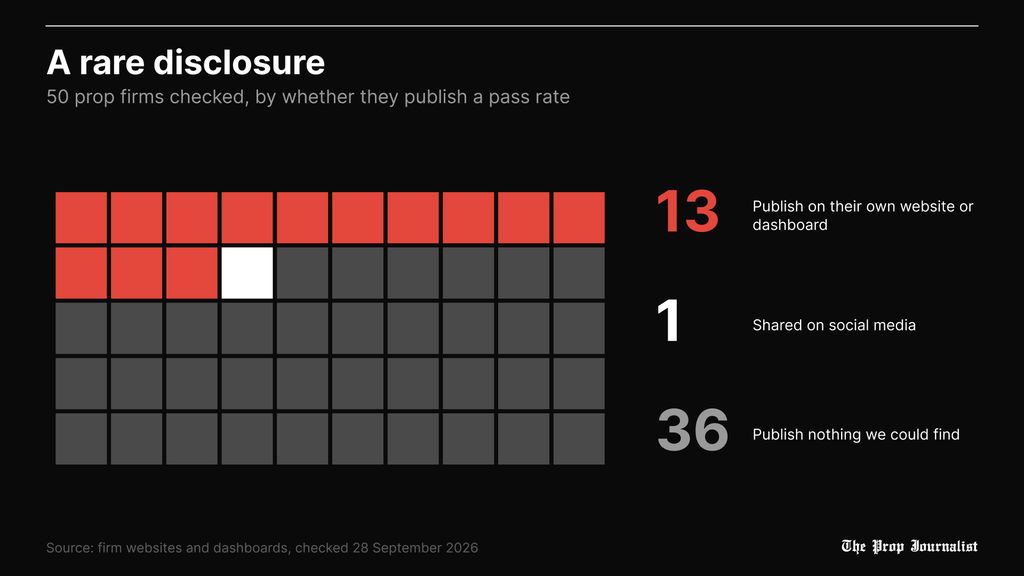
Most prop firms never tell you how many traders pass. We checked the websites of 50 prop firms across futures, CFDs and crypto. Only 13 publish a pass rate on their own website or stats dashboard, and 1 more has only shared its pass rate on social media. The biggest names in CFD prop trading, including FTMO, FundedNext and The5%ers, publish payout totals but no pass rate we could find.
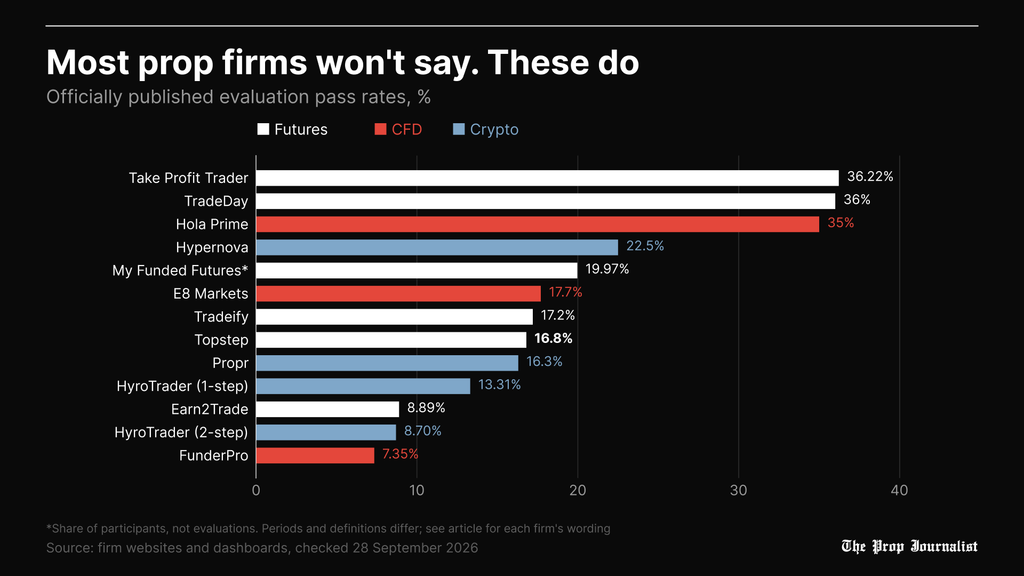
The firms that do publish are mostly US futures firms and a new wave of crypto firms with live, on-chain dashboards. Their numbers are more useful than any industry estimate. Topstep says 16.8% of its Trading Combines were passed in 2025. Tradeify reports 17.2% over the 12 months to July 2026. My Funded Futures reports that 19.97% of evaluation participants advanced. Earn2Trade reports 8.89%.
In this article I’ll list every official figure we found, explain exactly what each one measures, and show why 2 pass rates that look alike can mean very different things.
Key takeaways
- Only 13 of the 50 prop firms we checked publish a pass rate on their own website or dashboard. FTMO, FundedNext, The5%ers and Apex Trader Funding do not.
- Published pass rates range from 7.35% (FunderPro) to 36.22% (Take Profit Trader). The large futures firms that publish, Topstep, Tradeify and My Funded Futures, all sit between about 17% and 20%.
- Passing is not getting paid. At Topstep, roughly 17 in every 100 traders who try receive a payout, and fewer than 1 in 250 reaches a live account.
- At a typical 17% pass rate, the average trader buys about 6 evaluations per pass.
- The firms’ own data shows the biggest risk is the first day: Topstep says 63% of traders lost their account on their first trading day.
A note on method: we only count a number as “published” if the firm itself stated it, on its website, its own dashboard or its official social accounts. Figures from statistics sites, affiliates and forums are excluded. The full method is set out further down, under How We Collected This Data.
Last Verified: 28th September 2026
Every Official Prop Firm Pass Rate We Found
| Firm | Market | Pass rate | What it measures | Period | Where published |
|---|---|---|---|---|---|
| Take Profit Trader | Futures | 36.22% | Trading Tests passed | 2025 | Website |
| TradeDay | Futures | 36% | Evaluation pass rate | Jan to Jun 2026 | Website |
| Hola Prime | CFD and futures | 35% | Customers who took at least 1 evaluation and got funded | Nov 2024 to May 2025 | Website |
| The Futures Desk | Futures | About 25% | Candidate pass rate, the firm’s own estimate | Not stated | Website |
| Hypernova | Crypto | 22.5% | Paid evaluations passed, of those finished | Live dashboard | Stats dashboard |
| My Funded Futures | Futures | 19.97% | Evaluation participants who advanced | Not stated | Website |
| E8 Markets | CFD | 17.7% | Customers who traded and got funded | Jan 2023 to Mar 2024 | Website |
| Tradeify | Futures | 17.2% | Evaluation accounts passed | Aug 2025 to Jul 2026 | Website |
| Topstep | Futures | 16.8% | Trading Combines passed | 2025 | Website |
| Propr | Crypto | 16.3% | Paid evaluations passed, of those finished | Live dashboard | Transparency dashboard |
| HyroTrader | Crypto | 13.31% (1-step), 8.70% (2-step) | Challenges passed | Live dashboard | Transparency dashboard |
| Earn2Trade | Futures | 8.89% | Subscriptions passed vs new subscriptions | 2025 | Website |
| FunderPro | CFD | 7.35% | Challenge buyers who reached the funded phase | Since launch | Website |
| E8 Markets | CFD | 5% to 31% by program | Pass rate per challenge type | Nov 2025 | Social media |
| ATFunded | CFD | About 6% | Traders who reached funded status | Jun 2025 | Social media |
3 futures firms go further and publish what happens after the pass, using near-identical 4-part wording:
| Topstep (2025) | Tradeify (Aug 2025 to Jul 2026) | My Funded Futures (period not stated) | |
|---|---|---|---|
| Evaluations passed | 16.8% | 17.2% | Not stated |
| Participants who reached the funded stage | 51.8% | 40.3% | About 19.95% |
| Funded participants who received a payout | 33.3% | 28.5% | 39.2% |
| Funded traders moved to a live account | 0.71% | 3.0% | 4.2% |
We found no pass rate on the websites of these 36 firms as of 28 September 2026:
FTMO, FundedNext, The5%ers, FundingPips, Alpha Capital, Blue Guardian, Maven, BrightFunded, FXIFY, Goat Funded Trader, Instant Funding, Funded Trading Plus, The Trading Pit, Audacity Capital, For Traders, City Traders Imperium, Fintokei, Lark Funding, AquaFunded, Breakout, Trade The Pool, Apex Trader Funding, Lucid Trading, Alpha Futures, Bulenox, Elite Trader Funding, Phidias, Funded Futures Network, Top One Futures, Legends Trading, FXIFY Futures, OneUp Trader, DayTraders.com, BluSky, Tick Tick Trader and Leeloo Trading. Many publish payout totals or funded-trader counts instead, which tell you nothing about the odds of passing.
What Each Firm’s Pass Rate Actually Measures
Futures firms
Topstep: 16.8%. Topstep’s website footer reports that 16.8% of Trading Combines started in 2025 were passed, that 51.8% of individual traders passed at least one, that 33.3% of traders who reached the funded stage received a payout, and that 0.71% of Express Funded Account traders were moved to a live account. The gap between 16.8% and 51.8% means the typical successful trader bought several Combines before passing. We break down what that means for Topstep’s pricing in our Topstep Standard vs No Activation Fee guide.
Tradeify: 17.2%. Tradeify uses the same 4-part structure over the 12 months to July 2026. Its pass rate per evaluation is almost identical to Topstep’s, but fewer individual traders reach the funded stage (40.3%) and fewer funded traders get paid (28.5%). It does move far more funded traders to live accounts: 3.0% against Topstep’s 0.71%.
My Funded Futures: 19.97%. My Funded Futures says 19.97% of evaluation participants advanced beyond the evaluation, about 19.95% reached the simulated funded stage, 39.2% of those earned at least 1 payout, and 4.2% were promoted to a live account. That payout rate is the highest of the 3 futures firms that publish one. But the disclosure only refers to “the applicable measurement period” without saying what it is, and it counts participants rather than evaluations, so it can’t be lined up directly with Topstep’s 16.8%.
Take Profit Trader: 36.22%. Take Profit Trader says 36.22% of all Trading Tests were passed in 2025, more than double Topstep and Tradeify. It publishes no payout rate. Its FAQ also carries an older figure, 20.37% of registered users passing between January and August 2023, which uses a different denominator.
TradeDay: 36%. TradeDay reports a 36% evaluation pass rate for January to June 2026. It doesn’t say whether that is per evaluation or per trader, and it covers only 6 months.
Earn2Trade: 8.89%. Earn2Trade says 8.89% of candidates passed its Trader Career Path or Gauntlet Mini in 2025, measured as subscriptions passed against new subscriptions. Of those who passed, 5.23% traded a real live account rather than a simulated one, and around 18% of both account types had at least 1 withdrawal in 2025.
The Futures Desk: about 25%. The Futures Desk describes its evaluation’s pass rate as historically low and estimated at 25%. It is the firm’s own estimate, with no period or method given.
CFD firms
Hola Prime: 35%. Hola Prime says its customer pass rate was 35% between 10 November 2024 and 29 May 2025, counting traders who took at least 1 evaluation and obtained a simulated funded account. That is the highest CFD figure we found, and it is now over a year old.
E8 Markets: 17.7%. E8 Markets’ evaluation disclaimer, which sits in a collapsed section at the bottom of its homepage, gives a 17.7% customer pass rate from January 2023 to March 2024 for traders who traded at least once. E8 also posted November 2025 pass rates by program on social media: 5% on its 3-step challenge, 11% on its 2-step, and 26% and 31% on its 1-step challenges. We questioned whether those numbers add up.
FunderPro: 7.35%. FunderPro says 7.35% of traders who buy a challenge reach the funded phase. The figure covers the firm’s whole history, so it can’t show whether challenges have got easier or harder recently.
ATFunded: about 6%. ATFunded shared June 2025 data on social media, reported by Finance Magnates: 22.6% of traders passed Phase 1, 26.9% of those passed Phase 2, and just over 6% reached funded status overall. It is a single month.
Crypto/Perpetuals firms
The most transparent firms in this list are small crypto firms that pay out on-chain and publish live dashboards. Their samples are small and their figures change daily, so treat them as snapshots taken on 28 September 2026.
Hypernova: 22.5%. Hypernova’s stats page shows 723 passes from 3,210 finished paid evaluations. It also shows a full funnel: of 929 traders who paid for an evaluation, 333 got funded and 222 received a payout. That is 66.7% of funded traders and 23.9% of paying traders, the highest payout rates we found anywhere.
Propr: 16.3%. Propr’s transparency dashboard shows 3,943 passes against 20,241 fails on paid evaluations, plus 13.6% on its free trial. It publishes total payouts but not how many traders received them.
HyroTrader: 13.31% and 8.70%. HyroTrader’s transparency page shows 13.31% of traders passing its 1-step challenge and 8.70% its 2-step, with no period stated.
Beyond the pass: Lucid Trading’s live accounts
Lucid Trading has no pass rate on its website, but its Live program statistics, which we reported on X on 14 September 2026, show what happens at the very end of the funnel. 48% of live accounts were blown on their first day, 32% had at least 1 profitable day but never reached a payout, and only 18% received a payout. The average live account lasted about 3 days.
A historical benchmark: My Forex Funds
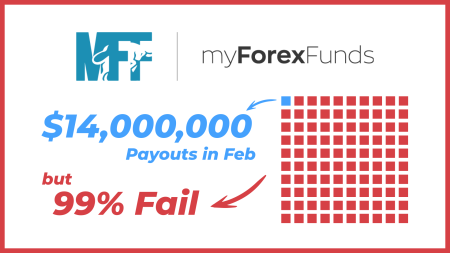
Before its 2023 shutdown, My Forex Funds published an 8% pass rate on its 2-step evaluation and said only 3.5% of funded traders earned a profit split the year before. Our analysis of those My Forex Funds stats is still one of the clearest end-to-end pictures of the CFD model.
Why You Can’t Compare Pass Rates Directly
A pass rate is a fraction, and firms choose both halves of it. Before comparing 2 figures, check 4 things.
Per evaluation or per trader. Topstep’s 16.8% counts Combines. Its 51.8% counts people. Both are true, and the second is 3 times higher only because traders buy multiple attempts. A firm quoting a per-trader figure will always look more generous than one quoting per evaluation.
What goes in the denominator. Earn2Trade divides passes by new subscriptions. E8’s November figures counted challenges completed that month rather than following a group of traders from purchase to outcome. Each choice changes the result, and most firms don’t say which they used.
The period. FunderPro’s figure covers its whole history. ATFunded’s covers 1 month. Neither tells you what the odds are on the challenge you would buy today, because rules and pricing change constantly.
The challenge structure. E8’s own figures run from 5% on a 3-step challenge to 31% on a 1-step. A 1-step challenge is not necessarily easier to profit from; it is just 1 hurdle instead of 3. Comparing a 1-step pass rate with a 2-step pass rate says more about the format than the firm.
Passing is not getting paid
The number that matters is not how many traders pass, but how many get paid. Only 4 firms publish enough to follow a trader all the way through. Here is what their figures imply for every 100 traders who try.
| Out of 100 traders | Topstep (2025) | Tradeify (Aug 2025 to Jul 2026) | My Funded Futures (period not stated) | Hypernova (live, paying traders) |
|---|---|---|---|---|
| Reach the funded stage | 52 | 40 | 20 | 36 |
| Receive at least 1 payout | About 17 | About 11 | About 8 | 24 |
| Moved to a live account | Fewer than 1 | About 1 | Fewer than 1 | Not published |
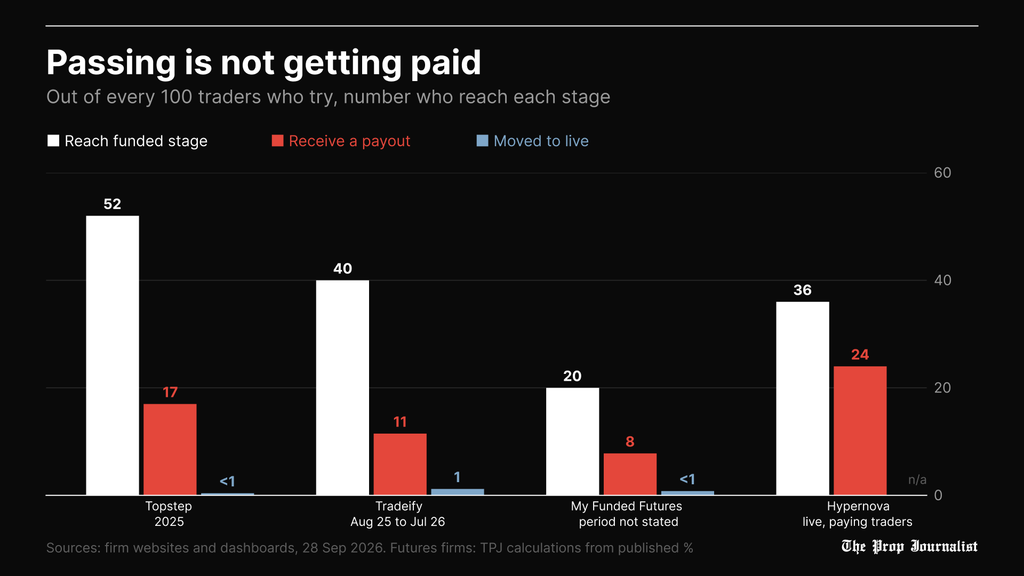
The Topstep, Tradeify and My Funded Futures rows are my calculations from each firm’s published percentages, and they assume each percentage applies to the group in the row above. Hypernova publishes the counts directly. The pattern holds either way: most traders who pass never get paid, and almost none reach a live account. For more on why firms depend on this, see how prop firms make money.
The largest independent dataset points the same way. In 2024, prop firm technology provider FPFX Tech analysed more than 300,000 accounts from 100,000 traders across 10 firms and found that 14% passed the challenge, 45% of funded traders received a payout, and just 7% of all traders were paid (Finance Magnates). The firms weren’t named, but the numbers sit comfortably inside the range the publishing firms report today.
How Many Attempts Does a Pass Take?
A pass rate is easier to use once you turn it into a number of attempts. If every attempt had the same odds, the average number of evaluations bought per pass is simply 1 divided by the pass rate. At Topstep’s 16.8%, that is 6 Combines per pass. At FunderPro’s 7.35%, it is almost 14 challenges.
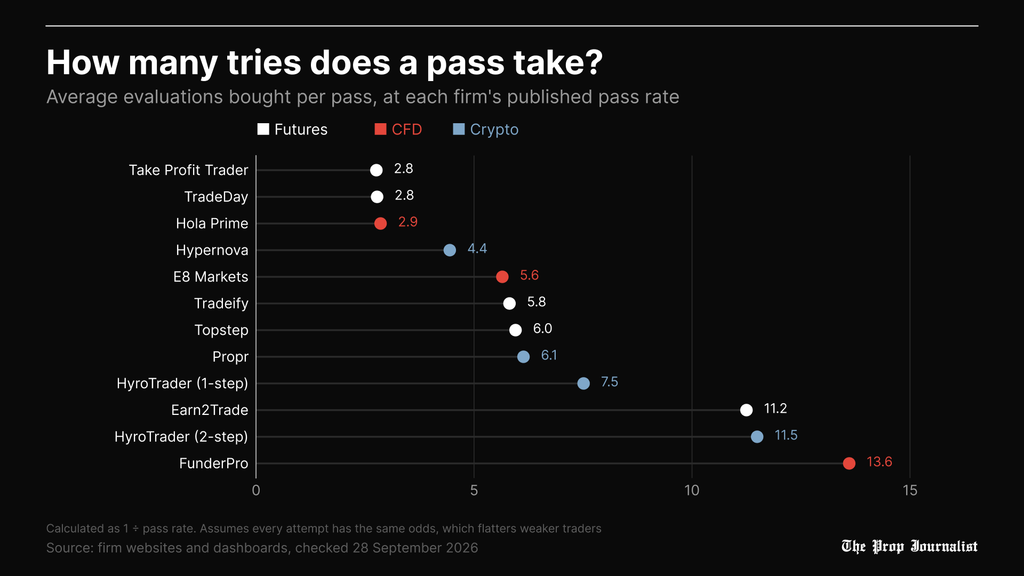
That makes the real cost of a pass easy to estimate. Here is what it looks like for an evaluation priced at $100.
| Pass rate | Evaluations per pass | Average spend per pass at $100 each |
|---|---|---|
| 36% | 2.8 | $278 |
| 22.5% | 4.4 | $444 |
| 17% | 5.9 | $588 |
| 13% | 7.7 | $769 |
| 8.7% | 11.5 | $1,149 |
| 7.35% | 13.6 | $1,361 |
These are averages across every buyer, so they flatter nobody in particular. A skilled trader will pass in fewer attempts, and a trader still learning will take more, because a small group of repeat winners lifts every published pass rate. The useful question is where you sit relative to the average, which is exactly the judgement we walk through in our Topstep Standard vs No Activation Fee break-even guide. If you do expect several attempts, buying during a sale matters more than the headline fee, so check our prop firm discount codes first.
Why Most Traders Fail: What the Firms’ Own Data Shows
Data from 3 firms now shows when accounts fail, and it all points to the same answer: the first day.
- Topstep said on social media that 63% of traders lost their account on their first trading day.
- Lucid Trading’s Live program figures show 48% of live accounts were blown on their first day, and 50% were blown in a single day.
- Hypernova’s dashboard shows a median account lifespan of 0.8 days before an account passes, fails or expires, and an average of 3.1 days.
I think this points to a sizing problem more than a strategy problem. Traders who lose an account on day 1 are usually risking a large share of their drawdown in the first few trades, often trying to reach the profit target quickly. A daily loss limit, or simply risking a small fraction of the maximum drawdown per trade, directly addresses the most common way accounts end.
Pass Rate Claims We Couldn’t Verify
Some of the most repeated pass rates online don’t trace back to the firms they describe.
“FTMO’s pass rate is about 10%.” This figure appears on many statistics sites, sometimes attributed to an FTMO statistics page. FTMO’s website publishes its customer count and total rewards, but we found no pass rate on it.
“Apex Trader Funding’s pass rate is 15% to 20%.” Apex publishes no pass rate on its website, and we couldn’t find where this figure came from.
“Only 5% to 10% of traders pass.” This industry range is rarely sourced. The closest real data points are My Forex Funds’ 8% in 2023 and FPFX Tech’s 14% across 10 firms in 2024. Today’s official figures, mostly between 7% and 36%, suggest the range is out of date.
None of this means those numbers are wrong. It means you can’t check them, and a figure you can’t check shouldn’t decide where you spend your money.
What This Means for Traders
The firms that publish these numbers are not necessarily the easiest to pass. They are the ones willing to show you the odds. I think that is worth something on its own: a firm that tells you 1 in 6 accounts passes is being more honest with you than one that only advertises how much it has paid out.
It also helps to know why these firms publish at all. The futures disclosures sit beside the US-style hypothetical performance disclaimers common on futures sites, which suggests a compliance habit rather than pure transparency. The crypto firms publish for a different reason: their payouts are on-chain and public anyway, so a live dashboard costs them little and wins trust. CFD firms, most of which operate outside the US and pay out off-chain, have neither pressure, and I believe that is why the largest of them publish payout totals instead.
Be cautious with pass rates you find on statistics sites. While researching this article we found several sites listing firm-specific pass rates as neat ranges, attributed to firm reports we could not locate. If a figure has no link to the firm’s own words, treat it as an estimate.
Before you buy a challenge, check these things:
- Does the firm publish a pass rate at all, and where?
- Is it per evaluation or per trader?
- What period does it cover, and does it match the challenge you’re buying?
- Does the firm publish how many funded traders actually get paid?
- Does the payout total come with a number of traders paid, or only a dollar figure?
If the answer to most of these is no, you’re buying without knowing the odds. Price that uncertainty into your decision, and compare firms on structure instead, starting with our prop firm reviews.
How We Collected This Data
Between 27 and 28 September 2026 we checked the websites of 50 prop firms across futures, CFDs and crypto. Where a firm runs a public statistics or transparency dashboard, we recorded the figures shown on 28 September. We also searched each firm’s official social accounts and industry news coverage for pass rates the firm had shared itself.
We recorded each figure exactly as the firm defines it, including the period, whether it counts evaluations or people, and any conditions attached. We did not adjust or combine figures from different firms. Where this article gives a number of traders out of 100, it is our calculation from the firm’s published percentages, and we say so.
We excluded figures from statistics sites, affiliates, forums and surveys unless we could trace them back to the firm’s own words. Firms that failed to load or blocked automated checks were left out rather than marked as not publishing.
We will re-check every firm each quarter. If you work at a prop firm that publishes a pass rate we’ve missed, contact us with the link.
Change Log
- 28 September 2026: First published with 50 firms checked, 13 publishing a pass rate on their own website or dashboard and 1 only on social media.
Prop Firm Pass Rate FAQ
What percentage of traders pass prop firm challenges?
Among firms that publish official figures, pass rates range from 7.35% (FunderPro) to 36.22% (Take Profit Trader). The large futures firms that publish, Topstep, Tradeify and My Funded Futures, all sit between about 17% and 20%.
What is Topstep’s pass rate?
Topstep says 16.8% of Trading Combines started in 2025 were passed, and 51.8% of individual traders passed at least one. Of traders who reached the funded stage, 33.3% received a payout.
Does FTMO publish its pass rate?
Not that we could find. FTMO’s website publishes its customer count and total rewards paid, but no pass rate or share of traders paid.
What percentage of funded traders get a payout?
Only 4 firms publish this: My Funded Futures (39.2%), Topstep (33.3%), Tradeify (28.5%) and Hypernova (66.7%). Earn2Trade says around 18% of its funded accounts had at least 1 withdrawal in 2025, and Lucid Trading’s figures show 18% of its live accounts received a payout.
Why do some firms have much higher pass rates?
Differences in challenge structure, reset rules and how the rate is calculated all matter. A per-trader figure, a 1-step challenge or a denominator that excludes some attempts will all produce a higher number without the challenge being easier to profit from.
Which prop firm has the highest pass rate?
Among official figures, Take Profit Trader reports the highest at 36.22% of Trading Tests passed in 2025, followed by TradeDay at 36% and Hola Prime at 35%. A higher pass rate doesn’t necessarily mean better value, because rules, fees and payout conditions differ.
Does Apex Trader Funding publish a pass rate?
No. We found no pass rate on Apex Trader Funding’s website. Figures of 15% to 20% that circulate online don’t cite an Apex source.
Are 1-step challenges easier to pass than 2-step?
They have higher pass rates. HyroTrader reports 13.31% on its 1-step challenge against 8.70% on its 2-step, and E8 Markets reported 26% to 31% on 1-step challenges against 11% on its 2-step in November 2025. But 1-step challenges often have tighter drawdown rules, so compare the rules, not just the pass rate.
How many attempts does it take to pass a prop firm challenge?
At the typical 17% pass rate published by large futures firms, the average trader buys about 6 evaluations per pass. Topstep’s own figures show 51.8% of its traders passed at least 1 Combine in 2025, which means most successful traders needed several attempts.
What is a good prop firm pass rate?
There isn’t one number to aim for. A very low pass rate can signal harsh rules, while a very high one can come from a lenient definition. The more useful figure is the payout rate, and a firm that publishes both is being more open with you than one that publishes neither.
Conclusion
The honest answer to “what are prop firm pass rates?” is that most firms won’t tell you. Where they do, around 1 in 5 or 6 evaluations pass at the largest futures firms, and somewhere between 1 in 6 and 1 in 12 traders ever gets paid.
That gap between passing and getting paid is the real story. A pass rate of 17% sounds manageable until you add that, at most firms that publish the figure, the majority of funded traders never receive a payout, and that the first trading day ends more accounts than any other. For the average trader, a payout is a 6-attempt project, not a 1-attempt bet, and the budget should reflect that before the first evaluation is bought.
It also changes how firms should be judged. A firm that publishes a low pass rate alongside a high payout rate may be a better choice than one advertising an easy challenge and nothing else, because the second number is the one that decides whether you’re paid.
The number to ask for is not the pass rate but the payout rate. Until more firms publish it, I’d treat the ones that do as the benchmark, and ask every other firm why it won’t. We’ll update this page as new figures appear.
Thanks for reading, for more prop firm analysis check out The Prop Journalist on YouTube and read our latest prop firm news here.