




Topstep has released its sixth Labs experiment, the $50K Static Trading Combine, for a $149 one-time fee.
It is exactly what the name suggests: the $25K Static Trading Combine from Drop #001, scaled up by a factor of 2. The price, profit target, maximum loss limit, daily loss limit, contract limit and payout cap have all doubled, so the value per dollar is essentially unchanged.
That makes it a reasonable account, but not a new one. The static drawdown is still the main attraction, yet it only lasts until your first payout, and the headline $8,000 payout cap needs a $16,000 balance before you can actually reach it.
In this article I’ll explain how the $50K Static works, compare it with the $25K Static and the standard $50K Combine, and show what happens to your drawdown the moment you withdraw.
How The Topstep $50K Static Combine Works
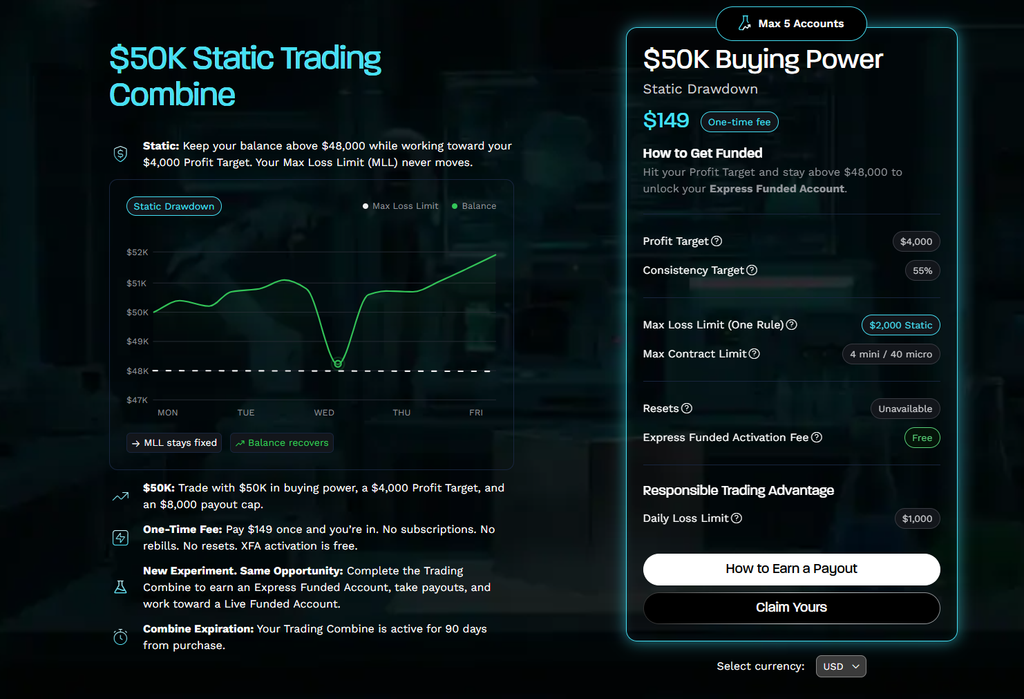
The $50K Static costs $149 one-time. There is no subscription, no rebill and no activation fee when you pass, but there are also no resets.
You need to make $4,000 while keeping your balance above $48,000. That floor never moves during the Combine, so every dollar of profit adds to your room before failing.
| Trading Combine | Express Funded Account | |
|---|---|---|
| Profit Target | $4,000 | None |
| Maximum Loss Limit | $2,000 STATIC | $2,000, then $0 after first payout |
| Daily Loss Limit | $1,000 (mandatory) | $1,000 (mandatory) |
| Consistency | 55% | Standard: none / Consistency: 40% |
| Maximum Contracts | 4 Mini / 40 Micros | Scaling plan, 2 to 4 Minis |
| Payout Requirement | None | Standard: 5 days of $150+ / Consistency: 3 days |
| Payout Cap | None | $8,000 per request, both paths |
| Activation Fee | None | Free |
| Resets | Unavailable | None |
The 55% consistency target means your best day must stay below $2,200 of the $4,000 target. The mandatory daily loss limit is half the maximum loss limit, so a single bad session can’t end the account, but it will flatten you once you are $1,000 down on the day.
Once you pass, you choose between the Standard and Consistency Express Funded Account paths. Both have the same $8,000 payout cap, which is double the $4,000 cap on a standard $50K Combine bought with the Responsible Trading Advantage.
As with every Topstep Express Funded Account, payouts are limited to 50% of your balance per request, with a 90/10 profit split. Full details are in Topstep’s Labs help article.
$50K Static vs $25K Static: Nothing New
Put the 2 Static accounts side by side and every rule scales by the same factor.
| $25K Static | $50K Static | |
|---|---|---|
| Price | $75 | $149 |
| Profit Target | $2,000 | $4,000 |
| Maximum Loss Limit | $1,000 STATIC | $2,000 STATIC |
| Daily Loss Limit | $500 | $1,000 |
| Maximum Contracts | 2 Mini / 20 Micros | 4 Mini / 40 Micros |
| Payout Cap | $4,000 | $8,000 |
| Drawdown : Target | 1:2 | 1:2 |
| Drawdown vs Fee | 13.3x | 13.4x |
| Payout Cap vs Fee | 53.3x | 53.7x |
The $50K is $1 cheaper than buying 2 $25K accounts, which is the only reason its ratios edge ahead. The difficulty is identical: you still need to make twice your maximum loss limit, with the same 55% consistency target and a daily loss limit set at half your drawdown.
So if you thought the $25K Static was good value, the $50K Static is good value for exactly the same reasons. If you didn’t, nothing here should change your mind.
There are 3 small differences, and none of them change the value:
- Scaling plan. The $25K Express Funded Account allowed 2 Minis from day 1 with no scaling. The $50K starts at 2 Minis and rises to 4 as your balance grows, so you begin funded trading with the same size but twice the drawdown behind it.
- Live sizing. A Live call-up mirrors the standard $50K Combine, with a $10,000 minimum starting balance rather than the $25K Static’s $5,000.
- Account slots. Topstep limits how many Express Funded Accounts you can hold at once. One $50K Static uses 1 slot for the same payout capacity as 2 $25K accounts.
The last point is the only practical reason to prefer the larger account. If you were planning to run 2 $25K Statics with mirrored trades, the $50K does the same job in 1 slot. But 2 separate accounts also give you 2 independent chances to stay alive, which a single account can’t.
The Static Drawdown Ends At Your First Payout
The static maximum loss limit is the headline feature, but in the Express Funded Account it only stays static until you withdraw.
Your funded account starts at a $0 balance with the maximum loss limit at -$2,000. While you build profit, that floor stays put, so a $3,000 balance gives you $5,000 of room.
But after your first payout, Topstep sets the maximum loss limit to $0 permanently. Your remaining balance becomes your entire buffer.
Say you reach $3,000 and request the maximum 50%. You take $1,500, or $1,350 after the 90/10 split, and your balance drops to $1,500. Your room before failing falls from $5,000 to $1,500.
That is a 70% cut to your buffer for a $1,350 payout.
| Balance Before Payout | Payout (50%) | You Receive (90%) | Room Before | Room After |
|---|---|---|---|---|
| $1,000 | $500 | $450 | $3,000 | $500 |
| $2,000 | $1,000 | $900 | $4,000 | $1,000 |
| $4,000 | $2,000 | $1,800 | $6,000 | $2,000 |
| $8,000 | $4,000 | $3,600 | $10,000 | $4,000 |
The Standard path only needs 5 winning days of $150, so it is possible to qualify with a balance well under $1,000. Taking a payout that early leaves you with a few hundred dollars of room on an account that still lets you trade 2 Minis.
This means the sensible first payout target is a $4,000 balance. Withdraw 50% and you keep $2,000 of room, the same buffer you started the funded account with. Anything less and you are trading with a smaller cushion than the account was designed around.
It also means the static advantage in the funded stage is smaller than it looks. On a standard Topstep $50K Express Funded Account, the end-of-day trailing limit stops at $0 once your balance reaches $2,000. After the first payout, both accounts sit on the same $0 floor and behave identically.
So the static drawdown is worth up to $2,000 of extra room in the funded account, and only before you withdraw. The real benefit of the static rule is in the Combine. Our prop firm drawdown guide covers how static and end-of-day trailing limits compare in more detail.
The $8,000 Payout Cap Needs A $16,000 Balance
An $8,000 cap sounds like a major upgrade on a $50K account. In practice, the 50% rule decides how much you can withdraw long before the cap does.
To request $8,000, you need a $16,000 balance. That is 4 times the Combine’s profit target, built in a funded account limited to 4 Minis and a $1,000 daily loss limit.
| $50K Account | Payout Cap | Balance Needed To Reach Cap |
|---|---|---|
| Standard Combine, Standard path (with daily loss limit) | $4,000 | $8,000 |
| Standard Combine, Consistency path (with daily loss limit) | $6,000 | $12,000 |
| $50K Static, either path | $8,000 | $16,000 |
Below an $8,000 balance, the $50K Static pays out exactly the same as a standard $50K Combine with the daily loss limit switched on. The higher cap only helps traders who leave more than $8,000 in the account before requesting, which also means leaving more profit exposed to the $0 floor.
I think the cap is a genuine improvement, but a narrow one. Topstep’s own 2025 figures show only 33.3% of traders who reached the funded level received any payout at all, so most traders will never get close to a balance where it matters. Our prop firm pass rates analysis puts those numbers in context across 50 firms.
$50K Static vs The Standard $50K Combine
The more useful comparison is with Topstep’s normal $50K Combine, which uses the same $2,000 maximum loss limit but trails it at the end of each day.
| $50K Static | Standard $50K, Standard Path | Standard $50K, No Activation Fee | |
|---|---|---|---|
| Price | $149 one-time | $49/month + $149 activation | $85/month |
| Reset | Unavailable | $49 | $85 |
| Profit Target | $4,000 | $3,000 | $3,000 |
| Maximum Loss Limit | $2,000 STATIC | $2,000 TRAILING (EOD) | $2,000 TRAILING (EOD) |
| Drawdown : Target | 1:2 | 1:1.5 | 1:1.5 |
| Best Day Allowed (55%) | $2,200 | $1,650 | $1,650 |
| Maximum Contracts | 4 Minis | 5 Minis | 5 Minis |
| Payout Cap (Standard / Consistency) | $8,000 / $8,000 | $4,000 / $6,000 | $4,000 / $6,000 |
Standard Combine prices and caps assume the Responsible Trading Advantage daily loss limit is switched on, matching the mandatory limit on the Static.
The target is harder, the drawdown is kinder
Both accounts start you with $2,000 of room, but the Static asks for $4,000 rather than $3,000. If your first week goes badly, that gap hurts. Down $1,000, you need $5,000 with $1,000 of room on the Static, compared with $4,000 on the standard Combine.
The Static pulls ahead once you are in profit. Up $2,000, its floor is still at $48,000, giving you $4,000 of room for the final $2,000. On the standard Combine, a close at $52,000 drags the limit up to $50,000, so you never have more than $2,000 of room.
I’d expect the Static to suit traders whose results come in uneven swings, with deep pullbacks after strong days. A trader who grinds steadily from day 1 is likely better off with the smaller target.
No resets makes failing expensive
The one-time fee looks cheap until you fail. A blown Static costs another $149, while a standard Combine reset costs $49 or $85.
| Attempts To Pass | $50K Static | Standard Path | No Activation Fee |
|---|---|---|---|
| 1 | $149 | $198 | $85 |
| 2 | $298 | $247 | $170 |
| 3 | $447 | $296 | $255 |
| 4 | $596 | $345 | $340 |
The Static only beats the Standard path if you pass first time, and never beats No Activation Fee with the daily loss limit on. Our Topstep Standard vs No Activation Fee guide explains how those two paths compare.
So you are not really paying for a cheaper route to funding. You are paying for static drawdown in the Combine and a higher payout cap later, and accepting a larger target and expensive retries in return.
Purchase Limit and Expiry
The $50K Static is a limited release, sold first come, first served. Each trader can buy up to 5, and closed or failed accounts still count towards that limit, so a blown account can’t be replaced.
The Combine expires 90 days after purchase and closes after 30 days without a trade. The Responsible Trading Discount does not apply to the $149 price.
Some products are restricted below the normal Combine limits: CL, GC, HO, QM, RB, MHG and SIL are capped at 2 lots, MCL and MGC at 25 lots, and PL, HG and SI cannot be traded.
Is The Topstep $50K Static Worth It?
I think the $50K Static is fair value, but it is not a new deal. It offers exactly what the $25K Static offered, at exactly the same ratios, in a bigger box.
The static drawdown is a real advantage in the Combine, particularly for traders who make money in uneven bursts. The $8,000 cap is also double what a standard $50K pays per request.
But both benefits are smaller than they first appear. The static floor becomes a $0 floor the moment you take your first payout, leaving the funded account no different from any other Topstep $50K. And the higher cap only matters once your balance passes $8,000, a level most funded traders never reach.
Against that, you face a $4,000 target instead of $3,000, 4 Minis instead of 5, and no resets. For anyone who doesn’t expect to pass on the first attempt, the standard $50K Combine is the cheaper route to a funded account.
The Labs drops that genuinely stood out, like the $49 $3K Challenge, did so because the price was out of line with the rest of the program. The $50K Static is priced exactly in line with its predecessor.
Conclusion
The Topstep $50K Static is the $25K Static doubled, and its value per dollar is unchanged at around 13.4x drawdown and 53.7x payout cap for the $149 fee. If you liked the $25K, buy it for the extra size or to save an account slot. If you passed on the $25K, there is nothing new here to change that.
Whatever you choose, don’t rush the first payout. Withdrawing resets your floor to $0, so I would wait until your balance reaches at least $4,000. That way the $2,000 you take leaves you with the same $2,000 of room you started with, rather than a few hundred dollars protecting a funded account you worked hard to get.
Before buying any Topstep account, check the latest prop firm discount codes, and if you’re weighing up Topstep’s fixed-payout products instead, read our Topstep $6K Challenge review.
Thanks for reading, for more prop firm content check out The Prop Journalist on YouTube and read more prop firm reviews here.