




Apex Trader Funding is a futures prop firm that has paid out over $850m to traders worldwide.
With heavily discounted challenges costing as little as $17, Apex makes getting funded accessible to anyone who has the trading ability. While previously the firm suffered from subjective rule interpretations, its all-new update has introduced transparent, fixed rules and added the much-requested End-Of-Day drawdown as an option.
In this Apex Funding review, we’ll explain the steps of how to get funded with Apex from start to finish, with all the key rules you need to know. We’ll also compare the account drawdown types and vendor options, so you can choose the right Apex challenge for your trading.
Apex Trader Funding: The Prop Journalist's Verdict
Apex is a top-tier futures prop firm with cheap prices and a huge payout record of over $850m. While the firm was previously held back by manual trade reviews and subjective rule enforcement, the updated Apex now offers a clearly defined path to payouts. End Of Day trailing accounts are much more trader-friendly, and are still priced affordably. With a huge 20 account limit and payout caps of over 100x the cost of getting funded, Apex offers huge earning potential to profitable futures traders. However, the trailing drawdown, funded account buffer and minimum profitable trading days rules mean beginner traders will struggle to get paid.
Pros
- Extremely cheap evaluation fees provide low cost of entry
- Option for EOD drawdown
- No payout denials
- Can pass challenge in one day
- 100% payouts from profits
- Trading up to 20 accounts at a time is allowed
- News trading allowed
- Daily loss limits only close trades and are not an an account breach
- No more 30% MAE or 5:1 Risk/Reward rules
Cons
- Funded accounts require buffer before profits can be requested
- 5 minimum profitable trading days for payout
- Trailing maximum drawdown
- 50% consistency rule on funded accounts
- Dashboard user interface could do with improvement
- Payout Reliability9
- Challenge Rules8
- Trading Conditions9
- Value For Money9
- Platform & Ecosystem8


Apex Trader Funding Firm Overview
 Location Location | 🇺🇸 United States |
 Year Founded Year Founded | 2021 |
 Owner Owner | Darrell Martin |
 Trading Platforms Trading Platforms | RithmicTradovateWealthchartsNinjaTraderTradingView |
 Instrument Type Instrument Type | Futures |
 Trading Assets Trading Assets | Equity FuturesCurrency FuturesAgricultural FuturesEnergy FuturesCryptocurrency Futures |
 Leverage Leverage | Up to 12 max contracts |
 Commissions Commissions | Up to $5.58 per contract round turn |
 Maximum Allocation Maximum Allocation | Max 20 PA accounts |
 Payment Methods Payment Methods |  Card Card |
 Payout Methods Payout Methods | ACH |
 Payout Frequency Payout Frequency | Weekly |
 Total Payouts Total Payouts | $850+ million |
Apex Trader Funding Challenges
Apex offers two types of challenge:
- End Of Day (EOD) Trail: Drawdown trails at the end of the day with new balance highs. A more forgiving drawdown, but it comes with a slightly higher prices and a higher activation fees.
- Intraday Trail: Drawdown trails with equity highs. Therefore, unrealised gains (trades in profit that have not been closed yet) cause the drawdown limit to move up. This is compensated by lower prices and lower activation fees.
 | EOD Trail | Intraday Trail |
|---|---|---|
Scores | ||
| TPJ Rating | ||
| Difficulty Score | 4.7 – 6.4 | 6.2 – 8.4 |
| Value Score |
0.3x – 0.6x
0.3x – 0.6x2x – 3.4x |
0.7x – 1.1x
0.7x – 1.1x3.3x – 5.4x |
Challenge Rules | ||
| Phase 1 Target | 6% | 6% |
| Max Drawdown |
2.67-4%
TRAILING EOD (B) $25k4% $50k4% $100k3% $150k2.67% |
2.67-4%
TRAILING (E) $25k4% $50k4% $100k3% $150k2.67% |
| Daily Drawdown |
1.33-2% $25k2% $50k2% $100k1.5% $150k1.33% |
1.33–2% Eval Funded $25k None 2% $50k None 2% $100k None 1.5% $150k None 1.33% |
| Funded Account Buffer |
2.73-4.4% $25k4.4% $50k4.2% $100k3.1% $150k2.73% |
2.73-4.4% $25k4.4% $50k4.2% $100k3.1% $150k2.73% |
| Profit Split | Up to 100% | Up to 100% |
| Max Contracts |
2–12 Eval Funded $25k 4 2 $50k 6 4 $100k 8 6 $150k 12 10 |
2–12 Eval Funded $25k 4 2 $50k 6 4 $100k 8 6 $150k 12 10 |
| Time Limits | 30 Days | 30 Days |
| Payout Frequency |
Weekly |
Weekly |
Pricing | ||
| Price Range |
$450 – $1,890 +$119–$159 Activation Fee
$450 – $1,890
$45 – $189 +$119–$159 Activation Fee
0.3x – 0.6x
0.3x – 0.6x2x – 3.4x |
$167 – $599 +$89–$149 Activation Fee
$167 – $599
$17 – $60 +$89–$149 Activation Fee
0.7x – 1.1x
0.7x – 1.1x3.3x – 5.4x |
| EOD Trail | Intraday Trail |
Both evaluations consist of a single phase with a profit target of 6%. Maximum drawdown is based on account size, ranging from 2.67% to 4%.
EOD accounts have daily drawdown, which is half the size of maximum drawdown. Intraday accounts do not have daily drawdown limits during the evaluation. Both account types have daily drawdown limits on the funded account.
Purchasing an evaluation is a one-time fee. Once you do so, you have 30 days to pass the Apex challenge.
Evaluations have no consistency rules, so they can be passed in a single day. Once you do so, you have 7 days to pay the activation fee to progress to the funded account, also known as the Performance Account (PA).
Funded Accounts pay out 100% of requested rewards weekly, with 5 minimum profitable days for payout.
Now let’s look at Apex’s challenges in-depth, first comparing the two challenge types, then covering key trading rules and payout requirements.
EOD Trail Challenge
| Size | Phase 1 Target | Max Drawdown TRAILING EOD (B) | Daily Drawdown BALANCE | Funded Account Buffer |
|---|---|---|---|---|
| $25k | 6% ($1,500) | 4% ($1,000) | 2% ($500) | 4.4% ($1,100) |
| $50k | 6% ($3,000) | 4% ($2,000) | 2% ($1,000) | 4.2% ($2,100) |
| $100k | 6% ($6,000) | 3% ($3,000) | 1.5% ($1,500) | 3.1% ($3,100) |
| $150k | 6% ($9,000) | 2.67% ($4,000) | 1.33% ($2,000) | 2.73% ($4,100) |
 Highlights
- Trailing drawdown is EOD balance based
- Very cheap evaluation fees
- 100% payouts
- News trading allowed
 Trade-offs
- Drawdown is trailing
- Activation fee required
- Funded account requires buffer
- Payout minimums and caps
 Profit Split Profit Split | Up to 100% |
| Max Contracts | 2–12 Eval Funded $25k 4 2 $50k 6 4 $100k 8 6 $150k 12 10 |
| Time Limits | 30 Days |
 Minimum Trading Days Minimum Trading Days | 1 |
 News Trading News Trading | ✓ Allowed |
 Weekend Holding Weekend Holding | ✗ Not Allowed |
 Consistency Rule Consistency Rule | 50% Best Day On Funded |
 Payout Frequency Payout Frequency | Weekly |
Challenge Pricing
The Apex End Of Day Trail account is the firm’s most trader-friendly challenge. Drawdown is calculated once per day at market close based on EOD balance.
This means you can earn floating profit and close trades in profit during the day, and your trailing drawdown will not move. It’s only after the trading day is finished that if your account balance is at new EOD highs, the drawdown will trail.
On evaluation accounts, the drawdown will trail until the profit target is reached. On funded (PA) accounts, the drawdown will trail until it reached account balance +$100.
With an 90% discount using the discount code TPJ, the EOD accounts cost from $45 to $189. You are first given an evaluation account, where you have 30 days to hit the 6% profit target before breaching the drawdown limit.
There are no consistency rules on the evaluation account, so you can pass it in a single day if you’d like.
Once you pass the evaluation account, you have up to 7 days to pay the $99 activation fee. Upon paying the activation fee, you’re given a Performance Account (PA) where you will eventually be able to request payouts.
If you don’t want intraday trailing drawdown, then the EOD account is the best choice for you. However, deciding which account size to buy is an important decision.
Smaller accounts have the advantage of larger maximum drawdown. $25k and $50k accounts have 4%, $100k accounts have 3% and $150k accounts have 2.67%. This means smaller accounts are easier to pass the challenge.
Meanwhile, large accounts are more cost-efficient given the flat activation fee across all accounts, and offer higher earning potential.
But because you can have up to 20 funded accounts at once, choosing account size is less about the amount you want to spend and more about your preferred account parameters.
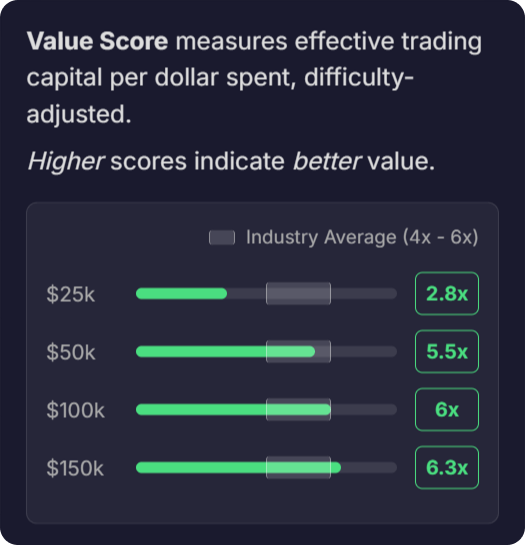
If we look purely at value score, it’s clear the $25k is uncompetitive, and the $150k comes on top. But the $50k and $100k aren’t far behind.
That’s why I’d recommend the $50k or the $150k.
The $50k is the easiest challenge to pass, with a drawdown to profit target ratio of 1:1.5. So this is the best choice if you want to maximise your chances of getting a payout.
Meanwhile, the $150k is the hardest challenge to pass, but overall provides the best value for money. So this is a good option if you’re extremely confident in your trading ability. But with a 1:2.25 drawdown to profit target ratio, be prepared to fail a few times before getting funded.
Intraday Trail Challenge
| Size | Phase 1 Target | Max Drawdown TRAILING (E) | Daily Drawdown (Funded Only) | Funded Account Buffer |
|---|---|---|---|---|
| $25k | 6% ($1,500) | 4% ($1,000) | 2% ($500) | 4.4% ($1,100) |
| $50k | 6% ($3,000) | 4% ($2,000) | 2% ($1,000) | 4.2% ($2,100) |
| $100k | 6% ($6,000) | 3% ($3,000) | 1.5% ($1,500) | 3.1% ($3,100) |
| $150k | 6% ($9,000) | 2.67% ($4,000) | 1.33% ($2,000) | 2.73% ($4,100) |
Highlights
- Extremely cheap evaluation fees
- 100% payouts
- News trading allowed
Trade-offs
- Drawdown is intraday trailing
- Activation fee required
- Funded account requires buffer
- Payout minimums and caps
| Profit Split | Up to 100% |
| Max Contracts | 2–12 Eval Funded $25k 4 2 $50k 6 4 $100k 8 6 $150k 12 10 |
| Time Limits | 30 Days |
| Minimum Trading Days | 1 |
| News Trading | ✓ Allowed |
| Weekend Holding | ✗ Not Allowed |
| Consistency Rule | 50% Best Day On Funded |
| Payout Frequency | Weekly |
Challenge Pricing
The Apex Intraday trailing account has the same parameters as the EOD account, but does not have daily drawdown in the evaluation stage.
Intraday accounts are cheaper than EOD, and have a lower activation fees.
However, the intraday trailing drawdown is much stricter. This trails with new equity highs. Therefore, unrealised gains (trades in profit that have not been closed yet) cause the drawdown limit to move up.
For example, on a fresh $50k account, the $2k max drawdown limit will start at $48k. If you open a trade and it goes into $200 profit, this means account equity is $50,200; therefore, the drawdown limit will be at $48,200. Even if the trade remains open and then goes into a loss, the drawdown limit will remain trailed up.
Like the EOD drawdown, on PA accounts the Intraday max drawdown will lock in place once it reaches the account balance +$100.
Intraday trailing drawdown is an extremely restrictive rule. While this is compensated by cheaper prices, most traders would still be better off choosing the Apex EOD account.
Apex Trader Funding Payouts
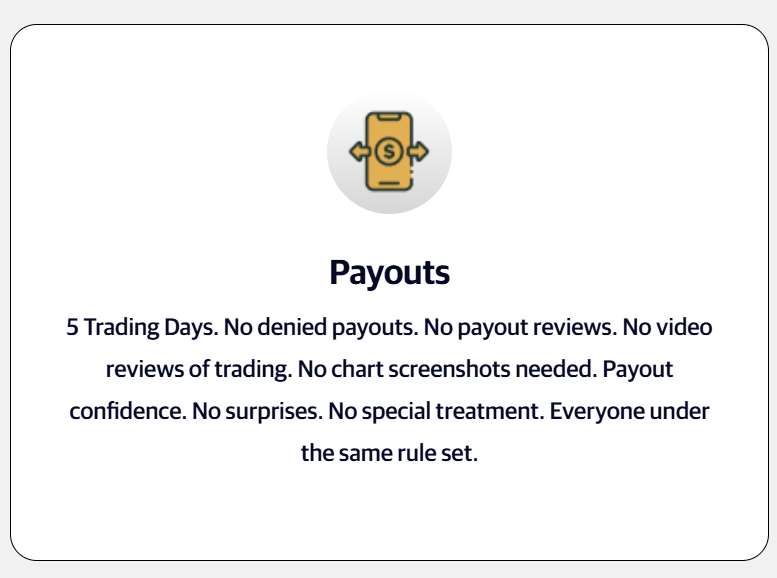
To be eligible for a payout on an Apex funded account, you must reach the minimum balance to request, have 5 minimum trading days, and pass the 50% consistency rule.
The minimum balance to request is calculated as the Safety Net + the $500 minimum payout amount.
The safety net is the account size + maximum drawdown + $100. For example, a $50k account with $2k max drawdown would have a $52,100. Only profits made above the safety net are eligible for withdrawal.
To qualify as a minimum trading day, you must have made the minimum daily profit. For example, a $50k account would require 5 days with at least $250 profit to satisfy the minimum day rule.
The 50% consistency rule states that no single profitable trading day may account for 50% or more of the total profit earned since your last approved payout. If this is not the case, you must keep trading until the consistency rule is satisfied to be eligible for payout.
| Account Size | Min Trade Days | EOD Account Min Daily Profit | Intraday Account Min Daily Profit | Safety Net | Min Balance to Request | Max Payouts |
| $25K | 5 | $100 | $100 | $26,100 | $26,600 | 6 |
| $50K | 5 | $250 | $200 | $52,100 | $52,600 | 6 |
| $100K | 5 | $300 | $250 | $103,100 | $103,600 | 6 |
| $150K | 5 | $350 | $300 | $154,100 | $154,600 | 6 |
Apex funded accounts pay out 100% of the requested profits. Each funded account can pay out a maximum of 6 payouts, with the max payout limit increasing with number of payouts.
One you are paid the 6th payout your account is closed and you can take another evaluation to become funded again.
| EOD Performance Account Max Payouts | ||||
| Payout # | $25,000 | $50,000 | $100,000 | $150,000 |
| 1 | $1,000 | $1,500 | $2,000 | $2,500 |
| 2 | $1,000 | $1,500 | $2,500 | $3,000 |
| 3 | $1,000 | $2,000 | $2,500 | $3,000 |
| 4 | $1,000 | $2,500 | $3,000 | $3,000 |
| 5 | $1,000 | $2,500 | $4,000 | $4,000 |
| 6 | $1,000 | $3,000 | $4,000 | $5,000 |
| Total | $6,000 | $13,000 | $18,000 | $20,500 |
| Intraday Performance Account Max Payouts | ||||
| Payout # | $25,000 | $50,000 | $100,000 | $150,000 |
| 1 | $1,000 | $1,500 | $2,000 | $2,500 |
| 2 | $1,000 | $2,000 | $2,500 | $3,000 |
| 3 | $1,000 | $2,500 | $3,000 | $3,000 |
| 4 | $1,000 | $2,500 | $3,000 | $4,000 |
| 5 | $1,000 | $3,000 | $4,000 | $4,000 |
| 6 | $1,000 | $3,000 | $4,000 | $5,000 |
| Total | $6,000 | $14,500 | $18,500 | $21,500 |
While having 6 max payouts is a disadvantage, the probability of reaching 6 payouts is so low that this restriction won’t impact most traders.
But for traders that achieve all 6 full payouts, the total earnings can be more than 100x the cost of getting, representing huge earning potential.
Total Payouts
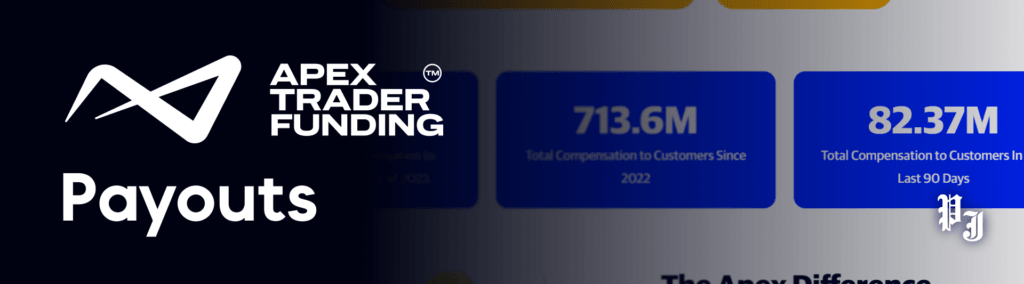
In total, Apex Trader Funding has paid over $850m to traders since 2022. In the last 90 days it paid out over $80m.

Trading Platforms & Conditions
Apex Trader Funding offers Rithmic, Tradovate and Wealthcharts as trading platforms.
Rithmic and Tradovate offer NinjaTrader. Tradovate also offers trading through TradingView.
Account commissions depend on the chosen platform.
Commission
Below are the maximum commissions per round turn for give instruments and trading platforms. The full commission structures can be found on the following pages:
- Rithmic Commissions & Instruments
- Tradovate Commission & Instruments
- WealthCharts Commissions & Instruments
| Instrument Type | Rithmic | Tradovate | Wealthcharts |
| Equity Futures | $3.98 | $4.64 | $4.64 |
| Currency Futures | $4.72 | $3.54 | $3.54 |
| Agricultural Futures | $5.58 | $3.54 | $4.54 |
| Energy Futures | $3.96 | $3.54 | $3.54 |
| Micro Futures | $1.02 | $1.34 | $1.34 |
| Cryptocurrency | $5.52 | $5.34 | $5.34 |
Scaling Levels – Daily Loss and Contract Limits
Apex has maximum position sizes of 2-12 contracts, depending on account stage and size.
This limit applies across all instruments and all open positions combined. If an order exceeds your maximum allowable exposure, it will be automatically rejected, and it will not count as a rule violation.
| Account Size | Max Contracts Evaluation | Max Contracts Funded |
| $25k | 4 | 2 |
| $50k | 6 | 4 |
| $100k | 8 | 6 |
| $150k | 12 | 10 |
On the evaluation, the contract limits are static as described in the table above. On the Performance Account, contract limits and the daily loss limit scale with account profit.
$25K Performance Account
| Profit Range | Max Contracts | Daily Loss Limit (DLL) | Tier |
| $0 – $999 | 1 Contract | $500 | Level 1 |
| $1,000 – $1,999 | 2 Contracts | $500 | Level 2 |
| $2,000 & Up | 2 Contracts | $1,250 | Level 3 |
$50K Performance Account
| Profit Range | Max Contracts | Daily Loss Limit (DLL) | Tier |
| $0 – $1,499 | 2 Contracts | $1,000 | Level 1 |
| $1,500 – $2,999 | 3 Contracts | $1,000 | Level 2 |
| $3,000 – $5,999 | 4 Contracts | $2,000 | Level 3 |
| $5,999 & Up | 4 Contracts | $3,000 | Level 4 |
$100K Performance Account
| Profit Range | Max Contracts | Daily Loss Limit (DLL) | Tier |
| $0 – $1,999 | 3 Contracts | $1,750 | Level 1 |
| $2,000 – $2,999 | 4 Contracts | $1,750 | Level 2 |
| $3,000 – $4,999 | 5 Contracts | $1,750 | Level 3 |
| $5,000 – $9,999 | 6 Contracts | $2,500 | Level 4 |
| $10,000 & Up | 6 Contracts | $3,500 | Level 5 |
$150K Performance Account
| Profit Range | Max Contracts | Daily Loss Limit (DLL) | Tier |
| $0 – $1,999 | 4 Contracts | $2,500 | Level 1 |
| $2,000 – $2,999 | 5 Contracts | $2,500 | Level 2 |
| $3,000 – $4,999 | 7 Contracts | $2,500 | Level 3 |
| $5,000 – $9,999 | 10 Contracts | $3,000 | Level 4 |
| $10,000 & Up | 10 Contracts | $4,000 | Level 5 |
Trading Restrictions
Overnight & Weekend Holding
Overnight and weekend holding is not allowed with Apex Trader Funding.
All trades must be closed, and all pending orders cancelled by 4:59 PM ET. Holding trades through the close is not permitted.. Apex has a safeguard to automatically close open positions and cancel pending orders attached to a position at 4:59 PM ET. This safeguard is a final resort and should not be relied upon. Therefore, you must manually cancel orders not attached to a position. If they remain open, they may liquidate your account.
News Trading
With Apex, trading during news is allowed for your normal trading strategy. Using news trading strategies that “chase the market” or place orders on both sides, but to be lucky or gamble the outcome of news is not allowed.
Maximum Account Allocation
Apex Trader Funding has no limit to the number of evaluation accounts. However, a single household may have a maximum of 20 Performance Accounts.
Prohibited Strategies
Key prohibited strategies at Apex Trader Funding are:
- Using the Trailing Threshold as a Stop Loss
- Stockpiling Evaluation Accounts
- Unsustainable Strategies
- Deviating from Professional Standards
- Manipulation of the simulated trading environment
- Allowing any individual other than the registered owner to access or perform account verification
- Account and Resource Sharing
- Multiple Account Creation:
- Holding open trade positions through the market close
- Automation or Algorithm Usage
- Hedging
For full details view the Apex prohibited strategies page.
Apex Trader Funding Review Conclusion

In conclusion, Apex Trader Funding offers excellent value for money and earning potential for profitable traders. However, the trailing drawdown and required profitable days for payout mean beginner traders will struggle to earn from this prop firm.
Apex’s EOD Trail accounts are the best and most trader-friendly option for most customers, but Intraday accounts are an extremely cheap option for those who think they can handle more aggressive drawdown.
Thanks for reading, if you enjoyed check out my YouTube Channel and read more Prop Firm Reviews here.